Late September 2020
Like most fly anglers, when I get to a favorite stream or river, I invariably immediately start working upstream in the traditional fashion, coming up behind the trout that are facing into the current. But increasingly as our waters become more and more crowded, I find it often pays to go against the grain and head downstream first where there is usually less pressure and work my way back up. A prime example of that is a recent outing I had on Cochetopa Creek high in the La Garita Wilderness Area north of Gunnison.
I’ve set up my mobile fish camp at Dome Lake State Wildlife Area, just few miles off of CO 114 between Gunnison and metropolitan Saguache.

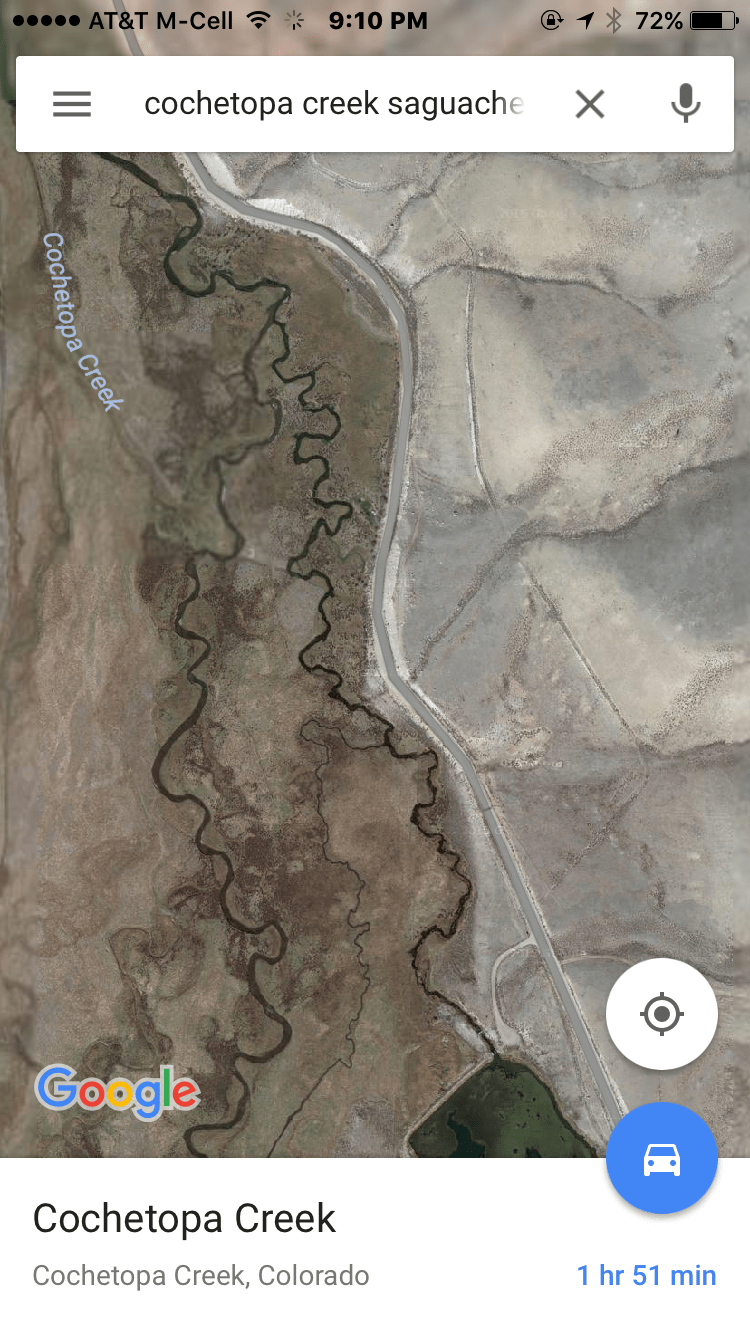
This location gives me access to miles of one of my favorite small waters, Cochetopa Creek. On this trip in late September, I have decided to fish the upper stretch of Cochetopa near the La Garita Wilderness Area. The lower section near Dome Lake is very low due to the drought gripping this area, running less than 15 cfs, and the water is warm. I’m hoping to find better conditions upstream in the high country where the nights have been cold with snow a couple of weeks ago. It’s about a 25-mile, one hour drive from Upper Dome Lake to the trailhead at Eddiesville. I have fished up from the trailhead into the wilderness area many times, hiking a mile south to where the trail intersects Cochetopa Creek. I usually cross paths with a few hikers and occasionally some anglers, although rarely do I fish without seeing a few boot marks on the shoreline. Only once in the past have I gone downstream from the trailhead, about one-half mile, and it was productive, especially in a string of big beaver ponds that were teeming with brown and brook trout. This time I decide to go contrarian again and walk another mile or so further downstream.
I’m up early and on the road at 7 a.m. My SUV thermometer registers a balmy 29 degrees, and I have to scrape ice off the windshield.

But the hour drive is so scenic, the aspens peaking, framing the scenic mountains along the Continental Divide, that I soon forget the icy temps.

When I arrive, a couple of hikers have pitched tents at Eddiesville, a stopping point along the Continental Divide and Colorado Trails, but fortunately none are anglers. I also breathe a sigh of relief when I see the creek has adequate water and is flowing nicely, low but definitely fishable. And thanks to the frigid nights and snow melt I will find it is ice cold.

I suit up in my lightweight waist-high waders, my Simms Vapor wading/hiking boots, my trusty wading/hiking staff, and of course my fly vest loaded to the gills then start hiking down the trail by 8:30. The going is slow because I am stopping every 10 minutes to soak up the gorgeous scene and snap a few photos of the sun rising, bright yellow aspens, and snow-covered peaks.


The trail is relatively flat with only a few moderate up and down stretches until at about one mile I come to a barbed wire fence and gate. Below there, I begin to hit a series of rocky, rugged, steep stretches high above the creek that is flowing fast, straight, and shallow in a narrow section below.


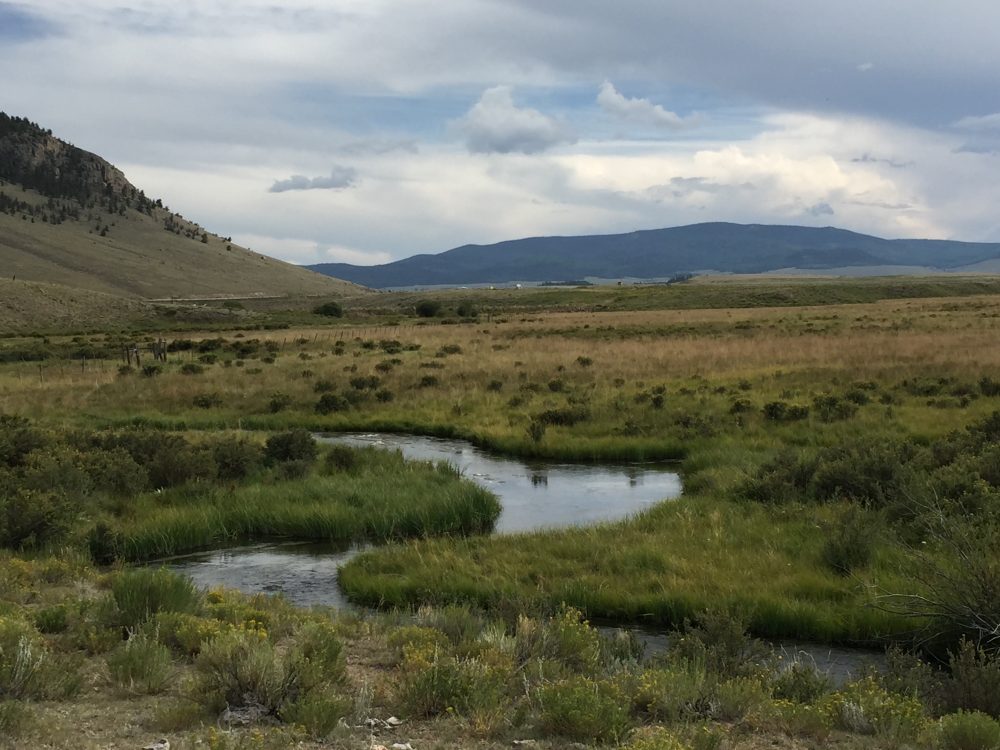
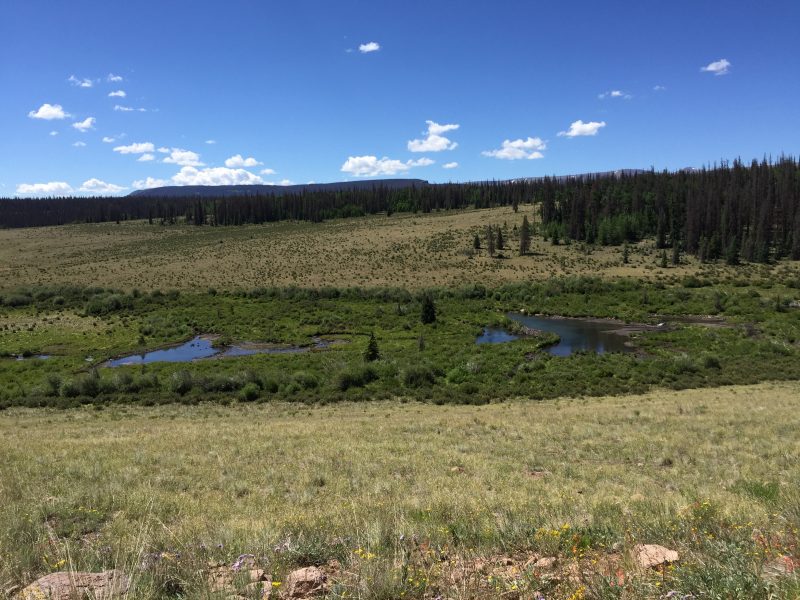
It doesn’t look too inviting from a piscatorial perspective so I continue downstream, making liberal use of my wading/hiking staff to keep my balance and prevent my aging body from sliding in the loose gravel and down the steep slopes. My objective is a broad meadow Google Maps promises another half mile further on where the creek twists and turns in a serpentine fashion–which usually signals deeper pools at the bends where the fish can hole up in safety and feast in the slower moving water without expending a lot of energy. It’s about 10 a.m. now, and the sun is up higher and quickly warming the air into the 70s with light winds—a perfect Indian summer day. To my delight, as I round a bend in the trail I see a big beautiful beaver pond below with fish dimpling the surface and a few actually jumping high out of the water to snatch a meal.

This is a pleasant surprise since the usually reliable Google Maps doesn’t show any beaver ponds in the vicinity. This I think must be fair compensation for what happened recently to me on nearby Nutras Creek (See my blog article from July.) where Google Maps promised a series of a dozen or more beaver ponds, all but one of which I found to be blown out after hiking a couple of miles along the creek. I decide to stow my lunch near the pond and hike down another 45 minutes to near the confluence with Nutras Creek, then work my way back up.
It’s 10:45 when I spy a pool below the trail in the meadow that screams fish. I descend, and as I come up from below the pool, can see a couple of decent size trout finning in the crystal clear water at the tail end of the pool.
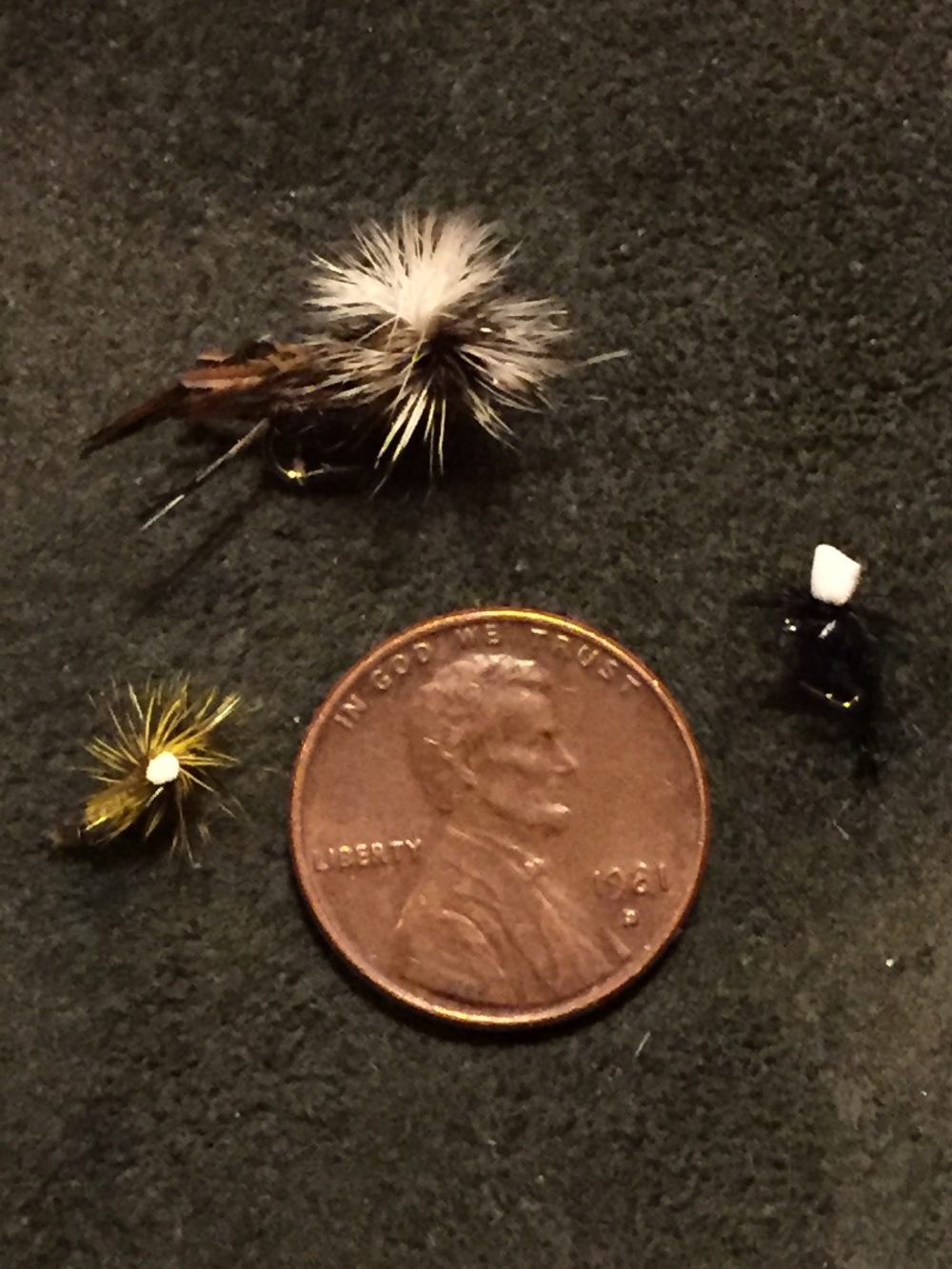
I kneel to keep a low profile, and on my very first cast a 13-inch brownie nails the #18 sparkle caddis nymph that trails under a #16 Royal Trude dry. Ten minutes and five fish later, I sneak up further to make a cast in the riffle that cascades into the head of the deep pool. The Trude slides quickly into the pool where a big trout rises slowly from the depths, scrutinizes the dry, then turns up his nose and disappears from sight. I quickly try another cast, and get a nice drag-free float. Just as I am about to pick up the fly and recast, the Trude suddenly disappears, and I set the hook into the big boy who seconds earlier had impudently ignored the dry fly. He turns tail and bores deep towards some submerged snags along the opposite bank, but with my rod bending perilously, I coax him away. After a couple more strong runs, he’s in the net, a beautiful, muscular 14-inch plus fish that will be the biggest of the day. I see the brownie has fallen for the nymph. Not a bad start!

From there my plan is to hopscotch past the shallow, fast stretches where I don’t see any fish, to concentrate on the deeper runs and bend pools, all of which prove productive for chunky, healthy 11-13 inch browns. By noon I am back at the big beaver pond where I carefully work towards an elevated spot covered in bushes just below the middle of the dam.

Here I can peer over the top without revealing too much of myself and still home in on the fish that are rising steadily all over the pond. No sooner does my first cast hit the dark green colored water in the middle of the pond, and the Trude is unceremoniously yanked under. It’s a scrappy 12-inch brownie that’s inhaled the caddis nymph.

For the next 15 minutes I cast to risers, catching three more between several long-distance releases while only uttering intermittent profanities when my line gets snarled in the tangle of sticks and other detritus at my feet the busy beaver employed in their construction efforts. When the action slows I creep gingerly south along the top of dam with the help of my wading staff to the shallow section of the pond that luckily has a firm enough bottom for me to wade across and up to the inlet where a couple of fish have been rising steadily. Here the creek is flowing with a good current creating a deep run along the north shoreline of the pond. I spot some good fish finning in the depths, so I stay back from the shoreline and throw a long cast across the pond into the current on the north side. The Trude floats jauntily over the hole where the trout are holding. One immediately rockets up and nails the dry. He’s a stout brownie pushing 14-inches. I take several more out of that run on the nymph then move up higher.
Now I cast upstream into the creek just above where it empties into the pond. As the Trude slides into the deeper, slower water, it disappears, and the fight is on. After a good tussle, I find to my surprise it’s a handsome 12-inch cutthroat, the first I have caught in the creek anywhere less than a mile and a half upstream of the trailhead.


Browns and brookies are the rule until then. I manage to fool a couple more browns at the head of the pond, then my growling stomach reminds me my lunch is stowed back downstream under a bush near the dam. I walk upstream a few yards and cross over to the north side of the pond and work my way along the shoreline past the beaver lodge where I fool several more brownies while scaring the daylight of many more that are putzing around in the shallows and in a skinny arm of the pond.
After lunch, revitalized by my RC Cola energy drink and a cooler full of victuals, I continue my approach of skipping the fast, shallow runs and concentrating on the bends and plunge pools. As I walk along a game trail that parallels the creek, I do spook some fish in the shallow stretches that are hiding along the banks or under the long strands of dense vegetation midstream. However, the strategy pays off with steady action for the next hour including another 14-inch brown and a nice brookie to boot that completes an unexpected slam.


Around 3 p.m. I sight a good-looking plunge pool far upstream, so hop out of the creek and start to follow the game trail again, bypassing a long shallow stretch. As I near the pool, out of the corner of my eye I catch some movement up on the slope just ahead above me and hear some cracking of branches. I think bear, but see it’s a huge bull moose. He’s making his way down to the pool I was aiming for. I yell “hey Mr. Moose” to make sure he knows I’m nearby—moose reportedly have very poor eyesight to go along with their truculent nature. He slowly looks around and finally spots me waving at him. The big guy gives me the once over then turns and thankfully proceeds nonchalantly back up the slope to the main trail. He’s coal black and at least six feet at his shoulders with massive horns, the biggest moose I have ever seen, including those in Yellowstone and Alaska. When he finally disappears down the trail I decide that’s a sign for me to vamoose back to the trailhead.
As I get back on the main hiking trail above the creek, I can see plainly the hoof marks he has left. Thankfully we didn’t meet face-to-face. Despite the fright, I guess I prefer that over boot marks, nary of which I saw anywhere on the stream all day.

I take it easy of the way back, soaking up the scenery–it will probably be my last outing into the backcountry this year.


By 4:15 I am back at the trailhead and popping a celebratory NA beer and eating some peanuts. My little picnic is quickly joined by my fan club of Canada Jays.


The cheeky winged little devils show no fear as they search for anything edible they can steal from me, including a half-eaten granola bar that they pick pocket out of my fly vest. But who can complain. It’s been a fabulous day with dozens of fish under a sunny sky and a double bonus of pure solitude and a slam. Going against the grain and that extra mile downstream definitely paid off, something I’ll keep reminding myself of when I set out on another creek or river. Back at camp a couple of hours later, a gorgeous sunset coupled with a good glass of wine makes for a perfect ending.