The Quest For A Wet Mountain Valley Trout Grand Slam—Day 2

Fall 2024

For Day 1 of the Quest, see: http://hooknfly.com/2024/10/22/the-quest-for-a-wet-mountain-valley-trout-grand-slam-day-1/

After a long, successful day yesterday on my holy quest, I decide to stick closer to camp on Day 2.  After all, I am halfway to a coveted grand slam—browns and rainbows already accounted for– and can relax a bit and chase some eager brookies just a few minutes from my camp.

I am roughing it in gentleman’s style, ensconced in my Keystone travel trailer at the outstanding Grape Creek RV park just south of Westcliffe, Colorado, a quiet campground with great views. 

An added attraction is that a stretch of upper Grape Creek above DeWeese Reservoir runs right through the RV park.  It’s only a few hundred yards down a slope from my camp site, and even better, it’s private water.  I have fished here a couple of times in past years and know it harbors feisty, but skittish brookies.  Grape Creek here is only a dozen feet wide and shallow in most stretches. 

So after a leisurely breakfast and some lounging in the morning sun reading John Gierach’s Even Brook Trout Get The Blues, I saunter down to do some reconnaissance.  After sizing things up creekside, I plan to drive the short distance into Westcliffe to scope out its shops and historic landmarks plus have lunch at one of my favorite establishments, Bootlegger’s Bistro. 

It’s only a 10-minute stroll to the water.  As I amble down the slope, I immediately spook some healthy, fine-looking deer—a mama and her yearling—hiding in the tall grass and bushes in a field to the north. 

The Ears Have It!!

I snap a couple of photos before they prance away, then continue on down to check in with some equine buddies that expect some grassy cuisine for allowing me to pass through their corral to the creek. 

Equine River Keepers

I emerge from the corral just downstream of a big beaver dam to find the water low and clear with small fish skedaddling to safety in a pool below the dam.  I mount the dam carefully and continue upstream along the west shoreline, trudging through shallow water.  I spot fish hiding under thick mats of aquatic vegetation and in small shady areas created by overhanging trees in a few scattered spots along the banks.  This is going to be more challenging than I expected.  I also pause to overturn some rocks on the creek bottom and find them crawling with caddis larva, which I expected, but not the cream-colored variety that I find. 

Surprise…Cream-Colored Caddis Larva

Usually caddis larva on Grape Creek are the normal bright green variety which I imitate with my Dirk’s Delight green hotwire CDC beadhead concoction.  That was certainly the ticket on lower Grape Creek yesterday.  Fortunately when I get back to the trailer I confirm I have some reasonable facsimiles of the cream ones—Caddis Poobah Cream Beadheads–tucked in a big plastic box containing hundreds of spare flies, most of which I rarely use. Then it’s off to town.

Poobah Creem-Colored Caddis Larva Matches Local Bug

Westcliffe has a fascinating history, and a good place to start exploring is at the Custer County Welcome Center in the bustling downtown just one block south of the intersection of Main Street and Highway 69. 

It’s only open Thursday through Saturday, but my timing is impeccable.  I’m greeted by a friendly lady who tells me she is a summer resident/snowbird who volunteers at the center.  After some pleasantries, she hands me a copy of the handsome Wet Mountain Valley guidebook, Custer County Past & Present. 

I find it to be well-written and profusely illustrated, a veritable treasure trove of information, a Bonanza that’s free!  Historic ranches like the fabled Beckwith spread, which is open to visitors, are covered in one section while others delve into the history of Custer County’s other towns–Wetmore and nearby Silver Cliff—plus offering a walking tour of Westcliffe’s historic buildings and landmarks.   Another page chronicles the many famous western movies filmed in the valley with a closing page extolling the efforts preserve the striking night sky whose brilliant stars and constellations are astonishing.  Then I am off on the tour, seeing historic sites like the Jones Theater that began as a saloon and pool hall in the 1800s and the Westcliffe jail, a calaboose built in 1888 for the princely sum of $330. 

When my stomach starts to growl just after noon, I head for the Bootlegger’s Bistro on Main Street just around the corner from the welcome center. 

Bootlegger’s Bistro

I’m in luck and get a good table on the patio in the sun.  My order is for the establishment’s famous Reuben sandwich along with a local brew from the great selection offered by the restaurant called Colorado Native Amber.  Then it’s off to catch a brook trout.

Back at camp I rig up my light weight 7.5-foot wand with a #18 cream-colored Poobah caddis larva dangling 18 inches below a #18 Royal Stimulator, then descend to the creek under a warm, sunny sky.  In that first pool below the beaver dam, a few fish dart away as I get close.  So I kneel and throw a cast just below where the creek cascades around the dam into the pool. 

Immediately the Stimi disappears, and I am onto a veritable leviathan—a 12-inch brookie erupts on the surface then cavorts around the pool, bending my three-weight rod double.  But before long the colorful beauty is sliding into my net and posing for a quick pix. 

First Cast Brookie!!

Whew, the grand slam pressure is off—I am three quarters of the way home!  Next cast, same result.   Over the ensuing 15 minutes I catch another half dozen spunky brookies before the pool goes quiet.

Now I am ready for more hot action above in the beaver pond so I scale the dam and unfurl my line, expecting it to be lights out.  But of course, I get nothing.  Turns out the water in the pond is still with no obvious current.  So I move on upstream to the mats of green aquatic vegetation where I see some nice brookies hiding in the shadows.  But a dozen casts fail to lure them from their hiding places. 

Green Aquatic Mats (In Foreground) Provide Good Impenetrable
Hiding Places For Brookies

I continue upstream above the underwater vegetation.  It is a long shallow stretch I scouted this morning punctuated by a couple of small trees that overhang the water creating shaded pools with some depth.  And right on time, I spot a couple of risers as I move carefully into position.  My first cast falls short, but the second manages to elude the clutches of the branches and settles daintily at the upper end of the pool. 

Streamside Trees Provide Shady, Cool Refuges For Wary Brookies

The Stimi glides gracefully down the current, under the branches, and into the shadows and deeper water.  BAM, a brookie smacks the Stimi and is soon joined by one of his buddies who can’t resist the caddis dropper zipping around the pool—a fun double.  I catch a couple more before moving up to the next shady spot against the bank.  Like the first, it is challenging to avoid the snags, but whenever I lay one in there, a brookie feasts. 

I continue upstream and hit a couple more shady spots and catch a few more, smaller brookies, then come to the fence on the upper boundary of the property.  It’s 3:30 p.m. so decide to end the day, take a shower, and grab a little nap, knowing I just need a cutthroat to complete the slam.  If I can survive the bone-jarring, teeth-rattling treacherous drive over Medano Pass tomorrow, I know my odds are good for catching a native Rio Grande Cutthroat in Medano Creek hidden deep in the reaches of the Wet Mountains at the south end of the valley.   That will give me some things to think about tonight and prepare for as I enjoy a glass of wine and watch the sunset….and the moon rise over the Wet Mountain Valley.

Grape Creek:  The Curious Case Of The Rambunctious Rainbow Resurgence

Late July 2023

For some of my earlier trips on Grape Creek, see: http://hooknfly.com/2022/08/05/grape-creek-comeback/

Grape Creek near Westcliffe, Colorado, is one of my favorite waters.  Flowing some 20+ miles in a remote canyon between DeWeese Reservoir and Canon City with only five public access points, over the past decade it has proven to be a great brown trout fishery plus providing an occasional thrill of a big rainbow.  But like most rivers in the West, Grape Creek has faced a series of threats including a huge gold mine in its watershed and wildly fluctuating water levels caused by irrigation demands and drought that have left water levels so low as to almost dry up the stream in summer.  More recently a series of catastrophic floods in 2019 scoured insects and fish from the stream, leaving it a mere shadow of its former self.

I experienced firsthand the deleterious impacts of these floods when in 2020 I led a visiting fishing buddy from Florida on an expedition into the canyon, having promised him hungry fish, only to narrowly avoid being skunked after six hours of flailing the water.  Two puny, malnourished brown trout helped avoid that ignominy.  Fortunately, by my next outing on the creek in the summer of 2022 with the same buddy my reputation was restored–we fooled a couple of dozen brown trout, including a leviathan of 18-inches, in addition to a surprisingly good number of smaller rainbows.

Big Brownie Certifies Grape Creek Comeback

Later that fall I returned and found the rainbows outnumbering the brownies on the same stretch.   It started me wondering what was up. Was this natural recovery and reproduction by those rainbows or had some fish escaped from DeWeese Reservoir miles upstream or migrated from the Arkansas River below? Maybe some stocking going on, although these rainbows didn’t have the bland colors and frayed fins common with hatchery trout.

Now it’s fast forward to 2023, and I am embarking on my first trip of the year to Grape Creek, a pre-birthday celebration as I turn three-quarters of a century old tomorrow!  The weather is perfect as is the water level which has been a steady 23 cfs the past week.  I have bushwhacked down into the canyon several miles below the lake. 

Into The Wild Canyon

I am using my TFO 4# rod with a #16 Chubby Chernobyl in anticipation of a major hopper hatch with a #18 Tung Teaser to imitate the scads of mayfly nymphs I find scrambling around when I pick up a rock from the streambed. 

I strike out in the first pool, but the second and third produce some smaller rainbows and browns.  Not the hot action I expected.  I check the rocks again and find far more caddis cases and larva, so switch the dropper to a #18 beadhead sparkle caddis larva.  That proves to be the ticket. 

The Deadly Duo–Gold Chubby Chernobyl
and Beadhead Sparkle Caddis

Now the action is fast and furious.  In a run below a short stretch of rapids I fool a couple of muscular rainbows, one almost 14-inches. 

Rainbow On!

Next pool I get more rainbows and one 13-inch brownie, most on the dropper. 

That pattern continues as I net another dozen fish by lunch in addition to several long-distance releases. But surprisingly, the rainbows predominate as I catch four bows to every brown, a remarkable turnabout from the years before the floods.

I again mull over the mystery as wolf down my lunch and quaff my RC Cola elixir.  Natural reproduction?  DeWeese or Arkansas River migrants?  Stockers?  I soon head downstream to test the various hypothesis with some serious piscatorial research.  Now the hopper hatch is in full swing, and the Chubby Chernobyl excels as I work back upstream. 

Hopper Hatch = Feeding Frenzy

I come to a favorite pool created by a giant boulder about 10 feet below a shallow rapid. 

Big Boulder Honey Hole Pool And Rapids Above

I catch a rainbow and brown in the pool, then am surprised by a big rainbow that smashes the Chubby as it bounces down the rapids above.  As soon as he feels the sting of the hook, pandemonium breaks loose as the feisty finned creature goes shooting downstream right by me.  I do a graceful pirouette while issuing some choice expletives and then give chase.  But just as I catch up with the rascal, he shoots back upstream past the boulder and actually climbs through the rapids into the pool above, much like a wild salmon would do.  I reverse course and fortunately catch up when he decides to take a little rest.  I finally slide my net under a beautiful, strapping 15-inch rainbow! 

Rambunctious Rainbow

In the next pool downstream, I coax a 14-inch neon rainbow to strike as well as a respectable 13-inch brownie.  For the next couple of hours I fool two or three trout in every pool or decent run.  Overall for the day, I catch and release over three dozen fish with a 4:1 ratio of rainbows vs. brooks—almost just the opposite of the pattern before the floods.  What gives??  The bows look and act wild with freckles all over their faces, sleek, perfect streamlined bodies, and plenty of spunk. 

Several weeks later I navigate the rough, narrow 4wd road down to the creek at Bear Gulch, one of the few public access points.

View From Bear Gulch Road!

The creek here flows through a large spectacular Bureau of Land Management wilderness study area.

I saunter up the stunning canyon, taking time to enjoy the abundant wildflowers, butterflies, and groves of giant cottonwoods along the creek.

I have another excellent day catching and releasing a couple of dozen fish. The rainbow/ brown split is about 50:50 compared to my past forays when the browns outnumbered the rainbows nearly 10:1 in this stretch. Most of the fish measure 10-14 inches, although I see a few larger finning in the depths of some deep pools.

Rainbow Pool

Now I am really flummoxed.  So I make a mental note to contact the Salida office of Colorado Parks and Wildlife (CPW) to see what they think is behind the rainbow resurgence up and down Grape Creek. 

When I called the next week I am lucky to connect with Alex Townsend, the helpful, knowledgeable aquatic biologist for the Arkansas River region, and he gave me the real skinny.  Rainbows, a variety of which had been stocked throughout the creek since the late 1980s, were virtually wiped out by the floods of 2019.  He tells me the brown trout seem to persist well in this system, bounce back better with natural reproduction, and are already showing some population growth, albeit slow.  However, the flooding gave him a chance to stock a new whirling disease-resistant strain of rainbow trout that is a cross between a Hofer from Germany, that is naturally resistant, with rainbow from the Gunnison River.  The Gunnison rainbows seem to have some natural resistance, are strong, wild fish, and have shown reproductive success.  He hoped that stocking these rainbows would give them a head start over the browns that seem to do well on their own.  He added that because the browns and rainbows have a somewhat different forage base and habitat, while there may be some competition, they don’t fully overlap.  Also, they do not use the same reproductive habitat during the same time of the year—browns spawn in the fall and rainbows in the spring.  My own experience this year and in the past supports Townsend’s point—I have caught many rainbows in faster, shallower water than browns which seem to favor deeper pools and slower runs.

CPW began stocking the hybrid rainbows from the Mt. Shavano Fish Hatchery near Salida in 2021 to the tune of 15,000 per year in 7-8 locations from the confluence of Grape Creek with the Arkansas near Canon City up to below DeWeese Reservoir.  He added that the stocked fish were about 2”-3” in size with an annual growth rate of about three inches although this is highly dependent on habitat and forage. Some fish will grow faster and some slower, he explained.  (The 15-incher I caught must have been feasting on those new steroid-infused hopper flies you can get at Ark Anglers.)  Townsend noted that next year he will be evaluating the population through electrofishing to determine if natural reproduction is occurring.

After hearing this explanation from Alex, I felt a bit like the inimitable Mr. Watson having just been educated by a piscatorial Sherlock Holmes, Townsend having provided a cogent explanation of the curious case of the resurgent rainbows. Quite elementary my dear Mr. Watson!!  It also gave me an even greater appreciation of the fine, hard-working folk at CPW like Alex.  Kudos to them for protecting and enhancing our rivers and streams.  They have created and maintained a wonderful fishery in Grape Creek with a vibrant mix of rainbows and browns. With climate change, habitat loss, and myriad other pressures our waters face, I am more thankful than ever for their efforts.  If you have some spare time, Alex and his CPW colleagues are periodically looking for volunteers to assist in their important projects—give them a ring at 719-539-5520.

Grape Creek Comeback

July 2022

For one of my earlier adventures on Grape Creek and a look at its fascinating history, see: https://hooknfly.com/2017/11/08/going-ape-over-grape-creek/

One of my favorite waters that features an intriguing history, great scenery, and even better fishing is Grape Creek in south central Colorado. While the entire twenty-plus miles in the canyon between Canon City and Westcliffe is productive, I’m partial to the upper ten miles between the rough Oak Grade/Bear Gulch access road and DeWeese Reservoir. That stretch is difficult to access without a 4WD vehicle, a vigorous hike, or both.

Like most creeks in Colorado, Grape Creek has faced (and survived) several serious threats including a proposed gold mine in its watershed and wildly fluctuating water levels courtesy of agricultural irrigation calls and the so-called Upper Arkansas Water Conservation District.  For the past decade it has provided me with consistently excellent fishing for some healthy, hard-fighting browns and rainbows.  So imagine my surprise when a couple of years ago when I took a fishing buddy from Florida into the canyon after a steep hike, and we almost got skunked, fooling a couple of little trout in six hours of flailing the water.  When I checked under the streambed rocks, I could find nary a caddis case or mayfly nymph that usually provided a dining smorgasbord for the fish.  Something clearly was wrong.  I started asking around and learned that a month earlier two tremendous consecutive flash floods had scoured the river of aquatic habitat, filled the honey holes with silt, and drove the fish out. 

Now two years later I stood on the canyon rim, looking down with trepidation. 

My buddy was due back soon for another go at it, and I knew I’d better produce if I wanted to keep my sterling piscatorial reputation intact.  The water level was at a decent level—38 cfs below DeWeese—so it was a go.  After slip sliding away down the steep slope, I eased into a good-looking pool, the water clear and cold.  With my nerves jangling, I picked up a fist-sized rock from the stream, held my breath, and turned it over.  What to my wondering eyes should appear but a half dozen caddis cases with little small green larva peeking out and several small mayflies scurrying for cover.  A big smile was in order.

First Pool

Now the real test—were the trout also back? My first two casts towards the head of the pool came up empty, but on the third my #18 Royal Trude floating jauntily along the undercut bank was rudely intercepted by a gold flash of a brownie. After a good tussle, the fish came to the net for a quick release.

Relief…The Fish Are Back

On the next cast into some faster water, the Trude suddenly disappeared as something snatched the #18 sparkle caddis larva dropper. I was expecting a rainbow in that heavy current, but it was a decent-sized brown! Now things were cooking. I lofted another cast into the fast water and the scene was repeated, but this time it was a hard-fighting, foot-long rainbow. It would be the first of many rainbows I would catch, all in excellent shape, perhaps the result of stocking of 4-to-5 inch fish soon after the wipeout two years ago.

The action was steady in the next two pools, just like old times.  Then I came to a deep bend pool that was one of my favorite honey holes.  Here the water was slower and deeper. 

Ye Olde Honey Hole

I threw a cast that landed perfectly just above a foam line that swirled along a ledge of rocks along the creek.  The Trude floated gently in the current and was suddenly jerked under by a nice brown who gobbled the caddis dropper and headed for the snags under the overhanging rocks.  My 4-weight rod bent dangerously as I put pressure on the fish and slowly eased him away from danger.  He ran back upstream towards the depths of the pool but immediately came jetting back with a giant brownie in hot pursuit.  The big boy nipped my fish a couple of times then disappeared.  I landed the smaller fish—a respectable 13-inches—then let the pool and my heartbeat settle down.

After a few minutes I again cast above the rock wall and let the flies drift close. Again the Trude plunged under, and this time it was the behemoth that had smacked the caddis dropper. The battle was on, and it was an epic one. The big boy plunged for the depths, then made a frantic run downstream with me in hot pursuit. When he hit the shallows at the bottom of the pool, he reversed course and jetted up to the fast current below a riffle where the water plunged into the pool. I slowly worked him within reach of my net, but that spooked him into another run for freedom below. He momentarily had the upper hand, his weight and the current stripping line out at a furious pace. But again he paused and let me catch up. I ran past him and then cautiously coaxed him back upstream to the depths of the pool. Finally, he tired and slid towards me, barely fitting his 19-inches into my outstretched net.

I admired this beauty, the largest trout I had ever caught from Grape Creek. After reviving the leviathan and releasing him, I laid back in the tall streamside grass, closed my eyes and relaxed.  My old heart needed the rest.   

Ten minutes later I decided to make one last cast in the pool before moving up, not expecting much after the major ruckus the big fish had created.  But to my great surprise, the Trude had no more than alighted when it disappeared.  The battle was again joined with another major-league fish.  The tussle was fast and furious, but before long a 16-inch brown came in for a quick release. 

Surprise Second Big Brownie

I danced a small jig as I moved up to the next pool–Grape Creek definitely back in form.

Before I could cast, however, I was distracted by a big patch of showy milkweed that always catches my attention with its squadron of beautiful monarch and swallowtail butterflies and the graceful antics of the big sphinx moths. 

Then it was the carpets of skyrockets, firecracker penstemons, prickly pear blossoms, and Rocky Mountain Bee Plants.  How’s a fellow supposed to concentrate on the fishing?? 

When I did resume, the action heated up as the sun got hot.  Rainbows took over center stage, over a dozen exhibiting their muscles before submitting.  Most were 11-12 inches but one pushed 14. 

I had only been on the creek for a little over three hours, but with a couple of dozen fish caught and released, I figured I’d better call it a day and save some for my buddy.  As I turned and started back to the trail up the canyon slope, I found myself face-to-face with three mule deer.  I froze, and they eyed me like they’d never seen a creature in baggy waders and an overloaded fishing vest carrying two long sticks.  The spell was broken when I said, “hello, girls.”  They turned tail and disappeared up a steep slope into the woods with their herd.    

What a treat, but the wildlife show wasn’t over.   Soon, out of the high grass emerged a hen turkey.  She played hide and seek with me for a few minutes before heading up the slope. 

That’s what makes Grape Creek such a special place—a wonderful potpourri of wild things. The Grape Creek comeback is complete!  Just remember to catch and release and leave no trace.    

Homeward Bound–I’ll Be Back!!

Exploring The Hidden Waters Of Lower Grape Creek In Temple Canyon—Act Deux

(Near Canon City, Colorado)

Early May 2021

For my earlier articles on fishing Grape Creek see:

https://hooknfly.com/2019/10/14/exploring-grape-creek-in-the-hidden-recesses-of-temple-canyon-near-canon-city-co/;

http://hooknfly.com/2017/11/08/going-ape-over-grape-creek/

Grape Creek is one of my favorite small waters in Colorado.  It offers wonderful scenery and solitude along with eager browns and rainbows.  I have been fortunate to have explored most of it from just below Deweese Reservoir near its headwaters near Westcliffe all the way down some 30 miles to Canon City.  There are only a few public access points between Deweese and its confluence with the Arkansas River a short distance west of Canon City.  Some of the roughest and wildest stretches are in Temple Canon just upstream of Canon City.  I had a blast exploring scenic upper Temple Canyon in 2018 (See link above.), but my first attempt at sampling those hidden last few miles above the confluence had ended in frustration.  

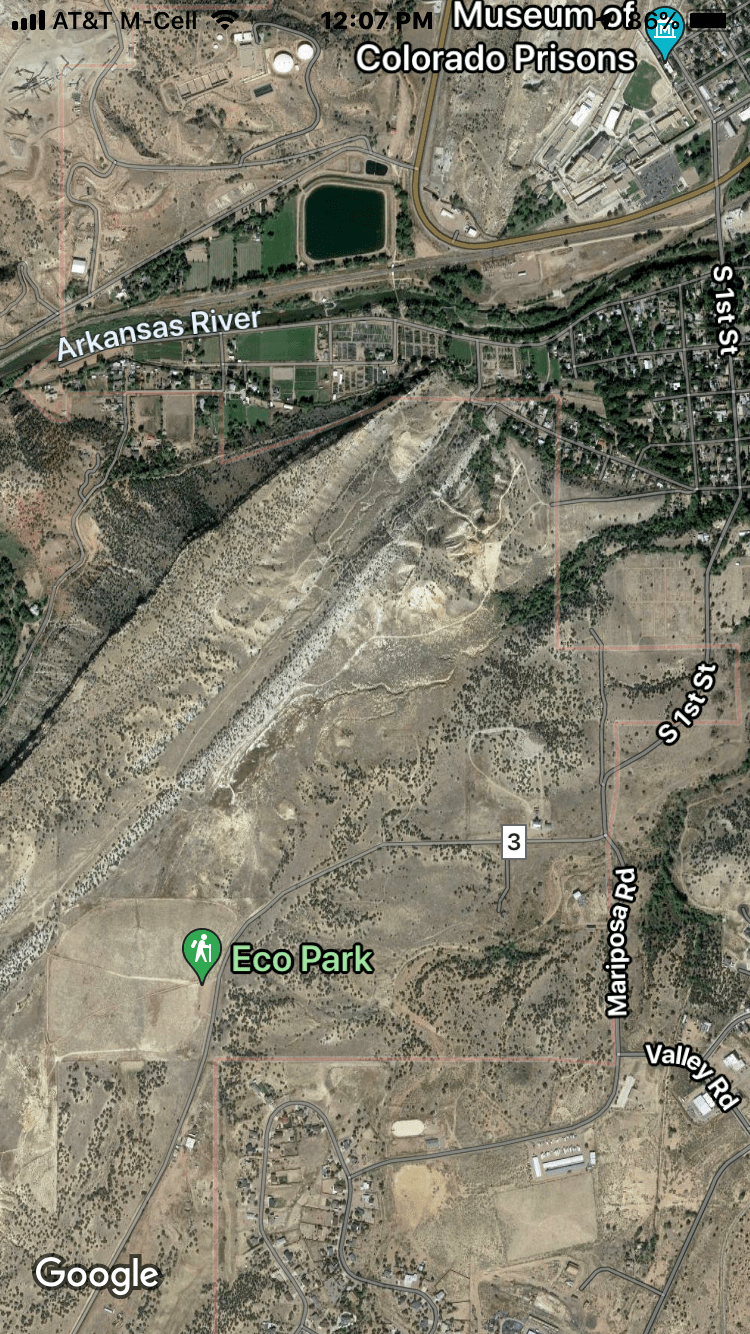
I was making the drive back from Denver to my cabin near Salida on a Sunday afternoon in early spring with notions of an outing on Grape Creek floating around in my noggin.  Canon City was right on the way, and Google Maps seemed to promise easy access to lower Grape Creek up either Riverside or Grape Creek Drives on the south side of the Arkansas just west of town. To my chagrin, I soon found the hoped-for access near the confluence failed to note that both routes were blocked by private gated  residential development.  Not to be denied, I drove back towards town and over the Arkansas then up to Tunnel Drive trailhead, only to find more “no trespassing” signs posted by the railroad along the north bank blocking any access upstream to the creek.  With my teeth grinding, I pulled out my cell phone and reconnoitered on Google Maps for possible access routes further upstream.  The only possibility I could find was something called Eco Park, accessed via South First Street in Canon City then County Road 3.  It was an easy drive out to Eco Park, but by the time I got there it was too late to attempt what looked to be a two-mile one-way hike to the creek.  Lower Grape Creek would have to wait for my return. 

Ecology Park Is The Gateway To Lower Grape Creek

Fast forward a couple of months and finally the weatherman forecast a day without snow, rain, or howling winds that had plagued my neck of the woods in late March and April, not to mention the so-called Arkansas Water Conservancy District finally decided to release more than a measly four CFS of water into the creek from Deweese Reservoir, which holds water for downstream irrigation by ranches and farms around Canon City.  The low water levels had been further stymying my spring fishing plans for weeks.  The water buffaloes who run the district had finally been releasing a steady 25 cfs for several weeks now, an ideal angling level. (Be sure to check creek water levels before your trip on the District’s web site or by calling Royal Gorge Anglers at 888-994-6743.)

I am suiting up in the Eco Park parking lot at 9:30 a.m. under sunny skies and with a gentle breeze blowing, all systems are go.  A meadowlark is chortling melodiously nearby, his serenade almost always a sign of future angling success for this Kansas farm boy (Meadowlarks are the state bird.).  I don my lightweight waders and get going, carrying a small lunch satchel and two rods.  I start out on the good trail that accommodates hiking, biking, and horseback riders that will take me to the creek in about 0.8 miles.  Immediately I come to a sign directing me south to Grape Creek, but I know from my on-line recon that I should follow the arrow towards Water Gap pointing me straight ahead due west.  As far as I can see on Google Maps, the so-called Grape Creek trail goes nowhere near Grape Creek, and the Water Gap trail route provides the quickest and most direct access to the creek.  Go figure.   

Hang Right–Follow The Water GapTrail

The hike is flat and easy across a wide-open plain for the first quarter mile.  I descend to a gate marking the start of BLM property and continue through it to follow the trail that loops to the right around a ridge and then turns back downhill to what is called the Water Gap, a narrow defile in jagged ridge where two ephemeral creeks have carved out a path to Grape Creek.  

From there the trail follows a broad wash down to the water in another quarter mile.  Sure signs of spring are everywhere, from the colorful flowers and buzzing busy bees to the leafy cottonwoods.

Temple Canyon and Grape Creek Canyon upstream beyond have a fascinating history. The intrepid explorer Zebulon Pike traversed the rugged terrain during the winter of 1806 as he explored the Great American West. He followed a trail used by the Ute Indians that led from the plains to their summer hunting grounds in what we now call the Wet Mountain Valley. Incredibly, in the late 1800s a narrow-gauge railroad line was carved up the canyon to tap the wealth of the silver and gold mines around present-day Silver Cliff and Westcliffe. But it operated for only a few years, landslides and washouts dooming the line. Remnants of this amazing feat can be seen today in the form of old bridge abutments and rock walls along the original rail bed. Workers in those bygones years discovered a spectacular natural amphitheater high above the creek that they dubbed the “Temple,” which became something of a tourist attraction.

Temple Canyon was transferred to the City of Canon City in 1912 by the federal government and today is managed to maintain its wild environment.  The road from the city to Eco Park is paved, but beyond that to the Route 3 bridge over the creek is scary rough in places and twisty-turny, best handled by a 4WD vehicle.  There are only a couple of primitive campgrounds for the hearty overnight visitor.  No motorized contraptions of any kind are allowed in Temple Canyon, only leg-powered hikers.  All of this is great news for the intrepid angler!

As I continue down the wash towards the creek I see a giant pipeline straight ahead.  Turns out it is part of the irrigation diversion system that is sucking a lot of water out of the creek somewhere upstream.  A hundred yards further on I see the result–Grape Creek is nearly dewatered, its flow barely more than a trickle and not a fish in sight in the crystal clear pools.

I had intended to stash my lunch here then hike downstream and work back up for victuals by noon then fish upstream in the afternoon.  Now I am wondering how far I’ll have to hike upstream to find decent flows. 

Fortunately, not too far.  In about 10 minutes following a dirt road that goes upstream, I cross a bridge and come upon a concrete dam where at least half the creek is diverted into the big pipe. 

Irrigation Diversion Dam

I double check my two rods. The 8 ½ foot 4-weight rod is rigged with a #16 Royal Trude that imitates the many small grasshoppers I saw jumping about on the hike in and a #18 sparkle caddis larva that is a reasonable facsimile for the predominate creek insect. On the other, a 5-weight, 8 ½ heavier rod, I have tied on a #18 Tung Teaser followed two feet below by a CDC green hotwire caddis of my own creation that will allow me to plumb some of the deeper bend pools I expect to find based on my experience fishing upper Temple Canyon. I am using a 5X leader on both.

It’s been a few weeks since I have on the water so I decide to take a practice cast into the frothy pool below the dam before I work the long, deep pool above. 

Practice Pool Below Dam

Immediately some small fish give chase to the dry, jumping out of the water in hot pursuit but failing to down the fake bug.  Next cast the dry disappears, and I am onto a feisty trout that has taken the nymph, a little 8-inch rainbow that makes up for lack of size with a good battle. 

Lilliputian Rainbow Starts The Day

Next cast the scene is repeated and another bow slides in to my net.  I miss a couple more strikes then finally the fish wise up. 

Now I’m primed and ready to hit the aforementioned alluring deep green pool right above the dam.  I climb up the concrete structure gingerly, keeping a low profile and cast the dry/dropper.  Surprisingly after a half dozen casts the trout are winning by a shutout.  I switch to the nymph rig to probe depths where I can’t see the bottom, but the result is the same.  I’m starting to think maybe this pool may get fished heavily since it is easily accessible.

Undaunted, I continue upstream. I see a few midges hatching, but no surface activity. I don’t see any boot marks and no broken branches along the shoreline, a telltale sign that it hasn’t been fished recently. Just around bend I come to promising run. It’s tight quarters, with overhanging tree branches in front and back of me. I carefully assess the situation and proceed to hang my first cast on one of the aforementioned branches to my rear. Fortunately I am 6’3” tall and can just barely reach high enough to retrieve the fly. The second cast is on target just off the main current, and as the dry dances downstream it disappears. I’m onto another pugnacious rainbow that has taken the caddis larva.

Narrow Lower Stretch Demands Pinpoint Casts

He’s a few inches larger than the first.  That’s more like it.  My next cast produces a small brownie. 

A few minutes later I come to tempting run along a sheer cliff face. 

Cliff Pool Produces

Another small rainbow immediately nails the nymph.  On the very next cast the dry again disappears, and I can tell I am onto something bigger.  The fish dives and tries to tangle me on the beaver detritus in the depths.  I work him slowly out and am rewarded with a 13-inch brownie that will be the biggest of day. 

Brownie Puts Up Good Brawl

I continue working upstream where the brush thankfully recedes and the creek begins to open up.  I get more frisky rainbows and an occasional brown.  Most are 8-10 inches with a couple of foot-long browns.  I’m a bit surprised that I am not getting anything bigger—in the upper reaches to Temple Canyon on my earlier trip I had shots at several fish that pushed 15-inches.  A narrow trail parallels creek, and I start to see a few boot marks and wonder if more pressure here is the issue.  Surely couldn’t be lack of piscatorial perspicacity or skill.

It’s pushing 1 p.m. now and with 15 or so fish to my credit, I pause for lunch in the warm sun and absorb the beautiful wild scene.  Tiger Swallowtail butterflies are flitting about, and I can see some red cactus flowers blooming up on the steep slope above.  The yellow buds of the cholla cactus are getting ready to burst.

After lunch I round a bend and come upon two huge dams—a beaver pond aficionados dream. I get a couple of small rainbows below the first dam and then see some rises near the left bank above so carefully scramble up on the dam and make a few casts.  I don’t see any fish and no more rises.   I gingerly wade out into the first pond which luckily has a fairly firm bottom and begin casting to the right bank where the current is flowing.  I get several perfect floats but only manage to scare the daylights out of a sizeable brown trout that comes jetting downstream by me.  My ego is salved when I pick up a couple more rainbows below the second dam on the dry fly. 

Then I spot some movement in the cholla meadow along the stream—it’s two anglers in shorts with fly rods hiking back downstream.  Hearty souls I think given the chilly water temperature!  I also think the early birds get the worm (and fish).  I toy with the idea of throwing in the towel, but decide to continue upstream where Google Maps reveals some beautiful bend pools.  Happily I continue to get more steady action for small bows while managing to make things interesting with a couple of my patented long-distance releases on bigger fish.

 By now it’s 3:30 and the sun is beginning to descend below canyon walls.  But I just can’t quit.  The serpentine creek reveals one tempting pool after another around each bend. 

Grape Creek Exorcises Cabin Fever

An hour later I have caught another dozen rainbows and browns and with shadows enveloping the pools and the air cooling quickly, decide to call it a day.  It will take me an hour to get back to the trailhead.  But there are still another two-plus miles of the creek I haven’t yet explored yet, the remotest stretches of Temple Canyon.  I’ll definitely be back!

Exploring Grape Creek In The Hidden Recesses Of Temple Canyon (near Canon City, CO)

October 2019

Photos by Chris Duerksen and Fran Rulon-Miller

For articles on my other adventures on Grape Creek, see my 2017 posts:

http://hooknfly.com/2017/11/08/going-ape-over-grape-creek/

Grape Creek southwest of Canon City, Colorado, is one of my favorite backcountry creeks, offering over 30 miles to explore in a rugged canyon where the wild brownies and bows are plentiful.  And happily, with only a few public access points the entire length, boot marks are scarce.

Most anglers fish the stretch upstream of Canon City, gaining access where County Road 3 crosses it a few miles outside of the town.

img_6447
County Road 3 Off US Highway 50 Is Best Access Route–Red Pin Marks Bridge Over Grape Creek and Parking Area

From the bridge an adventuresome angler has over 10 miles of state and federal land with beautiful water to explore before reaching the next public access at Bear Creek Gulch.  The canyon and stream gets wilder the further up you go.

But what of downstream from the bridge into Temple Canyon Park, owned by Canon City?  I’ve rarely seen any serious fisherman head that way.

Temple Canyon Map
Temple Canyon Park Map–Downstream Of County Road 3 Bridge

The creek disappears downstream a few hundred yards into the cottonwood-studded canyon, and most of the hikers venturing into the rocky, spectacular canyon have as their goal the magnificent natural amphitheater on a side canyon off the creek that gives the park its name.   I’m intrigued by the fact that there’s nary a mention online of anyone fishing the five-mile stretch down to the confluence with the Arkansas River, and my piscatorial appetite is whetted even further by the alluring twists and turns in the creek that Google Earth reveals, promising deep pools and maybe big fish.  Who can resist!

Temple Canyon and Grape Creek Canyon upstream beyond have a fascinating history.  The intrepid explorer Zebulon Pike traversed the rugged terrain during the winter of 1806 as he explored the Great American West.  He followed a trail used by the Ute Indians that led from the plains to their summer hunting grounds in what we now call the Wet Mountain Valley.  Incredibly, in the late 1800s a narrow-gauge railroad line was carved up the canyon to tap the wealth of the silver and gold mines around present-day Silver Cliff and Westcliffe.  But it operated for only a few years, landslides and washouts dooming the line.  Remnants of this amazing feat can be seen today in the form of old bridge abutments and rock walls along the original rail bed.  Workers in those bygones years discovered a spectacular natural amphitheater high above the creek which became something of a tourist attraction.

Temple Canyon was transferred to the City of Canon City in 1912 by the federal government and today is managed to maintain its wild environment.  The road from the city to the park is scary rough in places and there are only a couple of primitive campgrounds for the hearty visitor.  No motorized contraptions of any kind are allowed in Temple Canyon, only leg-powered hikers.  All of this is great news for the intrepid angler!

img_7509

While in the old days the canyon experienced wild floods, today the waters are controlled, for better or worse, by the (so-called) Arkansas Water Conservancy District through its DeWeese Reservoir on upper Grape Creek near Westcliffe.  The reservoir holds water for downstream irrigation by ranches and farms around Canon City.  Flows can still fluctuate greatly depending on irrigation demands, but in summer the water can get dangerously low—down to 4 CFS—as water is stored up for periodic releases.  State and federal wildlife agencies are working with the district to assure adequate summer flows, reportedly with some progress, albeit halting.  The controlled flows have also allowed heavy willow and brush growth along some stretches of the creek, vegetation that would have been swept away by annual raging floods before the dam was built.

Last night I checked the flow on the conservancy district web site and found it to be at 20 CFS, low but eminently fishable (I find 30-50 cfs is optimal.).  So it’s a go.

Continue reading