The Quest For A Wet Mountain Valley Trout Grand Slam—Day 3

Fall 2024

For Days 1 and 2 of my Grand Slam quest, see: http://hooknfly.com/2024/10/22/the-quest-for-a-wet-mountain-valley-trout-grand-slam-day-1/ and http://hooknfly.com/2024/11/05/the-quest-for-a-wet-mountain-valley-trout-grand-slam-day-2/

My holy quest for a trout grand slam continues. So far so good–browns, rainbows, and brookies checked off on Days 1 and 2. Now for the toughest one—a native Rio Grande Cutthroat.  My destination today is Medano Creek, hidden in a beautiful valley between the soaring peaks of the Wet Mountain and Sangre de Cristo ranges.  Medano Creek flows south into the Great Sands Dune National Park where it disappears into the sand. 

Medano Creek Flows Into Then Disappears In The Thirsty Sands of the National Park To the Delight of My Granddaughter Aly.

But don’t be fooled! Before it does, it flows free and cold, high in the mountains above and is one of the best cutthroat waters in Colorado. 

Miles Above the Great Sand Dunes, Rio Grande Cutthroats Thrive
in the Clear, Pure Waters of Medano Creek

Kudos go to the folks at Colorado Parks and Wildlife for this treasure.  Over a decade ago, they prepared the creek for cutthroats to survive and flourish by poisoning out invasive species like brown trout and then stocking it with Rio Grande Cutthroats, which were on the verge of being listed as endangered.  The cutts proliferated, a great success story. Fishing for the cutthroats is allowed, but catch and release is the rule.

Having fished the creek a couple of times, I know the cutts are thriving and hungry.  The question is–can I get there over the very rough Medano Pass road? In the best of conditions, it’s a teeth-jarring, bone-rattling drive, but with all the rain we have had in July and August it is likely to be in worse shape.  It doesn’t see a road grader very often that’s for sure, especially on the east side of the pass. 

For safety’s sake, it’s good to have someone with you on this trip, so I invite my fishing buddy from Salida, Mr. Tom P. to join me.  I call him Tenkara Tom.  Tenkara is a simple, traditional Japanese style that uses a very long rod, a short light line, and typically only one wet fly.  It has only become popular in the USA in the last 15 years.  It works best on small streams because of the short line that is simply flipped out with the fly without any false casting as with traditional fly casting.  Tom is a master at it, as he demonstrated by outfishing me last year on a small creek in the San Juan Mountains.  I am hoping to deliver his well-deserved comeuppance on Medano Creek. 

I meet him in Westcliffe at 7:30 a.m. on a Sunday for the two-hour drive over Medano Pass, our goal being a series of beaver ponds and open creek stretches several miles below.  Don’t be fooled by the Google Maps that portrays this as a one hour and five-minute drive.  It will take about two hours if you avoid any mishaps.  The first part of the drive is down CO 69 highway, which is a good paved road, about 25 miles to the turnoff on gravel road 559 which leads to Medano Pass.  Be sure to keep your eyes peeled for the Medano Pass turnoff sign.  Don’t follow the circuitous route suggested by Google Maps

Follow the Signs On CO 69 For the Turnoff To Medano Pass

The trip is a very scenic one that often features herds of elk or buffalo with the striking Wet Mountains framing the view. 

The first five miles or so on road 559 are decent, skirting a big lake on private property before beginning the ascent to the pass.  But from there things can get gnarlier by the mile as Tom and I soon discover.  The road clearly hasn’t seen a grader for some months as witnessed by the eroded channels coursing down the two-track carved out by recent rains. 

Every mile or so where the road splits to avoid a big boulder or stand of trees, Tom jumps out and evaluates the better route, which works well until we decide to go right to avoid a stretch to the left with some sharp rocks protruding from the roadway.  The right fork is steeper, but the roadbed looks to be in better shape.  I line up to gun up the grade as Tom steps to the side.  I am in 4-wheel drive with some new AT tires, so don’t expect what happens next.  I lurch a few feet forward, then my tires start to spin wildly getting no traction, and my SUV begins to slide backwards with the tires kicking up baseball-sized rocks.  I turn the wheel slightly hoping to avoid sliding into some big trees behind, but that maneuver results in the SUV starting to tilt on its side.  Luckily I get the vehicle stopped before I roll it.  I sit there shaking for a minute, having survived what felt like a near-death experience.  It probably wasn’t that bad, but the look on Tom’s face says it all.  We soon regroup, back up and take the rocky looking stretch which proves to not be as bad as it looked.  But you get the picture–this is a route for 4WD vehicles with high clearance only and drivers with substantial experience on rough backcountry roads.  Indeed, a better route may be through the Great Sand Dunes National Park.  While there are some challenges with that way as well, such as several deep creek crossings and the notorious Sand Pit that can swallow unsuspecting vehicles and requires you to deflate your tires before proceeding then reinflate when you hit solid roadbed, at least you are closer to civilization if you need to walk out or get help.

Most Creek Crossings Are Navigable Except After Heavy Rains

Once over Medano Pass, however, we breathe much easier and can enjoy the spectacular fall scenery.  The road in the National Park and Preserve proves to be much better maintained than in the national forest on the east side of Medano Pass.

The only challenges are a couple of stream crossings, but unless there has been a big rain they are easy in a high-clearance SUV.  Within a few miles down off the pass, we come to a series of beaver ponds and a hidden stretch of open creek water below where I have done well on earlier trips. 

That’s where we pull over and suit up.  I am wearing chest waders and Tom his wet-wading knee-high outfit.  Tom rigs up his 9-foot tenkara rod with a #14 soft hackled pheasant tail he will fish wet.  It’s a pattern I have seen him catch numerous fish on.  I have my short 7.5 foot 3# wand ready to go with a #18 Chubby Chernobyl dry and a #18 Dirk’s Delight green caddis larva dropper.  By 9:45 we are bushwhacking towards a nice open stretch of the creek hidden downstream of the big beaver ponds.  But as we reach our destination we find the busy beavers have been hard at work—they have built a series of small beaver dams that make casting very difficult.  The dams have backed up water into the overhanging trees and bushes, and the new ponds are too deep or mucky to wade. 

Fortunately, we can see the fish, some rising insouciantly beneath the overhanging bushes.  Tom boldly fords the creek and crashes further downstream.  Soon he is hooting and hollering that he has a good one.  “First fish of the day—a cutt over 12 inches!” he shouts.  Likely story I think!  And he never snaps a photo or produces any other evidence of the event.

We head upstream and finally come to an open stretch that was a hot spot last year.  The water is very low and clear, but with a careful approach we get within casting distance of the pool and have some fun sight fishing.  We can see a half dozen fish looking upstream waiting for their next meal to float by.  I give Tom first chance, and he immediately snaps off his pheasant tail in some bushes behind us.  I wait patiently while he searches for a replacement in his fly box, but all he comes up with is a bushy #18 caddis dry fly.   I have to stifle my chuckle, but then on his first cast he connects immediately.  A beautiful small cutthroat. 

Then it’s my turn, and on my first cast a colorful cutty nails the dry!  Grand Slam!! 

Beautiful Rio Grande Cutthroat Completes The Grand Slam!

From then on, it’s non-stop action for the beautiful natives.  In a few minutes Tom manages to fool a gorgeous one, sporting a namesake bright reddish-orange slash on its throat, that goes almost a foot, one of the biggest of the day.

We continue on upstream and come to a challenging bend pool guarded by snags mid-stream.  On previous trips it has produced some good-sized, feisty fish for me. 

Tricky, Snag-Filled Bend Pool Holds Muscular Cutts

Being the gentleman fly fisherman, I motion for Tom to go first.  He shows off his stealthy moves by creeping up to a spot on the opposite shore where he can flip his fly out without spooking the fish and still reach the honey hole between the snags.  He sits quietly to let things settle down, then flicks a backhand cast that results in his fly alighting perfectly between the snags.  In a flash, he’s onto a good fish.  He lands that one and then fools two more from the same pool.  Good show Mr. T!!

We continue upstream and come to my favorite long, open stretch of the creek just below an old big beaver dam.  But of course, things have changed since last year.  The beaver have constructed another big dam—almost 4 feet high–that has flooded the creek all the way up to the foot of the old beaver dam, creating a long linear pond 20 or so feet across.  My heart sinks as I utter a few choice words.  But hope springs eternal, so I begin to scale the new dam, a bold move by a septuagenarian.  I manage to get near the top so I have enough clearance to cast but still keep low enough not to spook the fish….if there are any in the new pond.

I throw a long cast into the slow current, let the flies settle, then give my line a twitch.  The water explodes as a good cutt gulps down the dry.  He cavorts back and forth around the pond, then something almost jerks the rod out of my hand.  Low and behold, another trout surfaces with the caddis larva in its jaw.  He goes one way, the dry fly guy the other.  It’s a fun battle, and I beam as I lift my line out of the water with two fish wriggling wildly.  Soon they are swimming back to their pals. 

Not to be denied, Tom hikes around the dam to get into the action from the shoreline.  Together we get another couple dozen in short succession before we decide to take a lunch break around 12:30. We will hit the old beaver ponds above after feasting on the comestibles.

But the weather has other ideas.  As we lounge over lunch, some ominous looking clouds start to roll in from the west along with gusty winds.  Instead of flying the white flag, however, we decide to hustle back to the ponds and give them a try…and soon are catching more eager cutthroats in the new narrow pond where I scored the double.  Next we do a highwire act along the old dam upstream till we come to an open spot were we can cast.  Bingo, the fun continues!  Tom, sans waders, has a little trouble reaching the best spots in deeper water offshore with his short line Tenkara rig, but I boldly wade in and am able to cast to some risers out of his reach and net a couple more.  Retribution completed! 

By now, however, the clouds start to spit rain and the wind is howling, sending us scurrying back to the SUV.  It’s about 2:30 when we hit the road back to Westcliffe. 

Rain Clouds and Gusty Winds Signal The End To A Fantastic Day

Again we enjoy the scenery with the aspen showing off their fall colors from bright yellow to flaming orange. And now that we know the rough spots on the road from the travails of the morning, the drive back going downhill from Medano Pass is definitely easier and more pleasant, especially with the Grand Slam accomplished.  It’s been an enjoyable three days pursuing these beautiful fish in magical, remote surroundings, topped off with a good dose of camaraderie with Tenkara Tom today.  After all, that’s what fly fishing is really all about. 

The Quest For A Wet Mountain Valley Trout Grand Slam—Day 2

Fall 2024

For Day 1 of the Quest, see: http://hooknfly.com/2024/10/22/the-quest-for-a-wet-mountain-valley-trout-grand-slam-day-1/

After a long, successful day yesterday on my holy quest, I decide to stick closer to camp on Day 2.  After all, I am halfway to a coveted grand slam—browns and rainbows already accounted for– and can relax a bit and chase some eager brookies just a few minutes from my camp.

I am roughing it in gentleman’s style, ensconced in my Keystone travel trailer at the outstanding Grape Creek RV park just south of Westcliffe, Colorado, a quiet campground with great views. 

An added attraction is that a stretch of upper Grape Creek above DeWeese Reservoir runs right through the RV park.  It’s only a few hundred yards down a slope from my camp site, and even better, it’s private water.  I have fished here a couple of times in past years and know it harbors feisty, but skittish brookies.  Grape Creek here is only a dozen feet wide and shallow in most stretches. 

So after a leisurely breakfast and some lounging in the morning sun reading John Gierach’s Even Brook Trout Get The Blues, I saunter down to do some reconnaissance.  After sizing things up creekside, I plan to drive the short distance into Westcliffe to scope out its shops and historic landmarks plus have lunch at one of my favorite establishments, Bootlegger’s Bistro. 

It’s only a 10-minute stroll to the water.  As I amble down the slope, I immediately spook some healthy, fine-looking deer—a mama and her yearling—hiding in the tall grass and bushes in a field to the north. 

The Ears Have It!!

I snap a couple of photos before they prance away, then continue on down to check in with some equine buddies that expect some grassy cuisine for allowing me to pass through their corral to the creek. 

Equine River Keepers

I emerge from the corral just downstream of a big beaver dam to find the water low and clear with small fish skedaddling to safety in a pool below the dam.  I mount the dam carefully and continue upstream along the west shoreline, trudging through shallow water.  I spot fish hiding under thick mats of aquatic vegetation and in small shady areas created by overhanging trees in a few scattered spots along the banks.  This is going to be more challenging than I expected.  I also pause to overturn some rocks on the creek bottom and find them crawling with caddis larva, which I expected, but not the cream-colored variety that I find. 

Surprise…Cream-Colored Caddis Larva

Usually caddis larva on Grape Creek are the normal bright green variety which I imitate with my Dirk’s Delight green hotwire CDC beadhead concoction.  That was certainly the ticket on lower Grape Creek yesterday.  Fortunately when I get back to the trailer I confirm I have some reasonable facsimiles of the cream ones—Caddis Poobah Cream Beadheads–tucked in a big plastic box containing hundreds of spare flies, most of which I rarely use. Then it’s off to town.

Poobah Creem-Colored Caddis Larva Matches Local Bug

Westcliffe has a fascinating history, and a good place to start exploring is at the Custer County Welcome Center in the bustling downtown just one block south of the intersection of Main Street and Highway 69. 

It’s only open Thursday through Saturday, but my timing is impeccable.  I’m greeted by a friendly lady who tells me she is a summer resident/snowbird who volunteers at the center.  After some pleasantries, she hands me a copy of the handsome Wet Mountain Valley guidebook, Custer County Past & Present. 

I find it to be well-written and profusely illustrated, a veritable treasure trove of information, a Bonanza that’s free!  Historic ranches like the fabled Beckwith spread, which is open to visitors, are covered in one section while others delve into the history of Custer County’s other towns–Wetmore and nearby Silver Cliff—plus offering a walking tour of Westcliffe’s historic buildings and landmarks.   Another page chronicles the many famous western movies filmed in the valley with a closing page extolling the efforts preserve the striking night sky whose brilliant stars and constellations are astonishing.  Then I am off on the tour, seeing historic sites like the Jones Theater that began as a saloon and pool hall in the 1800s and the Westcliffe jail, a calaboose built in 1888 for the princely sum of $330. 

When my stomach starts to growl just after noon, I head for the Bootlegger’s Bistro on Main Street just around the corner from the welcome center. 

Bootlegger’s Bistro

I’m in luck and get a good table on the patio in the sun.  My order is for the establishment’s famous Reuben sandwich along with a local brew from the great selection offered by the restaurant called Colorado Native Amber.  Then it’s off to catch a brook trout.

Back at camp I rig up my light weight 7.5-foot wand with a #18 cream-colored Poobah caddis larva dangling 18 inches below a #18 Royal Stimulator, then descend to the creek under a warm, sunny sky.  In that first pool below the beaver dam, a few fish dart away as I get close.  So I kneel and throw a cast just below where the creek cascades around the dam into the pool. 

Immediately the Stimi disappears, and I am onto a veritable leviathan—a 12-inch brookie erupts on the surface then cavorts around the pool, bending my three-weight rod double.  But before long the colorful beauty is sliding into my net and posing for a quick pix. 

First Cast Brookie!!

Whew, the grand slam pressure is off—I am three quarters of the way home!  Next cast, same result.   Over the ensuing 15 minutes I catch another half dozen spunky brookies before the pool goes quiet.

Now I am ready for more hot action above in the beaver pond so I scale the dam and unfurl my line, expecting it to be lights out.  But of course, I get nothing.  Turns out the water in the pond is still with no obvious current.  So I move on upstream to the mats of green aquatic vegetation where I see some nice brookies hiding in the shadows.  But a dozen casts fail to lure them from their hiding places. 

Green Aquatic Mats (In Foreground) Provide Good Impenetrable
Hiding Places For Brookies

I continue upstream above the underwater vegetation.  It is a long shallow stretch I scouted this morning punctuated by a couple of small trees that overhang the water creating shaded pools with some depth.  And right on time, I spot a couple of risers as I move carefully into position.  My first cast falls short, but the second manages to elude the clutches of the branches and settles daintily at the upper end of the pool. 

Streamside Trees Provide Shady, Cool Refuges For Wary Brookies

The Stimi glides gracefully down the current, under the branches, and into the shadows and deeper water.  BAM, a brookie smacks the Stimi and is soon joined by one of his buddies who can’t resist the caddis dropper zipping around the pool—a fun double.  I catch a couple more before moving up to the next shady spot against the bank.  Like the first, it is challenging to avoid the snags, but whenever I lay one in there, a brookie feasts. 

I continue upstream and hit a couple more shady spots and catch a few more, smaller brookies, then come to the fence on the upper boundary of the property.  It’s 3:30 p.m. so decide to end the day, take a shower, and grab a little nap, knowing I just need a cutthroat to complete the slam.  If I can survive the bone-jarring, teeth-rattling treacherous drive over Medano Pass tomorrow, I know my odds are good for catching a native Rio Grande Cutthroat in Medano Creek hidden deep in the reaches of the Wet Mountains at the south end of the valley.   That will give me some things to think about tonight and prepare for as I enjoy a glass of wine and watch the sunset….and the moon rise over the Wet Mountain Valley.

Grape Creek Comeback

July 2022

For one of my earlier adventures on Grape Creek and a look at its fascinating history, see: https://hooknfly.com/2017/11/08/going-ape-over-grape-creek/

One of my favorite waters that features an intriguing history, great scenery, and even better fishing is Grape Creek in south central Colorado. While the entire twenty-plus miles in the canyon between Canon City and Westcliffe is productive, I’m partial to the upper ten miles between the rough Oak Grade/Bear Gulch access road and DeWeese Reservoir. That stretch is difficult to access without a 4WD vehicle, a vigorous hike, or both.

Like most creeks in Colorado, Grape Creek has faced (and survived) several serious threats including a proposed gold mine in its watershed and wildly fluctuating water levels courtesy of agricultural irrigation calls and the so-called Upper Arkansas Water Conservation District.  For the past decade it has provided me with consistently excellent fishing for some healthy, hard-fighting browns and rainbows.  So imagine my surprise when a couple of years ago when I took a fishing buddy from Florida into the canyon after a steep hike, and we almost got skunked, fooling a couple of little trout in six hours of flailing the water.  When I checked under the streambed rocks, I could find nary a caddis case or mayfly nymph that usually provided a dining smorgasbord for the fish.  Something clearly was wrong.  I started asking around and learned that a month earlier two tremendous consecutive flash floods had scoured the river of aquatic habitat, filled the honey holes with silt, and drove the fish out. 

Now two years later I stood on the canyon rim, looking down with trepidation. 

My buddy was due back soon for another go at it, and I knew I’d better produce if I wanted to keep my sterling piscatorial reputation intact.  The water level was at a decent level—38 cfs below DeWeese—so it was a go.  After slip sliding away down the steep slope, I eased into a good-looking pool, the water clear and cold.  With my nerves jangling, I picked up a fist-sized rock from the stream, held my breath, and turned it over.  What to my wondering eyes should appear but a half dozen caddis cases with little small green larva peeking out and several small mayflies scurrying for cover.  A big smile was in order.

First Pool

Now the real test—were the trout also back? My first two casts towards the head of the pool came up empty, but on the third my #18 Royal Trude floating jauntily along the undercut bank was rudely intercepted by a gold flash of a brownie. After a good tussle, the fish came to the net for a quick release.

Relief…The Fish Are Back

On the next cast into some faster water, the Trude suddenly disappeared as something snatched the #18 sparkle caddis larva dropper. I was expecting a rainbow in that heavy current, but it was a decent-sized brown! Now things were cooking. I lofted another cast into the fast water and the scene was repeated, but this time it was a hard-fighting, foot-long rainbow. It would be the first of many rainbows I would catch, all in excellent shape, perhaps the result of stocking of 4-to-5 inch fish soon after the wipeout two years ago.

The action was steady in the next two pools, just like old times.  Then I came to a deep bend pool that was one of my favorite honey holes.  Here the water was slower and deeper. 

Ye Olde Honey Hole

I threw a cast that landed perfectly just above a foam line that swirled along a ledge of rocks along the creek.  The Trude floated gently in the current and was suddenly jerked under by a nice brown who gobbled the caddis dropper and headed for the snags under the overhanging rocks.  My 4-weight rod bent dangerously as I put pressure on the fish and slowly eased him away from danger.  He ran back upstream towards the depths of the pool but immediately came jetting back with a giant brownie in hot pursuit.  The big boy nipped my fish a couple of times then disappeared.  I landed the smaller fish—a respectable 13-inches—then let the pool and my heartbeat settle down.

After a few minutes I again cast above the rock wall and let the flies drift close. Again the Trude plunged under, and this time it was the behemoth that had smacked the caddis dropper. The battle was on, and it was an epic one. The big boy plunged for the depths, then made a frantic run downstream with me in hot pursuit. When he hit the shallows at the bottom of the pool, he reversed course and jetted up to the fast current below a riffle where the water plunged into the pool. I slowly worked him within reach of my net, but that spooked him into another run for freedom below. He momentarily had the upper hand, his weight and the current stripping line out at a furious pace. But again he paused and let me catch up. I ran past him and then cautiously coaxed him back upstream to the depths of the pool. Finally, he tired and slid towards me, barely fitting his 19-inches into my outstretched net.

I admired this beauty, the largest trout I had ever caught from Grape Creek. After reviving the leviathan and releasing him, I laid back in the tall streamside grass, closed my eyes and relaxed.  My old heart needed the rest.   

Ten minutes later I decided to make one last cast in the pool before moving up, not expecting much after the major ruckus the big fish had created.  But to my great surprise, the Trude had no more than alighted when it disappeared.  The battle was again joined with another major-league fish.  The tussle was fast and furious, but before long a 16-inch brown came in for a quick release. 

Surprise Second Big Brownie

I danced a small jig as I moved up to the next pool–Grape Creek definitely back in form.

Before I could cast, however, I was distracted by a big patch of showy milkweed that always catches my attention with its squadron of beautiful monarch and swallowtail butterflies and the graceful antics of the big sphinx moths. 

Then it was the carpets of skyrockets, firecracker penstemons, prickly pear blossoms, and Rocky Mountain Bee Plants.  How’s a fellow supposed to concentrate on the fishing?? 

When I did resume, the action heated up as the sun got hot.  Rainbows took over center stage, over a dozen exhibiting their muscles before submitting.  Most were 11-12 inches but one pushed 14. 

I had only been on the creek for a little over three hours, but with a couple of dozen fish caught and released, I figured I’d better call it a day and save some for my buddy.  As I turned and started back to the trail up the canyon slope, I found myself face-to-face with three mule deer.  I froze, and they eyed me like they’d never seen a creature in baggy waders and an overloaded fishing vest carrying two long sticks.  The spell was broken when I said, “hello, girls.”  They turned tail and disappeared up a steep slope into the woods with their herd.    

What a treat, but the wildlife show wasn’t over.   Soon, out of the high grass emerged a hen turkey.  She played hide and seek with me for a few minutes before heading up the slope. 

That’s what makes Grape Creek such a special place—a wonderful potpourri of wild things. The Grape Creek comeback is complete!  Just remember to catch and release and leave no trace.    

Homeward Bound–I’ll Be Back!!

Texas Creek 2’fer

March 2021

Want to fish a Gold Medal trout river in the morning then after lunch drive a few miles to explore a wilderness creek full of scrappy browns and rainbows hidden in a remote canyon?  Then read on about the Texas Creek 2’fer! 

Halfway between Salida and Canon City, Colorado, at the junction of US 50 and CO 69, stands the former railroad town of Texas Creek hard on the banks of the Arkansas River, my home water. 

Texas Creek And Environs

For years on my way to Denver from Salida I whizzed by the crossroads not paying much attention to the motley assortment of a couple of permanent buildings, sheds, trailers, and outdoor paraphernalia like rafts and ATVs scattered about.  One morning on the way to the Front Range, at the insistence of my growling stomach, I finally stopped to sample breakfast at Barry’s Den, whose sign promised “howlin’ good cookin’.”  It delivered! 

As I returned sated and several pounds heavier to my SUV I noticed there was a one-lane bridge over the Arkansas.  Curiosity got the better of me, so I crossed the bridge and followed a Bureau of Land Management (BLM) road to the north.  The road eventually swung to the west paralleling the river upstream for several miles.  At the end of the road I jumped out and scrambled down the slope to the water.  My fishing fever soared as I looked at the beautiful runs and pools upstream and down. 

The Texas Creek Area Offers Easy Access To Several Miles Of Good Water On The Arkansas River

Over the next decade I would return several times each year to chase the willing browns and bows that inhabit this productive stretch, all the while keeping an eye out for the big moose who lorded over this territory as if he owned it.  Several times I stumbled onto him lounging in the tall riverside grass and was forced to execute a hasty and wide exit up around him as he cast a baleful eye in my direction. (Caveat–Pay heed to the “no trespassing” signs in this checkerboard of public land interspersed with a few private parcels.)

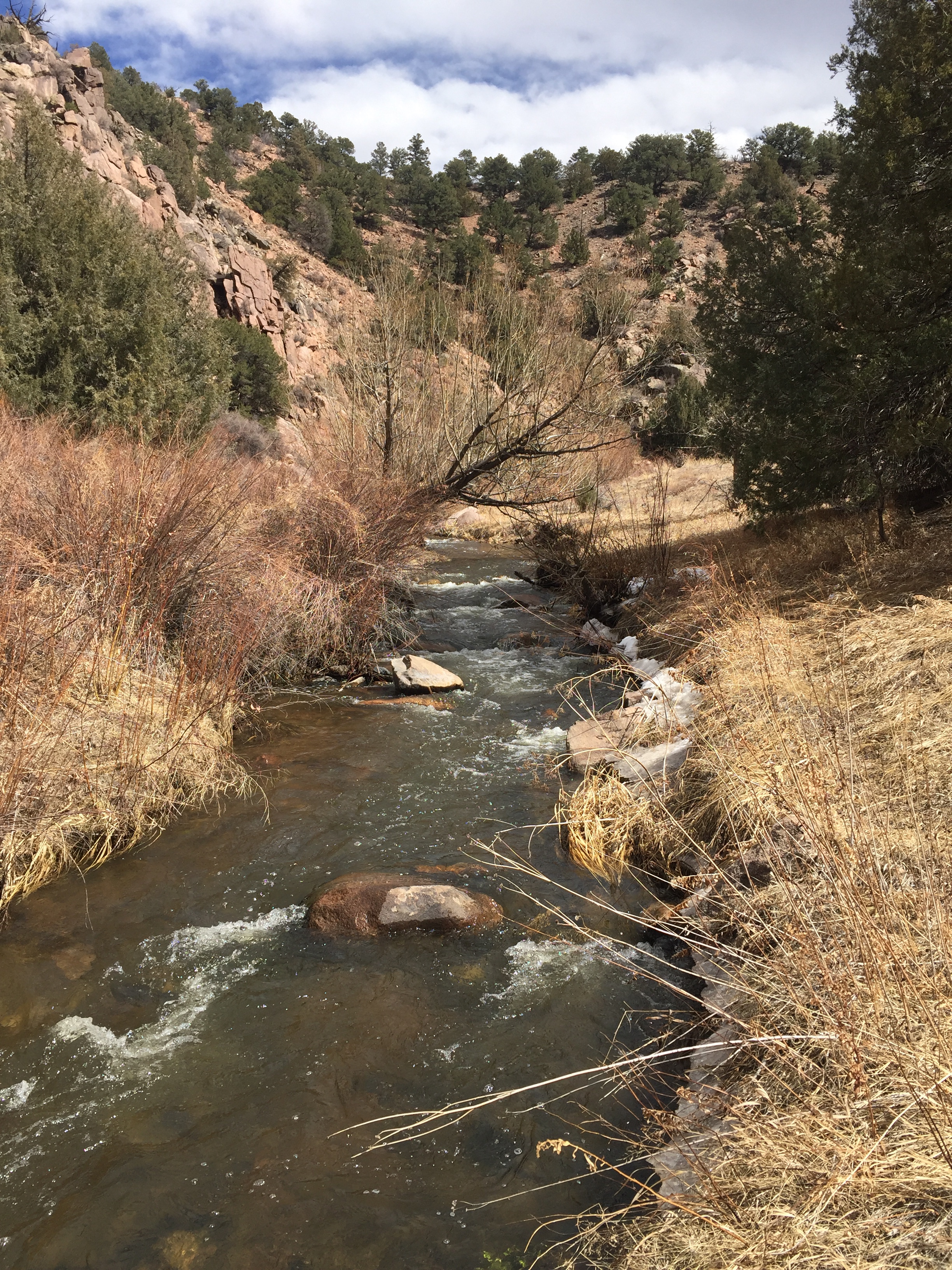
But the real revelation about would come a decade later when I decided to explore Texas Creek, the small stream that gives the hamlet its name.   Until then I had dismissed the stream as it didn’t appear to amount to much where it flows under US 50 and into the Arkansas, maybe 3 feet wide and overgrown by streamside bushes.   

All that changed a few months ago when I took a nature hike several miles north of the junction towards Westcliffe off of CO 69.  The outing was organized by GARNA (Greater Arkansas River Nature Association) and led by a knowledgeable young BLM biologist.  The focus was on the life and habitat of pinon jays, but my mind started wandering about Texas Creek that lay somewhere to the west, hidden in a rugged canyon. 

Texas Creek Hides From View In A Rugged Canyon

As the erstwhile birders in the group questioned him about the lives and loves of the raucous jays, I of course quizzed him about Texas Creek and potential piscatorial inhabitants.  He said he had heard the creek was definitely fishable.  Game on! 

Crafty Coot Pumps Guide For Fishing Secrets While Birders Distracted

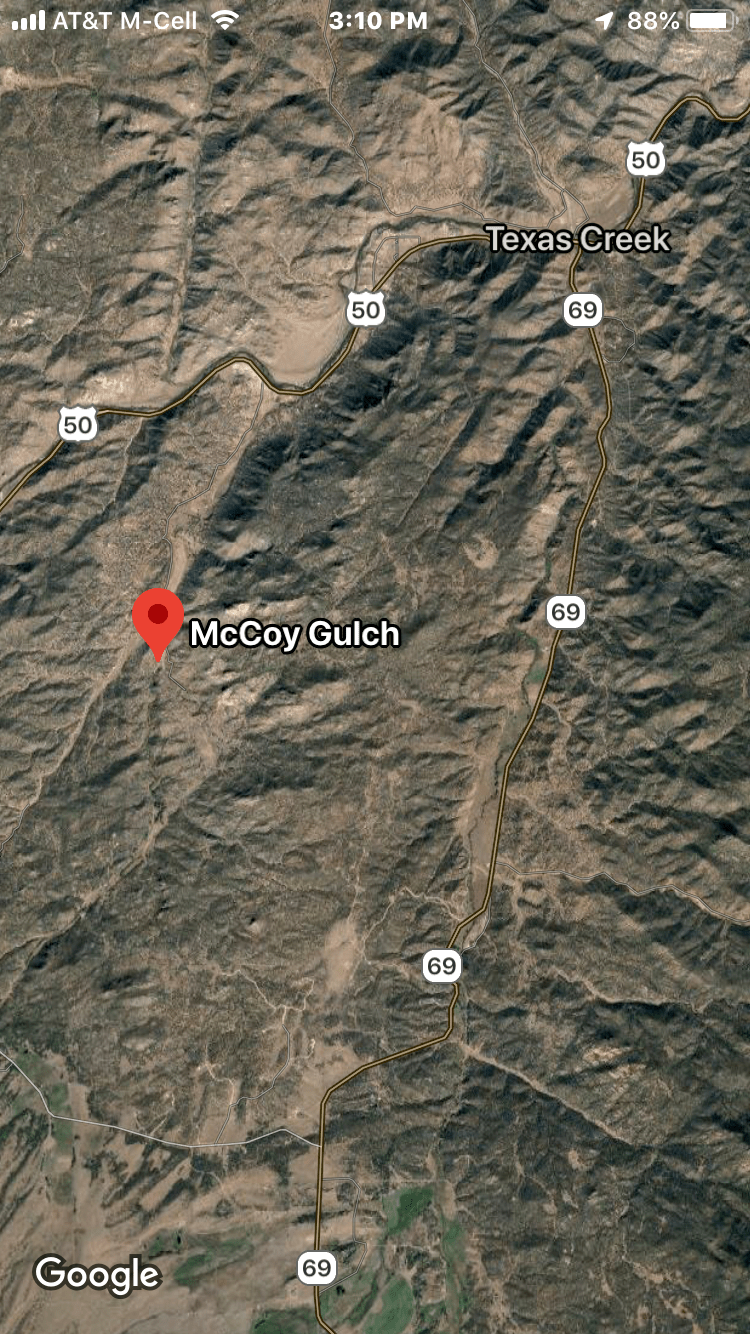
Back home later that week I started doing my homework.  Like most towns in this area it has a fascinating history featuring cattle drives, outlaws, railroads, and mining.  Exhibit one is the story of how the area came to be called Texas Creek.  In the late 1800s two cattlemen from Texas, Joe Lamb and Nat Rich, drove a big herd of longhorn cattle from Texas towards a payoff in the booming mining town of Leadville, where beef was almost as valuable as gold to the hungry miners.  Having traveled almost 500 miles over several weeks and with another 100 to go, they decided to camp by a creek near its confluence with the Arkansas River.  During the night, as the tale goes, a mountain lion spooked the herd and stampeded it up and down the valley, some never to be seen again.  Old Joe and Nat decided to name the stream Texas Creek in their honor.  For the next couple of decades the remote area provided cover for outlaws such as the notorious McCoy gang that rustled cattle, held up stage coaches, and when the railroad was built up the Arkansas River from Canon City in the 1880s, even robbed trains.  Infamous bad guys Jesse James and Kid Curry reputedly rode with the gang, whose name lives on in McCoy Gulch a few miles to the west. 

Outlaw Hideout In McCoy Gulch

By 1880 the Denver & Rio Grande Railroad had been pushed through the Royal Gorge and built a station at Texas Creek.  In 1900 the railroad built a spur from Texas Creek to the mining and cow town of Westcliffe twenty miles uphill to the south.  To make the sharp turn up the valley in a big loop from the Arkansas River required the building of an enormous and impressive bridge that was 648 feet long and 95 feet high!  The old grade can still be seen on the flanks of the canyon. 

By 1920 Texas Creek was a bustling railroad center sporting a depot, section house, a general story, a one-story schoolhouse, and cabins and homes.

Texas Creek In The Early 1900s

However by 1930s the spur was abandoned and the town began its slow decline.  Little of the original settlement remains today.

While this history was intriguing, what really got my angling juices flowing was the prospect of exploring a new remote creek.  The long Colorado winter was coming to an end soon and although I had notched some very good days on Ark the past few months catching some respectable brownies and bows, I was itching to fish a small creek without any other anglers in sight or traffic whizzing by. 

Using Google Earth, I spied a half-dozen access routes into the canyon where the creek nestled upstream, all within five miles of the US 50/CO 69 junction.  Most appeared to be through public BLM Land.  A couple of weeks later during a weekend warm spell I did some on-the-ground corroboration.   

The first access I attempted was off a highway pullout about three miles north of the junction, a single-track rough road with lots of twists and turns through the pinon and juniper forest.  I was glad to have a high-clearance 4WD vehicle as I bounced down the grade.  Ten minutes later I was peering at a beautiful series of beaver ponds, albeit locked in ice.  

In a few spots I could see and hear the stream gurgling by.  I smiled, knowing I’d be back soon.   I explored several other jeep trails, one of which ended up high above the creek, offering a stunning view but far too steep to climb down to the creek, at least for a septuagenarian.  Now I had a couple of backup routes in case the beaver ponds didn’t pan out.

I returned sooner than I contemplated, a week of balmy 60 degree weather luring me to the creek in hopes the ice was gone.  It was a weekend, which I typically avoid like the plague as anglers descend on the Arkansas from all directions.  Indeed as I drove from Salida to Texas Creek, I counted over 40 people fishing or preparing to do so in 30 miles.  I wondered what I would find on the creek in the canyon.

As I rounded the last bend in the access road about 10:30 in the morning, I smiled.  Nary a vehicle nor soul was in sight!  As I exited my SUV in the warm sun and strode toward the water, I was greeted by a squadron of truculent Canada Geese guarding the string of beaver ponds, who objected strenuously to my presence. 

Creek Guards

I smiled even more broadly when I got to the bank of the big pond, happy to find it ice-free as were several others I could see up and downstream. 

However, because of warm weather melting last week’s big snow, they were brim full and out of banks in several spots, washing over the bordering wetlands.  The ponds appeared too deep with banks too mucky to navigate, so I decided to bushwhack downstream on a faint trail on the east edge of the canyon then work my way back up.   When I emerged from the tangle of bushes about a quarter mile downstream, I gazed on what looked to be a surefire bet—a beautiful run below a substantial beaver dam with promising deep water above in the pond.  Then as if a sign from the fishing gods, a caddis fly landed on my hand.  Honest!

All Systems GO!!

My lightweight 8-foot, 4-weight rod was rigged up with two nymphs below a yellow yarn strike indicator with no weight.  The top fly was a #18 Tung Teaser imitating the mayflies nymphs I found under the streams rocks, and the trailing one a #18 CDC beadhead caddis larva, a reasonable facsimile of the little green buggers crawling about the streambed. 

Texas Creek Treats (clockwise from top center): Tung Teaser, CDC Beadhead Caddis, and Sparkle Caddis Larva

With great confidence I waved my wand back and forth, and the flies gently alighted in the pool below the dam and came floating back down in a beautiful run flecked with foam, an almost sure sign of fish to come.

Surprisingly an hour later the air was redolent with the odor of Mephitis mephitis (aka skunk).  Despite numerous casts into alluring deep pools, perfect looking eddies, and stretches that screamed fish, I had exactly zero strikes and saw only one miniscule fish darting to safety, and couldn’t even swear that it was a trout.

As I got back to my SUV thoughts of bagging the creek and heading down to the Arkansas River were floating through my head.  But I decided to persist and try another section downstream at another access point I had spotted. 

Within 15 minutes I was pulling up to the creek a mile or so downstream from the beaver pond debacle.  I stepped cautiously down from the parking area to a fine-looking stretch where the creek plunged past a big mid-stream boulder into a fine looking pool where I immediately caught saw the flash of a small trout feeding on the bottom.  Bingo! 

Act Two: Hope Springs Eternal

I began to unfurl my rig to cast, but noticed an old campfire on the bank a few feet downstream and some old boot marks on the sandy shoreline.  I decided to explore downstream where there might have been less pressure, and where Google Earth promised some good-looking bend pools.  I crossed over the creek and picked up the faint trail on the north side.  Within 100 yards that track had disappeared entirely, and from then on I wouldn’t see another boot mark. 

Into The Wilds

The valley was nice and wide for about a half mile downstream, allowing the sun to bathe the creek and offering easy walking.  Then the canyon walls began to pinch in and the going got rougher with thorny bushes and a thicket of willows calling for some serious bushwhacking.  Finally I came to a jumble of big boulders along the creek flanked by what looked to be an impenetrable tangle of vegetation extending up the canyon walls.  I also noticed the pesky bushes had eaten my caddis fly somewhere along the way.  That was a signal to stop, rerig, and go fishing. 

I scrambled up on the boulders, one of which was car-sized, to get a good look at the creek.  Ten feet below me was a tempting plunge pool that couldn’t be accessed from below and blocked upstream by the sheer canyon wall. 

Lair Of The Big Bow

It was going to be tough to cast down into the pool and allow my flies to drift into the quiet eddy just outside the raging main current.  After a couple of practice efforts I figured out how to get a drift into the quiet water without dragging the flies pell mell downstream.  On the fourth cast my yellow yarn strike indicator disappeared, and I set the hook on a…. jagged rock hidden below the surface.  This was not going well.  After several fruitless efforts to free the snag, I executed a last-ditch effort roll cast and miraculously the fly came loose.  I started to give up but a last-second death wish took hold, and I attempted yet another cast into the maelstrom below.  As if on cue, the strike indicator disappeared in about the same spot, and I lifted the rod slowly hoping to disengage from the rock, but to my great surprise a large rainbow, maybe 16-inches or more, thrashed to the surface with the caddis larva in this mouth.  He dove and went deep as I started to wonder how I would ever bring him in, perched as I was high above the pool.  Then the bow jumped, and I executed a perfect long-distance release, rendering the issue moot. 

As I sat on the rocks licking my wounds, I looked upstream at the next pool.  From there on up for quite a piece the water was much shallower and clearer.  There were also a few caddis and other bugs winging above the surface.  Maybe, I mused, time to try a dry-dropper rig—a caddis dry on top which would also serve as a strike indicator for the caddis nymph below.  This rig would be much more manageable and easier to cast under the big broken tree branch guarding the puddle above.   Problem was, I soon discovered, I had left all my dry fly boxes at home given the fact I hadn’t needed to use a dry during the past few months of winter fishing which is almost strictly subsurface.  I continued to paw through every nook and cranny of my fly vest and somewhat miraculously discovered a #16 Stimulator misplaced in corner of a nymph box.  It would be a passable imitation of those caddis flies.

I lowered myself carefully from the boulders and crept stealthily towards the pool upstream, then crossed over the creek to get a better casting angling under the tree branch. 

Lair Of The Big Brownie

There I caught a glance of some movement in the shallows, a hefty brown trout about 14-inches finning nonchalantly as it picked off food floating by.  I knelt down slowly and made a perfect cast (maybe lucky?) under the clutching branch.  The dry floated slowly over the fish, which I expected would grab the nymph, but instead he rose slowly and sucked in the dry.  I set the hook, and the brown took off for shelter in the deeper reaches of the pool above.  I put on the brakes, my rod doubled over, and slowly worked him back towards me, my net at the ready.  The fish would have none of it and cavorted around the shallows until he finally flipped off.  Was this going to be the story of the day??  Now I was 0 for 2 on two good-sized fish.

But soon I redeemed myself.  I executed another sidearm cast that landed further up under the branch near the head of the pool.  Almost instantly the dry disappeared, and I was onto another feisty brown.  He came in for a quick photo and release, a respectable 12-inches.  I missed another strike and then connected with another brown before moving on.

Scrappy Brown Trout Ends Shutout

Around the bend I was greeted by a long, straight stretch of water with promising pockets here and there behind rocks in the creek.  But the current proved to be too strong to get any kind of decent drift. 

No sooner would the flies hit the quieter water behind a rock where fish usually reside than they would be dragged downstream at warp speed.  A couple of fish did flash at the flies as they rode the cascade, but I came up empty.

Another 100 yards upstream I came to a larger, promising plunge pool that offered more depth and a back eddy with quiet water.  I could see several trout swimming back and forth, feeding just off the main current.  Problem was that I would again have to kneel and use a sidearm cast to avoid a big overhanging tree branch as well as brush on the opposite bank. 

Bring Your “A” Casting Game To Texas Creek

My first two casts swung too far to the left of the tail end of the pool allowing the flies to be dragged under by the current.  But the third was right on target.  The flies floated over and then past the fish, but then one turned in hot pursuit and nailed the nymph.  It was another brownie, this one about 11-inches.  A twin soon followed.

Texas Creeks Brownies Are Eager and Feisty–If You Can Reach Their Hideouts

Next I crossed back over to the opposite bank and walked further up to try the big eddy that swirled against the far bank.  The flies alighted gently and then spun upstream in the eddy, reached the top near the water cascading in the pool and drifted slowly down on the current’s edge.  Suddenly the dry disappeared unceremoniously, dragged under by a brownie that was hugging the bottom in the quieter water.  I quickly caught two more—all 10-12-inches—and missed a couple before things went quiet.

Above, the creek curved back to the north and offered some attractive pools where the water careened against boulders.  But there proved to be too heavy a flow to get a decent drift.  I made a mental note to revisit these pools when the early runoff had subsided a bit. 

Now I was nearing my SUV where I had started a couple of hours ago.  There was one more long, deep pool inviting below it, created by a small beaver dam.  I crept up below the dam, keeping a low profile, and unfurled a long cast upstream. 

I was surprised there were no takers.  Same result the next five casts, so I scaled the dam and worked towards the little waterfall at the head of the pool.  Still no action even though the water look inviting, deep enough to hid a fish and not too fast.  Then I saw a possible reason.  The lower branches of a streamside tree had been snapped off in several  places, undoubtedly by another angler several days earlier. 

That was a sign to retreat to my SUV and the lunch that awaited along with my usual RC Cola elixir.  But as I came to the clearing around that first pool where I started, I again saw some small trout flashing on the bottom.  I decided to postpone lunch for a few minutes and was rewarded when a scrappy small brown darted out and nailed the nymph—a good appetizer for the feast awaiting.

After a relaxing and pleasant lunch lounging in the sun in my camp chair, I decided to reconnoiter upstream.  I found some promising looking pools and runs, but they were blown out as the runoff picked up steam.  Next time!

Miles Of Water To Explore Upstream

But who’s complaining?!  I didn’t see another angler all day, the scenery was spectacular, and the fish were eager, obviously not having seen many faux flies.  I left with a big grin on my face, already planning a Texas Creek  2’fer for April, fishing the Big Ark before noon and then the creek after lunch… and vowing to solve the puzzle of those picture-perfect beaver ponds!!

Return To Sand Creek Lakes: Revenge Of The Skunked!

Update: Both the Upper and Lower Sand Creek Lakes and the upper four miles of Sand Creek were treated with Rotenone in 2020 to remove non-native fish. After successful treatment, the lakes and creek were restocked with native Rio Grande Cutthroat Trout. According to Colorado Parks and Wildlife staff, as of November 2025 the trout are doing well in both lakes and the creek. Reportedly the lower lake has the highest density of fish, up to 14 inches, and the upper has fewer fish but larger, up to 15 inches. Both lakes and the creek are open for fishing with lures and flies. Catch and release only. ENJOY!

Early July 2020

My first trip to the beautiful remote Sand Creek Lakes high above the Wet Mountain Valley in Colorado was in 2017, a year of the big runoff. The Arkansas and local streams around my home base of Salida were blown out and muddy well into July. As a consequence, by mid-June I was going a bit stir crazy and had contracted fishing fever. I needed to chase some trout in the worst way, so I turned my attention to the high alpine lakes nearby. One in particular—Upper Sand Creek Lake in the Sangre de Cristo Mountains near Westcliffe—caught my eye. I had heard tales of giant cutthroats there, which were confirmed by my high country lake bible, Tom Parkes’ excellent Central Colorado Alpine Lakes Fishing Guide. He wrote “The lake has large cutthroats (approaching two pounds)…” What sane angler could resist??

My next step was to research the trail over Music Pass to the lake in more detail.  Even for a youthful septuagenarian like me, it looked to be a challenge—an up and down and up almost four mile one-way hike to nearly 12,000 feet with a good possibility of running into snow banks along the trail and around the lake.  But the lure of cruising leviathans won out. 

It was all worthwhile humping over the pass and crunching through snow banks on the trail when I got that first glimpse of the lake and immediately spotted the behemoths finning along the shoreline within casting distance.  Parkes had not been exaggerating.  That was around noon.   By 5:30 p.m. when I had to hightail it back to my SUV to beat the dark, I was skunked!  I had thrown every fly in my mountain fly box at them, had post holed through snow to reach the west side of the lake that was supposed to be productive, and had even broken out my ultralight spin outfit and thrown spinners like the normally reliable purple Vibrex at them.  The cutts studiously ignored all offerings, the boys being much more interested in chasing the girls.  Amore was in the air along with the distinct odor of skunk, something that had not happened to me in years! As I scrambled and grumbled back over Music Pass to the trailhead I vowed, like General MacArthur, I shall return.

Now three years later I am on the road from my cabin at 6 a.m. to make the Music Pass trailhead by 8. While the waters in my neck of the wood are lower and more fishable this year, the wind has been howling every day for practically two weeks making fly fishing nearly impossible.  Today it is supposed to lay down substantially.   I am resolute to avenge that ignominious skunk while celebrating my oldest son Ben’s birth on this very date, July 1, 35 years ago. 

It’s an easy drive through the little hamlet of Westcliffe until I reach the Grape Creek trailhead, but beyond that the gravel road deteriorates quickly into a bone-jarring rough track suitable only for real off-road ready 4WD vehicles with an experienced driver behind the wheel.  It takes me almost 30 minutes to cover the last three miles. 

Since my trip in 2017 I’ve turned 70 and my knees aren’t what they used to be even a few short years ago.  Could I make the long hike to Upper Sand Creek Lake again? I decide it may be wiser to head for the lower lake that requires about a mile shorter hike in, but is still up and down.  Also, the fish are also supposedly smaller.  I consult with my knees and get the green light only for the lower lake.  Sanity thus prevails. 

When I get to the Music Pass trailhead I am surprised to find six vehicles already there, reminding me the 4th of July weekend is coming up and many people are already out taking advantage of the holiday falling on a Saturday.  Fortunately most will turn out to be hikers, not anglers.  I quickly begin gearing up, stuffing my daypack with food, drink, and fishing paraphernalia.  As I get ready to hit the trail, another vehicle pulls up and two gents about my age emerge.  They begin loading up their big backpacks—at least 60 pounds—including packing fly rods.  I strike up a conversation with the two amiable chaps, Roland and George, and learn they are setting out for a week-long stay in the Sand Creek Valley to fish both lakes.  My daypack, although loaded to the gills, weighs probably a measly 30 pounds.  So that does it, I can do it if they can.

Graciously, the duo allow me to play like a wily race car driver and slipstream behind them, saving some energy. 

View Of The Wet Mountain Valley From Music Pass Trail

Still after a rugged 1.25 mile climb over a nasty trail to Music Pass, with an elevation gain of almost 1,000 feet, I am wheezing and barely keeping up with the hearty pair.

Roland And George–Intrepid Anglers!

We sign in dutifully at the wilderness boundary and decide to take a little rest.

The boys look worried when at the pass I do my imitation of Red Foxx’s heart attack skit—“It’s the big one!!  I’m coming to you honey!!”  Gallows humor I’m thinking. 

It’s The Big One!!

After the hijinks, we are soon scooting downhill to the point where the trail forks—to the left leads over Sand Creek then up to the lower lake in a bit over one mile. To the right at 1.7 miles is the upper lake.

Down From Music Pass And Into The Wilds

Along the way, we bump into a couple of young backpackers who tell us they had good luck in the lower lakes for cutthroat.  I’m beaming!  Also along the way, we get a sobering wake-up call as Roland, an agile 74, suddenly takes a nasty tumble on a scree-like section of the trail.  Fortunately although he comes down hard on his back side and left wrist, he avoids serious injury.  He shows his true angling colors by immediately remarking that thankfully he didn’t land on his casting wrist! It does remind me why I carry a Garmin InReach emergency satellite phone on these backcountry trips.

As we near the fork we say our good byes as they split off to set up camp in a meadow nearby.  I continue on to the crossing over Sand Creek where I take a breather, resisting the urge to break out my fly rod and sample the scenic little water.  On earlier trips Roland and George reported they had fun catching the smaller trout I can see finning in several pools. 

Alluring Sand Creek

As I cool off in the shade, I reflect on the Great Sand Dunes National Park and Preserve, which has a fascinating history including Native Americans, Spanish conquistadors, and American explorers like Zebulon Pike and John Fremont.  First designated as a national monument in 1932 as a result of lobbying by local citizens worried about gold mining in Medano Creek, the Great Sands Dunes were elevated to a national park and preserve in 2004.  The core national park covers about 168 square miles, mainly the towering sand dunes, and the preserve another 233 square miles that encompasses the surrounding range of high mountain peaks and lakes, including Upper and Lower Sand Creek Lakes.  Some activities such as hunting that are prohibited in the national park are permitted in the preserve.

After a brief respite to recharge my batteries, I ford Sand Creek by tiptoeing across the top of a log jam. My smile fades soon thereafter as I encounter the first in a series of steep switchbacks that no one seemed to have mentioned in their on-line posts about the trail. I have been back from my winter hideout in Florida for almost a month, but am still quickly wheezing as I pass the 11,000-foot elevation mark. It takes me almost an hour to navigate the final mile, but fortunately am distracted by a couple of curious deer and beautiful wildflowers between frequent breathers.

Curious Mule Deer On Trail

But all doubts fade quickly when I see the beautiful lake water and the magnificent Tijares Peak towering directly above at 13,612 feet. Tijares is Spanish for scissors, an apt name for the rugged, sharp-edged, serrated mountain and line of peaks that dominate the skyline. And better yet, no one is around!!

Jagged Tijeras Peak Towers Over Lower Sand Creek Lake

As I approach the lake shore, the wind kicks up unexpectedly strong from the north, not what the weatherman predicted. But then again anyone who has fished alpine lakes knows that the winds are completely unpredictable and are likely to change directions and wax and wane throughout the day. But if I’m going to fly fish, I need to find a sheltered shoreline. Then I remember that in his mountain lakes guidebook, Tom Parkes mentions a hidden cove on the south end of the lake that just might be the ticket. Sure enough, as I trek along the south shoreline, I see the curve of the cove, its entry having been obscured by a peninsula of land that juts out into the lake.

Gimme Shelter–Hidden Cove At South End Of Lake

I hike over the peninsula ridge and immediately the wind abates…and better yet, I see trout dimpling the calm, clear lake water, and they don’t appear to be small as some posts reported.

I quickly stow my pack and start to rig my fly rod, soaking in the sun’s warming rays.  But then it dawns on me it’s going to be a challenge casting along the shoreline here crowded with spruce and pine trees.  And wading isn’t an option at this point because the bank drops off sharply into deep water.  So I also pull out my ultralight spinning pack rod and rig it with an old reliable alpine lake combination of two nymphs—a zug bug and zebra midge trailing a clear bubble.  As I approach the water to scope things out, I spy a good-sized cutthroat feeding over deep water.  He’s too far out to reach with the fly rod, so I grab the spinning rod and throw a cast 15-feet in front of the cruising fish.  As soon as the flies hit the water he jets forward at light speed and nails the zug bug without hesitation before it sinks even a foot!  As I tussle with the cutt, I think I have the ticket to success.  Surprisingly, it will be the only fish I take all day on the spin outfit or on a nymph.  Such are the vicissitudes of alpine lake fishing.

Fat Cutthroat–First Fish Of The Day

After 15 minutes of fruitlessly flailing the water with the nymph combo, I decide to walk back from the point of the peninsula further into the cove where I see the water is much shallower. As I approach, I spy some big cutthroats cruising in the clear water, nonchalantly picking small bugs off the surface. I see one working his way towards me only a few feet from the shoreline and hastily tie a #16 foam beetle on my fly line, a morsel that has successfully tempted many alpine lake trout. The bank is lined with trees, so I have to execute a tricky cast parallel to the shoreline, leaning out of the water to give me room to execute. My efforts are rewarded as he sidles up to the fly, opens his mouth and …..darts away at the last second.

After several more casts with the beetle and no takers, I switch to a smaller #18 black ant. Soon, a nice colorful 16-inch cutt casually sucks in the fly. Now I think I’m onto the right pattern, but again a succession of fish scrutinize the ant but shy away at the last moment. Frustrated, I get down on my belly and lean out over the water to get a better look at what the timid trout are feeding on—some very, very small little midges. So I tie on a #20 black midge emerger, but still only get brief looks and no hits. I step down further to a #22 black midge dry with a white foam top that enables me to see the microscopic offering on the water.

I lay a gentle cast a few feet in front of another big cruiser and success!  He sucks in the fly without hesitation, and the fight is on.  He’s strong, but with my trusty old Sage 9-foot, 5# fly rod, the cutthroat finally succumbs, agrees to a quick photo, and is back on his way.  From then on for the rest of the day, it’s a movable feast! 

For the next hour in the cove, I hide behind the trees and wait, letting the trout come to me, often in pairs.  I target the larger ones, and net a beauty that goes 17-inches! 

Big Colorful 17″ Cutt

The only glitch is a short period where several trout come up to the midge, examine it closely, then refuse to take. I finally conduct a close examination of the fly and discover a small wind knot in the leader an inch in front of the fly. In the clear water apparently the fish can see this tiny glitch. I retie, and the fish again cooperate. By noon I have caught a dozen more beautiful cutthroats of several varieties. Some look like natives and other the more colorful Yellowstone Cutthroat that have been stocked here. Who am I to quibble?

After lunch I decide to work around to the south end of the cove where two creeks feed in. 

Hidden Cove Looking North

On the way I continue sight fishing for cruising fish in the shallow flats, having a blast trying to lay the fly in their path, close but not too close to spook them. Luckily there are no trees crowding the shoreline so the casting is easy.

Sight Fishing For Cruising Cutthroats

I’m successful about one out of four tries.  When I get to the creeks, I find smaller fish already spawning there, but the big girls and boys are cruising and feeding just off-shore, often within casting range in two-three feet of water.  By 3:30 p.m. I have caught another dozen, including a showy 16-incher. 

It’s been one of the best days I have had in years on an alpine lake, where the fish can often be extremely finicky.  It’s certainly been the most fun—sight fishing for big trout and getting to watch them take in the crystal clear water!  And the odor of skunk has definitely dissipated in the clean mountain air. 

Now it’s time to head home. Last trip it took me two hours to hike out, but now it will be closer to three. As I start trekking back down towards the fork on the steep switchbacks, my knees immediately start complaining—going down is often tougher than hiking up. So I slow down and take a little time to reflect on the 72 years I have had on this beautiful planet. Thirty-five years ago at noon in the Fredericksburg, Virginia, hospital I first held my oldest son Benjamin in my arms. Back then fathers were not allowed in the delivery room but had to wait in a little waiting room for nervous dads just down the hall. I suddenly heard a baby cry, and then a nurse appeared with small bundle. Ben squinted up at me, his expression seeming to say, “Who’s that!” Now 35 years later he’s grown into a fine young man who excelled academically at Colorado College and then studying for his master’s degree in history from Texas A&M—who would have thought I would have ever raised an Aggie!! Now he works for a law enforcement agency using his smarts to track down the bad guys. I reflect on how lucky I am to have two good boys—his younger brother Matthew is a wonderful, doting father to my #1 sweetheart and fishing buddy Aly.

Proud Dad With Ben (on right) and Matthew

I suppose most fathers ask at some point as they age what they would have done differently, how they could have done better for their children. I tried to give my boys a world view and to stoke their curiosity by taking them on trips to Africa, Great Britain, Greece, the Boundary Canoe Waters of Minnesota, and other interesting places. I was happy to pass on my love of tennis to them—both played varsity for East High, a big public school in Denver, and could handle me on the courts by the time they were seniors. Matthew even won the Denver Public Schools doubles championship. We had great fun along the way peeling around Denver in that old 1987 Corvette and lots of fun camping and fishing in the streams of lakes of Colorado and exotic places like the Boundary Waters for northern pike and smallmouth bass and the backcountry of Alaska for salmon and grayling. I hope they will always stay curious and also remember that if you follow all the rules you’ll miss all the fun.

I probably traveled too much on business in the 1990s when I was starting my land use consulting firm, having been fired with just three days notice from my job as an agency head in Denver by a new mayor. But fortunately they had a wonderful mother who filled the gaps I left and gave them much more. I think many guys in my generation were that way, putting business and work ahead of family at times, but there’s nothing like being unemployed with two kids at home to focus your attention. If I had to do it over again, I would draw brighter lines between work and the rest of my life.

My musings are abruptly interrupted as I start the steep climb up from the trail fork to the top of Music Pass.

What Comes Down Must Go Back Up! Whew!!

I finally make it with the assistance of numerous short stops in the shady spots along the route,  pausing to admire the wonderful views and wildflowers.

Shooting Stars

Plentiful Lupines

But the worst is yet to come.  The mile-long plus trail from Music Pass to the trailhead is in terrible shape—eroded and strewn with loose rocks, a sad commentary on how this wealthy nation has short-changed its agencies that take care of our public lands. 

Music Pass Trail Back To SUV—No Picnic For Old Codgers!

I nearly lose it twice, my legs slipping out from under me as the rocks break loose under my feet, saved only by my hiking pole slowing my abrupt descent.

I realize, sadly, that this will probably be the last time I will hike to the Sand Creek Lakes. My knees are just not up to it, the penalty for playing too much tennis and basketball in my earlier years. Not that I regret that, but just end up now paying the price. Indeed I will be hobbling around for a couple of weeks after this hike. I know, happily, there are still lots of remote places with fish to explore that will not require what one of my fishing buddies wryly calls a DDM—Duerksen Death March. I’m already planning that for that one in a couple of weeks, a secret little creek I stumbled on last summer with relatively easy access and just loaded with wild trout! More on that one in my next article!!

P.S.—If you want to sample the fabulous cutthroat fishing on either of the Sand Creek Lakes, do it soon.  The National Park and U.S. Forest Services have plans to restore the Sand Creek drainage, including both lakes, with native, rare Rio Grande Cutthroats.  That will mean poisoning all existing fish in the lakes and creek.  Check the status of these plans on-line before you go.