Taming The Tigers Of Torsido and Upper La Jara Creeks (near Del Norte, CO)

Late September 2022

For my earlier articles on fishing La Jara Creek below La Jara Reservoir, see: http://hooknfly.com/2018/01/10/colorado-dreamin-on-such-a-winters-day-la-jara-creek-near-alamosa-co/ and https://hooknfly.com/wp-content/uploads/2018/02/la-jara-creek-article-pdf.pdf

It’s the last day of my annual fall fishing fling in southern Colorado, and I’m on the road early at 7:30 a.m. from the Woods and River RV Park in Del Norte where I have been staying for the past week in my mobile fishing camp. 

My aim is to explore Torsido and La Jara Creeks above La Jara Reservoir. I have had some terrific days fishing La Jara Creek below the dam, but this is my first venture above in the expansive treeless meadow. My research tells me both tiny creeks offer some fun fishing for small, colorful brookies and maybe even some cutthroats.

It’s about a two-hour drive from Del Norte to the lake, the last 20-mile stretch on a scenic but bumpy gravel road (Fdr240/259) that clearly hasn’t seen a grader blade since the end of our long monsoon season.  The aspen on this route are at their best, so I just slow down and enjoy the brilliant display.


As I crest the hill, La Jara Reservoir greets me with a mirror-smooth surface reflecting the surrounding trees and foothills. 

La Jara Reservoir In Fall Colors

I continue north on the gravel road that flanks the lake and then above where I reconnoiter for the best jumping off point.  The wide meadow hides any sight of either stream until I’m a mile or so above the lake where I catch a glance of La Jara Creek as it twists and turns, just a stone’s throw from the road.  But I’m puzzled as I can’t see Torsido Creek anywhere, and up another mile La Jara Creek fizzles out completely at a big bend in the road.  So I turn around and drive back down towards the reservoir, and finally decide about a mile above the lake to go exploring in the meadow, parking by the side of the road not far from a long hillock a couple of hundred yards to the east.  My hunch is that Torsido flows in La Jara Creek somewhere on the other side of that hill out in the meadow.  But it’s hard to gauge from the maps I have as the reservoir is low, exposing a lot of ground that’s usually underwater. 

I suit up in my lightweight chest waders and carry my 4# wand rigged with a #18 Royal Trude to imitate the little hoppers that are still flitting about teamed with a #18 sparkle caddis larva dropper.  I head south and, in a few minutes, cross La Jara Creek. 

La Jara Creek

This is going to be challenging I think upon spying the tiny dimensions of the stream flanked by tall grass that will make casting challenging.  Not only that, the shoreline in most places appears to have been the scene of a cow dance party, stomped into mush by the big bovine I can see in the distance.  Did I mention the long in-stream strands of vegetation that promise to snag any fly beneath the surface?  The good news is that the flow is strong and water cold, plus it’s a beautiful sunny day.  Perfect for an easy ramble in the meadow. 

I soon come to a lovely stand of grass with feathery purple spikes swaying gently in the light wind.  I check with my favorite phone app, Picture This, and learn it’s called wild or foxtail barley. 

The app notes that it is an easy plant to grow, suited perfectly for brown thumbs!  As I admire the scene, something white catches my eye in the distance.  I focus and see that it’s a big herd of pronghorn antelope lolling around at the upper end of the meadow.  Then something spooks them, and they take off running lickety split. 

Later I will cross paths with a big coyote which may explain their flight. It’s always a good sign to see some antelope when exploring a new water—usually means there aren’t many people around.

I continue south, aiming towards a big jumble of rocks surrounded by grazing cattle in the middle of the meadow not far from the lake.  I hope to get up higher for a better view and maybe see Torsido Creek.

I use my farm boy mooing talent to scatter the dumbfounded bovine, except for the big bull who just glares  at me.  I hustle past him and scale the big rocks, a safe haven.  They look strangely out of place in the serene meadow, seemingly plunked down randomly.  I scan 360 degrees but the errant creek is nowhere to be seen.  I think maybe it’s hidden in one of those ravines, hidden among the aspen, so I continue the trek.

To reach the foothills, I end up sloshing through some mucky marshland, then have to navigate a barbed wire fence.  On reaching dry ground, I head east to check out one ravine, but only find a trickle there.  Perplexed, I reverse course and check out another gulch. 

Same story, including another stout barbed wire fence to surmount.  Then as I crest another hill, a big coyote with a raggedy coat flashes by me, only 20 feet away.  No wonder those pronghorns were skittish. 

With no Torsido in sight, I decide to circle back to towards the road, have lunch that I stowed by La Jara Creek on the way in, and focus on fishing that water.  It’s almost 12:30 p.m. when I reach the hillock close to La Jara Creek, having completed a fruitless three-mile circuit around the meadow.  Thankfully, my magic RC Cola elixir banishes the depression and desperation that were starting to grab hold of me.

By 1 p.m. I’m ready to go again.  I approach the stream cautiously and immediately spy a trout rising casually upstream.  Casting is tricky if I stay too far back or kneel, courtesy of the tall grass and reeds along the shoreline.  But if I get too close, I risk spooking the fish as well as having to deal with the mushy soup the cattle stomping has created.  Against all odds, I throw a decent cast, and the fish inhales the dry without any hesitation.  To my surprise, it’s a small tiger trout, a sterile hybrid of a male brook and a female brown trout that have been stocked in the lake. 

Surprise Tiger Trout

They must be moving up the creeks in search of food, maybe snacking on the brook trout reputed to be here.  Some anglers turn their noses up at tigers, but I am not complaining after wandering in the proverbial wilderness all morning. 

I continue upstream and get several more small tigers, miss a good one in a big bend pool, then spook several more. The going is tough trying to work standing back from the shoreline so I defy conventional wisdom and start wading right up the middle of the creek that fortunately has a fairly firm bottom. I also dispense with the nymph which hasn’t produced anything except a lot of slimy moss to clean off after most casts. Those two moves are the tickets. By now the sun has warmed the creek, and trout are rising steadily as I work upstream. I have a ball casting for rising tigers and start to pick up some brilliantly colored brook trout as well.

They are modest in size—ranging from 6-to 12-inches–but scrappy.  Who can complain with a couple of dozen caught and released.

Then I get a wakeup call.  Just below a big bend in the creek, a large blue dragonfly zooms upstream a couple of feet above the water, zigzagging this way and that.  All of a sudden, a big trout rockets into the air, just barely missing snagging the insect.  How it could have seen that dragonfly scooting by while underwater let alone react quickly enough to almost dine on it is beyond me. Probably not much chance he’ll surface again, but I decide to wait a minute to let the pool calm down, then place my dry just above where he was hiding along the shoreline.  No sooner than the Trude alights and the mini-brute gulps it down in a showy rise.  I set the hook, and the fish explodes in the air, then heads upstream.  My rod bends double as I put pressure on to stop the run.  It’s nip and tuck for a minute or so, but finally I tame the tiger and slid him into the net.  He’s a muscular beauty, pushing 14-inches!

I continue around the bend and see another showy rise. This time a gaudy brook, biggest of the day, slams the Trude.

Then it’s several more nice tigers followed by another colorful brook trout. But then I hear a menacing rumble! In the midst of all the fun, I didn’t notice the storm clouds welling up from the southeast.

I throw caution to the wind, which has started gusting, and trudge on.  Good move.  I come to another bend in the creek, see a trout rising, and fool him on the first cast.  It’s another ferocious tiger who thrashes on the surface before diving for his lair that is full of snags.  I run upstream, applying pressure to horse him out of the mess.  Miraculously, he slides out into the open with the Trude still in the corner of his mouth.  From there, it’s a battle of inches, him gaining the upper hand, then me.  Finally, he gets close enough to slide the net under his silver flanks.  What a beauty, measuring 15+-inches!

As I release the shimmering beauty, as if by magic, the angling gods push the clouds away momentarily, allowing me a few more casts before the rain comes….and I cash in. A flashy brook trout is followed by another nice tiger, then the Lilliputian of the day! A good way to close out an interesting outing!

Later when I get back to camp and have service for my Google Maps and can scrutinize some USGS topomaps more carefully, I figure out where Torsido Creek was hiding. I see a gap in the middle of the mile-long hillock near the road. I had thought Torsido would meet La Jara Creek below and other side of the hillock in the big meadow where I wandered about for a couple of hours. In reality, Torsido cuts through the hillock in the gap and joins La Jara there, near to the road. But it is all but invisible if you don’t know where to look as the creek is so narrow and obscured in the tall grass. In my excitement and haste, I completely missed it.

Ah, another good excuse to come back next year to tame some more tigers and brookies…as if I needed one!

Blanca Peak Reigning Over The Beautiful San Luis Valley On My Way Home

Fall Frolic In The Park (Creek, that is) Near South Fork Colorado

Late September 2022

Those who dwell among the beauties and mysteries

of the earth are never alone or weary of life.

Rachel Carson

I’m on my annual fall fishing trip to southern Colorado, my mobile fishing camp set up on the Rio Grande River in Del Norte at the venerable Woods and River RV campground.   Yesterday I finished up a day of field work for an article about nearby La Garita Creek for a national angling magazine, so I started nosing around for another creek to fish while enjoying the spectacular Colorado fall weather and scenery.

One of my standard fishing research references is the excellent guide 49 Trout Streams of Southern Colorado by Williams and McPhail.  Paging through the book, Park Creek, a tributary of the South Fork of Rio Grande near the town of South Fork, caught my eye.  It’s only a short 45-minute drive from Del Norte to the turnoff for the creek west of South Fork on US 160.  The authors have this to say about Park Creek: “A Rio Grande feeder stream, this jaunty creek is one of our favorite sleeper spots in southern Colorado.”  Case closed!!

I decided to spend the day scouting Park Creek and other nearby waters.  I took a jaunt up Demijohn Road (FR380) along Park Creek for a few hours at the end of the day to take a look and spotted two inviting stretches. 

Scouting Along Demijohn Road

The first one, only a few miles off the paved highway, called for a short but very steep hike into a scenic canyon that paralleled the good gravel road. The other, several miles further upstream in a broad scenic valley, would require a longer but less daunting hike from the road.  They promised two very different experiences with a bonus of some solitude in an area with a fair number of campers along the creek and ATV types cavorting about.

Next morning, I decided to lounge around a camp a bit since the fall sun wouldn’t shine in the narrow canyon till late morning.  That would give the water and fish a chance to warm up after a cold night.  Yesterday I spotted a couple of alluring pools in the creek with decent-sized fish fining in the current, unaware of my presence far above.  However, on further examination, I soon concluded that decent access points to the creek in the canyon that wouldn’t risk a nasty tumble are few and far between–unless you hike from the bottom or top of the canyon.  Which of course is where there would be more angling pressure. 

By 11 a.m. I’m driving up and down the road searching for a safe route into the ravine.  I finally notice a faint trail that zig-zags across the slope to the water. 

It looks doable, especially for a septuagenarian. I slide my SUV into a tight turnout and suit up. I immediately regret wearing my felt-soled wading boots—I’ve left behind at camp my other pair with good rubber treads that would have made the hike in…and out…less treacherous. Fortunately, I navigate the steep slope without serious incident, holding onto bushes a couple of times to slow my descent. Then I bushwhack downstream, following a faint wildlife trail through and around the streamside thicket. I finally emerge below a pool where I am pleased to see there are no boot marks in the shoreline sand. The creek is running clear and low, maybe 15 cfs.

First Pool Looks Promising

I check for trout victuals underneath several rocks, but don’t find many aquatic goodies. Well at least the sun is shining into the canyon by now, the temperature in the low 60s. It will reach 70 later in the afternoon. I’m using my lightweight #4 rod with a small Chubby Chernobyl as my dry and my special Dirk’s Delight caddis larva in a size 18 as a dropper. The Chubby is a good imitation for the hoppers that are still around, and as a bonus floats like a battleship and can be seen easily by aging eyes.

Chubby Chernoble At Top Flanked By Dirk’s Delight To The Right

With great anticipation I throw a good cast upstream into a seam that swirls down against a good-size boulder.  It looks very fishy, but a half dozen drifts later, I’m still scoreless.  I move up into the next small pool, but the results are the same.  Where are the fish??

Then I come to a stunning, picture-perfect pool, right out of a fly-fishing magazine.  A log lays across the creek mid-pool, creating a nice pocket.  But it’s going to take a long, delicate cast to get a good float. 

Fortunately the angling gods are with me, and my dry lands quietly just below the log, then starts to bounce downstream.  It floats a couple of feet, then disappears abruptly.  I set the hook and am onto a….little guy!  But at least it’s a fish, a chunky little brownie that puts up a worthy battle given his size. 

Little Brownie Vanquishes Skunk.

I continue upstream and fool another couple of Lilliputians on the nymph, but don’t see anything bigger and start to wonder what gives.  At least that’s what I am thinking when I spook a couple of 12-inchers in shallows below a big boulder.  I run my rig through that pool and several others without success.  The alluring deeper holes don’t seem to hold any fish.

Inviting Deep Pools Fail To Produce

Then I come to another “can’t miss” pool with a log conveniently positioned to make casting an adventure. But before I throw a long cast into the upper reaches, I make a short one into the sun-lit shallows and voilà, a foot-long brownie shoots out from the shoreline to nail the Chubby!

Beautiful Pool Produces Nice Brownie Sunning Himself In Shallows

With renewed confidence, I work the deep upper end of the pool, but come up empty.

That will be the scene for the next couple of pools, the fish sunning themselves in the shallows.  I catch another 12-incher and execute a couple of long-distance releases.  I come up empty in the deeper pools and don’t see any larger fish.  The creek also gets to be rockier and tougher to navigate as I go up further, with big boulders forcing me to exit the stream and claw through the underbrush.  I also start to see a few boot marks. 

I ponder why I am not seeing more and larger fish.  Is it lack of food?  Just then I look upstream and see huge logs piled on top of big boulders in the stream blocking my route.  By the looks of the jumble of logs there have been some tremendous floods in this narrow canyon.

On other similar water like Grape Creek near Westcliffe, I have seen the results of flash floods in a narrow canyon that scour the stream of aquatic insects and fish.  Of course, my relative lack of success certainly could not be my lack of piscatorial acumen! This jumble of huge tree trunks and an impassable thicket on the shoreline convince me it’s time to throw in towel and head to big valley.  That turns out to be good decision.

There is light but steady weekend traffic on the road, a combination of leaf peepers, travel trailers, tent campers, hunters, and ATV tourists—the scenic route leads all the over Summit Pass to Summitville and beyond. The angling key is to get away from the primitive campsites along the creek just below and above the Fox Mountain turnoff that have easy access to the creek directly off the road. Fortunately, an old primitive two-track trail heading upstream from the turnoff along the creek deep into the valley has been blocked off requiring a hike to get to good water. I end up following Demijohn Road (FR380) as it turns away from the creek and tracks high above valley to the east. I find a turnout, disembark, and hike west back down to creek.

Old Two Track Near Creek Blocked–Hiking Required!
Down To The Creek…And Solitude

It’s only about a 15-minute hike traversing a moderately steep slope along a cattle trail, but it pays off—I won’t see anyone on the creek all afternoon. 

In the meadow, Pass Creek is only about 10-15 feet wide with long shallow stretches, so I start looking for a bend pool which I find a few hundred yards downstream.  I wade in carefully and loft a cast above the bend.  The Chubby swirls into a shadow, and I lose sight of it.  Then I see my line tighten and set the hook.  A nice brown trout rockets to the surface then dives deep.  After a good tussle, he relents and comes to the net for a quick photo.  Over 12-inches, he’s a good start.

A Good Start To The Afternoon In The Meadow

From there I have steady action as I work upstream, mainly against the shoreline where there is a good flow and depth to provide cover.  It takes pinpoint casting—there are lots of overhanging limbs, so I spend some time doing aerial retrievals up in branches, the result of errant casts.  I do see a few risers and manage one fish on the dry, but the dropper caddis larva is the ticket.  By 4:30, with the sun starting to dip over the mountains to the west, I have caught and released 7 or 8 fishing.  All 11-13 inches, strong fighters and in good shape, most in sunny stretches.  A bonus has been the beautiful creek-side scenery with golden leaves shimmering in the breeze.

Fall Scenic Bounty

Now the big issue is whether I should head home, having had an enjoyable day, especially this afternoon in the meadow, or see what’s around that big bend in the creek above.  I can see some rock outcroppings through the trees along the creek, which often indicates a deep run.  Who can resist!

I soon come to best looking stretch of the day at a bend in the creek where a big boulder looms over the water, creating a beautiful pool with just enough depth so I can just barely see the bottom in the shadow.  I catch sight of a sign on a tree above, a dedication to an angler who must have plied these waters.

Can’t Miss Pool

A kneel to keep a low profile and make a short cast towards the riffle above the pool.  Off target a bit, the flies bounce off the rock and alight perfectly in the shadow.  Whew!  And then the Chubby is unceremoniously yanked under and all hell breaks loose.  A big fish has inhaled the caddis larva and rockets upstream when he feels the hook.  But the water is shallow there, so he reverses course and porpoises back to his home.  Then as I creep closer to net the leviathan, he rushes downstream past me, almost slashing between my legs.  I pirouette to avert disaster and splash downstream after the cagey critter.  The epic battle wages to and fro for another minute before he sulks, and I lunge to slide the net under a beautiful 14-inch brown trout. 

Just One More Pool Pays Off!

I release the valiant fish and, deciding it’s a great way to end the day, begin the hike upstream to a game trail I can see that will lead back up the hill to the road. 

But wouldn’t you know it, as I get up higher above the creek, I can see the stream ahead runs up against a sheer rock palisade as it makes a hard turn to the south creating a fishy looking pool. I cannot resist, so descend and standing on the shoreline throw a cast over some bushes upstream below the pool. Immediately I get a strike but miss. At that exact moment, the sun dips low enough to throw the pool and palisades into a deep shadow. A cool breeze gives me a chill. I take that as a sign to call it a day. It’s been interesting. Next time, I think. Lots of water upstream to explore.

Tough Eastern Beastly Boys Tangle With Truculent Colorado Trout!

Late August 2022

For some of my earlier outings on Carnero Creek and the South Fork of the South Platte River, see: http://hooknfly.com/2022/07/21/south-park-under-the-radar/ and http://hooknfly.com/2021/07/22/into-the-backcountry-day-3-prospecting-for-trout-on-carnero-creek-near-del-norte-co/

This past August I hosted fishing buddies from the East Coast, Steve Spanger and Paul Hughes, in their quest to catch some manly, muscular Colorado trout. Under my watchful eye and refereeing to ensure no funny business, they chased their quarry on the South Arkansas River, Carnero Creek, and the South Fork of the South Platte. In three pugnacious, fish-filled days, the eastern contingent proved up to the challenge, catching and releasing dozens of fiesty fish including a 17-inch brown plus a rare two-species double (brown and cuttbow) by Mr. Spanger and a slam by Mr. Hughes (brown, brook, and cuttbow in one day). A quartet of flies proved to be the downfall of many hungry trout.

The Fab Four (from top clockwise): Chubby Chernobyl, Dirk’s Delight (CDC hotwire caddis), Royal Stimulator, and Sparkle Caddis Larva

All-in-all, it was a fun time with two gentlemanly anglers who also proved their mettle by dodging amorous llama to reach the water one day as well downing copious amounts of Colorado brews and a variety of fruits of the vine in post-fishing celebrations. Here’s a slide show with a little music that captures the spirit of the week. Hats off to the beastly boys from the East.

On The Angling Road Again

Late March 2022

Last month I enjoyed a week-long visit with my old college roommate and buddy, Morris Douglas Martin, at my place on Chokoloskee Island in Florida. Morris flew in from Kansas where we both grew up, and we proceeded to chase snook in my motor boat a couple of days during his stay. We got some nice fish, but I think the highlight was the afternoon we decided to relax and do some road fishing along the historic Loop Road in the Everglades. Our quarry was anything that would bite, except gators, of which we saw quite a few. We had a blast catching lilliputian Oscars and Atomic Sunfish (aka Mayan Cichlids) and just being goofy. We capped the trip at a Red Sox spring training game featuring $10 beer!! Morris hasn’t changed much over the years–he’s remains a fun-loving, amiable guy with a twinkle in his eye and still is handsome….just ask him! In one short week we proved conclusively we’ve grown old, but not up. Here’s a tribute to my old friend and all the good times we had together over the years.

Exploring The Hidden Creeks of the Sangre de Cristo Mountains: Day 1 On The Huerfano (Orphan) River

October 2021

For an account of my earlier trip in the Sangre de Cristo mountains where I fished for big cutthroats in an alpine lake see:https://hooknfly.com/2020/07/25/return-to-sand-creek-lakes-revenge-of-the-skunked/

I’m off on my last camping/fishing trip of the year.  Snow is already on the jagged peaks of the Sangre de Cristo (Blood of Christ) Mountains in the San Luis Valley, and colder weather will be rolling in next week. 

Early Fall Calling Card In The Rockies

I have set up my mobile fish camp in an RV campground just outside of Alamosa, and have my eyes on two waters I haven’t yet explored in the remote high country of this imposing mountain range—the Huerfano (p. WEAR funno) River and Medano (p. MAY dunno) Creek.  The Huerfano River lies on the east side of the Sangres in the southern reaches of the Wet Mountain Valley where it springs from the flanks of the majestic Blanca Peak, a fourteener and one of the highest summits in the Rocky Mountains.  The second, Medano Creek, lies only about 15 miles away as the crow flies to the north of the Great Sand Dunes National Park on the west side of the Sangres.  It is home to colorful, rare Rio Grande Cutthroats.  While in close proximity on maps, the two waters actually lie a couple of hours apart by road. 

The Sangre de Cristos are one of the most rugged mountain ranges in the United States rising abruptly over 7,000 feet above the valleys to the east and west, one of the steepest vertical rises of any mountains in North America.    Nine of its peaks top 14,000 feet.  Unlike the San Juan Mountains on the west side of the San Luis Valley that were created by volcanic activity, the Sangre de Cristo range is the product of tremendous uplift forces which helps to explain their jagged profile.  Numerous alpine lakes and streams are hidden away in the deep folds between the soaring peaks.  Hiking in this rough high country is not for the faint of heart as I can attest from an outing on Sand Creek lakes several years ago. 

Doing my due diligence research prior to this October trip, I found very little mention of either water on-line, except occasional posts by intrepid hikers.  I couldn’t find anyone at my local fly shop who had heard of, let alone fished either.  Apparently neither is on the angling radar screen—my kind of streams!

Day 1:  The Huerfano River

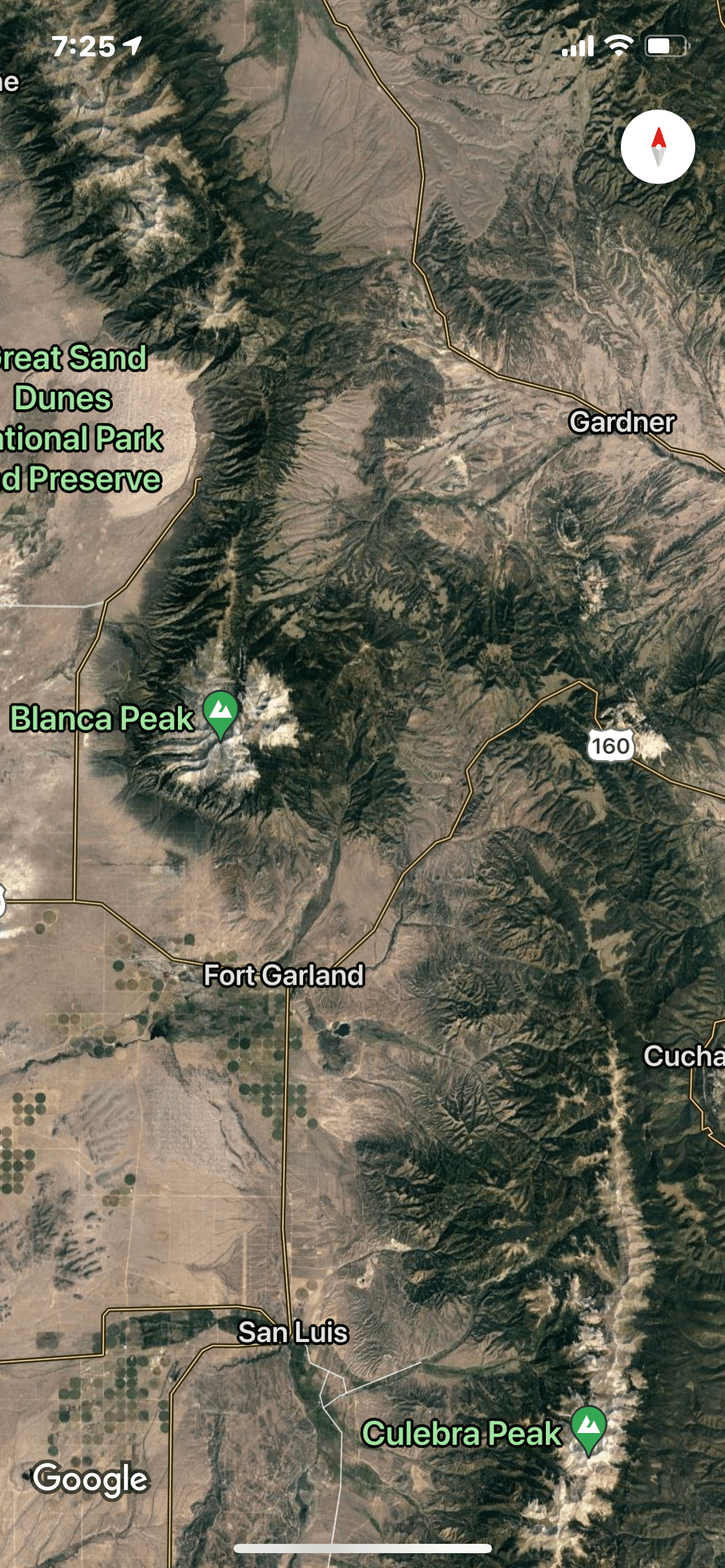
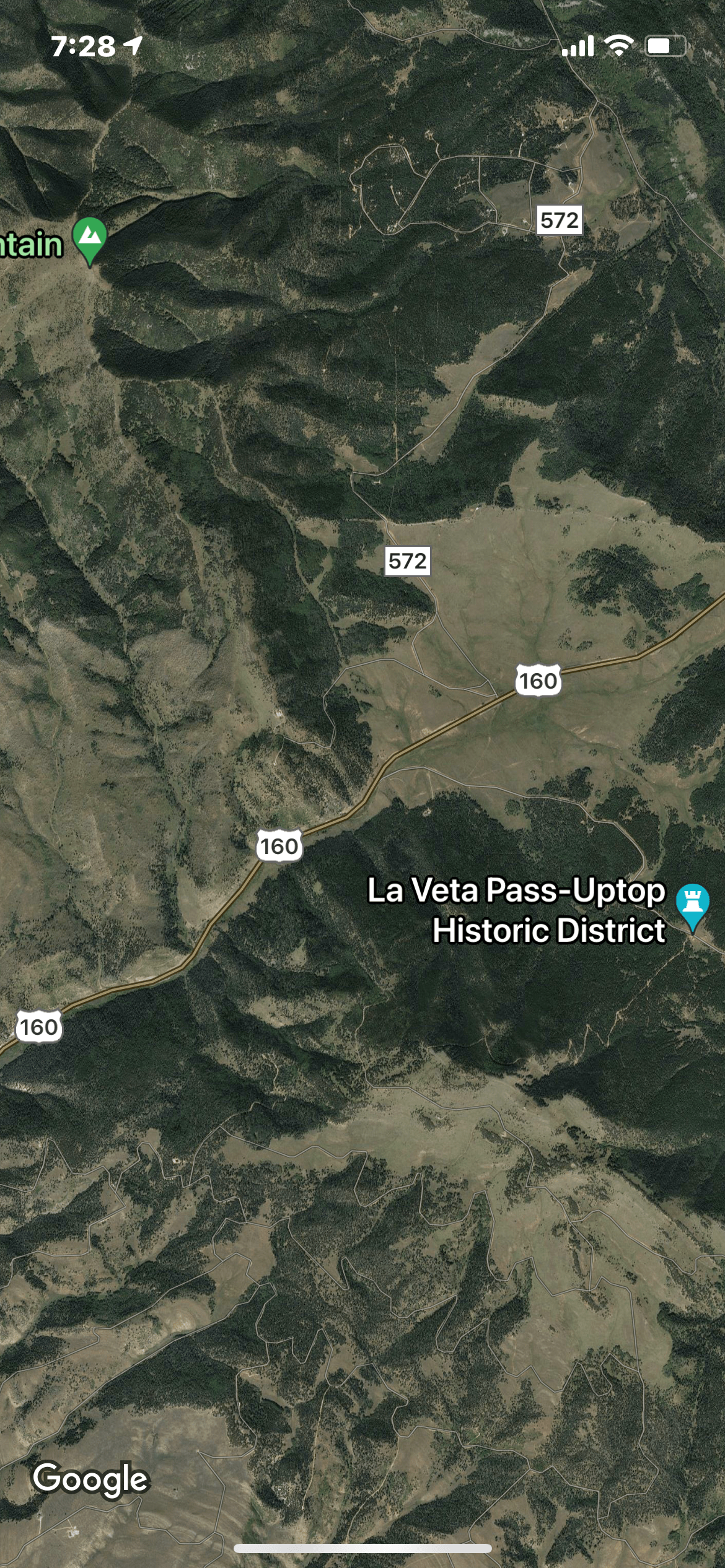
I’m up early the next morning for what will be a two-hour drive east of Alamosa to the headwaters of the Huerfano.  It’s a pleasant scenic route on US 160 through historic Fort Garland to the turn off to the north on Pass Creek Road (Rd572) just before reaching La Veta Pass. 

Blanca Peak And Mt. Lindsey Above Fort Garland
Turn Off On Pass Creek Road (572) Near La Veta Pass

The gravel road starts out fine, the dust settled from a good soaking rain the past few nights.  But then I start to run into stretches where the edges of the road are partially washed out where the rain cascaded through acres of burnt timber and denuded ground from a recent wildfire.  I drive by some heavy equipment trying to repair the damage and am fortunate to squeeze by.  Luckily the road soon improves, and I have to worry about dodging free-ranging cattle and occasional wild turkeys. 

Rd 572 finally turns into Rd 570, and in a few miles when Rd 570 crosses the Huerfano River, I’m not surprised to see it is very low.  This stretch of the river runs through a broad agricultural valley where its waters are diverted for irrigation.  I figure I will find more water higher up.  Rd 570 dead ends into Road 550, a paved highway where I turn left (west) and start up towards the headwaters. 

The Hispanic heritage of the valley and agricultural lands to the east is reflected in the river’s name which means “orphan” in Spanish.  The name comes from an iconic 300-foot high conical butte that stands alone by itself near the river in the prairie eight miles north of Walsenburg.  This massive lone sentinel was an important landmark for early explorers like John Fremont. 

The Orphan Butte

In a few miles Rd 550, a paved highway, transitions into a good gravel road that winds up the valley and then through the narrow confines of the Huerfano State Wildlife Area.  I get my first glimpse of the river and its rushing waters.  It’s heavily overgrown, but has a better flow than down below as I had hoped.

Soon I come to a prominent warning sign notifying me that the next three miles are through private land and that trespassers will be shot and then shot again (or something like that).  Now the road steadily deteriorates with some rocky, bumpy sections.  I shift into 4WD, happy that I have four good AT tires and a high-clearance vehicle.  I pass by a couple of mountain mansions, and then the valley opens up again. It’s hard to keep my eye on the road as the spectacular scene emerges, brilliant golden aspen framing the snow-covered east side of the Sangres. 

But I’m jolted back to reality when I crest a ridge, and the road drops precipitously down the slope. 

Keep An Eye On The Road!!

Road 550 transitions into Upper Huerfano Road 580 that is recommended for 4WD, trails bikes, and ATVs only.  Rd 580 isn’t particularly steep but is pocked with big rocks and an uneven roadbed that require careful navigating.

4-Wheel Drive Vehicle Highly Reommended!

Only in a few places does the road come close to the river, and then it’s mostly overgrown like below.  I decide to keep going to the Lily Lake Trailhead where my map shows the trail intersecting the river in a broad open meadow.  Finally at about 10:45 a.m. I reach the trailhead and am surprised to see four vehicles there, two that are average AWD passenger cars!  I say a quick prayer for the drivers, hoping they have good 6-ply tires.  It’s a long way from any tow truck.

I saunter over to the edge of the parking area, noting the remnants of a SUV running board being used as a fire pit bench. 

Rough Road Casualty

I am greeted by a stupendous view of the river several hundred feet below in a canyon.  The plunge pools look inviting, but only a mountain goat would dare descend from there.  I hatch a plan to walk upstream on the trail then rock hop back down into the canyon.

Mountain Goat Territory

I suit up in my normal high-country fishing uniform—chest waders, Simms Vapor wading/hiking boots, wading staff, and fishing vest loaded to the gills.  I decide to carry only one rod, a lightweight 8.5-foot, four-weight wand rigged with a dry/dropper combo—a #18 Royal Coachman Trude for the surface and a #18 green beadhead caddis larva below. My leader and dropper are 5X.

The trail is in excellent shape thanks to the good work of a corps of volunteers according to a sign I pass.  It ascends gently then descends into the big open valley promised on my map.  The view is spectacular and will distract me for the rest of the afternoon—Blanca Peak and Mt. Lindsey in a magnificent cirque covered with the first snow of the season.  I decide to veer off the trail and follow a game trail that wends through high grass down to the river. 

As I get close to the river, I can see the water is low and crystal clear so I switch into stealth mode.  I creep up to the shoreline, but despite my sneakiness, immediately spook a good-sized brook trout that zooms frantically downstream. 

Ah, the vicissitudes of small stream fishing! My plan is cross the river in a shallow spot that I see 20 yards upstream then hike downstream through the brush on the east side into the canyon where I had spotted those alluring plunge pools–then work my way back up.

My plan works perfectly for about three minutes.  As I wade across in the shallows, I can see a beautiful, deep pool at a bend in the river just above.  Better yet, there is a school of brookies finning in the depths, apparently oblivious to my presence.  I crouch to lower my profile and execute a dainty cast to the head of the pool just below where the current cascades in.  I can see my nymph dropping down to the quarry that awaits.  But the brookies don’t move a centimeter towards either fly.  I try again, with similar results.  Persnickety little devils.  After a half a dozen skillful casts and floats later I stand to get a better look and send the trout into a fleeing vs. feeding frenzy.  Oh well, I rationalize, I will deal with them later when I come back this way.

Then it’s off into the bushes and boulders above the creek to work my way into the canyon.  The game trail I’m following soon runs into a nasty looking loose scree slope forcing me to cross over to the other side. 

Into The Canyon

The streambed rocks are surprisingly slippery, but I execute my best nimble septuagenarian moves to emerge without a dunking.  My sights are set on a tempting pool downstream.  I creep slowly through the brush fishing a couple of little plunge pools on the way, one of which harbors a good-sized brookie who zooms to safety.  When I get to the top of the target pool, I’m disappointed to find it’s very shallow and barren of any fish.  I can see further below where the going gets even rougher, so decide there is plenty of water to work back upstream in the meadow. 

I retrace my steps to below another alluring pool and am immediately captivated by the entrancing view. 

I sit on a warm rock and soak in the grand scene for a few minutes.  This moment is alone worth the trip I think to myself.   The bonus is the four trout I see finning mid-pool in the current, one large one and three smaller.  Then it dawns on me that they are in the pre-spawn amorous courting mode.  I confirm my suspicious by executing several delicate casts which the trout respond to with zero interest.  I decide to switch to a Parachute Adams with a 6X leader and add a #18 Two-Bit Hooker below on a 6X dropper.   Same results.  Clearly amore is trumping appetite. 

Soon I am back to the pool just below where I started in the meadow.  Five brookies are stationed in the depths of the pool.  I kneel craftily and loft a cast above them.  The flies drift perfectly towards the trout, but sadly, like their brethren, they show no interest in my offerings, so I switch flies again.  I add a size #22 black zebra midge to the offerings.  This has no noticeable effect on their obvious case of lockjaw.  If frustration, I stand to size things up, which sends them jetting back and forth upstream and down in the pool in utter terror.

I continue upstream, hoping for better, but the results are the same.  In a half dozen picture-perfect pools, the trout stick their noses up at my offerings while they swim around in romantic bliss.  I take care to stay out of the water when I spot fish over gravel beds just in case some are already spawning.  I spot one beauty that looks to be at least 14-inches, but like females of certain other species she won’t give me the time of day. 

Recalcitrant Brook Trout

Next I try a long perfect looking run along the shoreline upstream that normally would be loaded with fish, but come up empty. 

Toward the top of the meadow, the river splits, and I follow the east fork.  I see a few trout here and there then come to a little beaver pond.  A dozen trout are swimming in the pool created by the spillway, but I get too close, and they go flying downstream by me.  Above the dam the river actually disappears, so I hike back downstream to find the other fork. 

The Orphan Disappears!

It is narrow and winds back west through the meadow and some marshes.  Here and there I spot brookies lying up against the undercut banks, but can’t persuade them to bite. 

It’s about 1:30 p.m. by now and my stomach is growling and patience growing very thin.  I am beginning to resign myself to my first ignominious skunk of the year.  Almost three hours of flailing the water and not a rise or bite let alone a fish.  At least it’s been a scenic ecotour, and I have had the river to myself, nary a boot mark anywhere—just lots of sign of deer and elk!  But wait, what about that good-looking freestone water back down in the state wildlife area I passed through in the morning ?  That could salvage my reputation,

On the short hike back to the trailhead, I begin to plan my redemption.  Without wasting any time shedding my boots and waders, I climb back into the SUV and roll downhill towards the wildlife area, a determined glint in my eyes.  The scenery is again mesmerizing, blazing yellow and orange leaves capturing the afternoon sun, but I keep chugging along. 

More Gorgeous Fall Scenery To Distract From The Angling Task At Hand!!

By 2:30 I’m back at the boundary of the wildlife area and find a nice turnout overlooking the river.  I set up my folding chair and table overlooking a beautiful pool and partake of a hearty lunch and can of RC Cola power drink that helps me regain my mojo. 

Lunch Overlook

Below the turnout, the river bends away from the road and becomes invisible behind the trees and tangle of brush.  I have a hunch that the hidden stretch doesn’t get much pressure, so walk down the road several hundred yards then plunge into the thicket.  I follow a faint path that emerges just below a big boulder where a log has jammed to create a small plunge pool below it. I check the streambed rocks and find them loaded with caddis cases. I also see a few caddis flies flitting about in the air.

I tie back on the Royal Trude and caddis nymph and probe the pool carefully, but the current is much swifter here and not likely to hold a fish.  I navigate around the log and boulder and spy a stretch of water along the opposite bank where the current is slower and the run deeper.  I pop the dry at the top of the run and watch it slide down against the shoreline.  Something flashes at the dry, but misses the fly.  I quickly recast and this time a nice 14-inch brown trout inhales the nymph at the end of the run.  Battle on!  The fish heads for the undercut bank replete with snags, but my rod has enough back bone to turn him.  Soon he’s sliding into my net for a quick photo followed by several deep bows from this appreciative angler and then is released.  The pernicious skunk has been banished!! 

Nice Brownie Banishes Skunk!

I continue working upstream, concentrating on every pocket or run of quieter water where the brownies are hiding out to avoid the strong current.  I manage a half-dozen more before I get to the beautiful pool at the turnout. 

There I fool one more and decide since it’s 4:30 and I have a two-hour drive ahead of me, I’d better hit the road. 

Beautiful Brownie Sporting Fall Colors Caps The Comeback

Good thing I did.  When I get back down to the turnoff for the Pass Creek road (570), a big sign announces the road has been temporarily closed, no doubt because of the washouts.  That means Iwill have the take the long way back around east through the hamlet of Gardner then south on CO 69 with a turn on Rd 520 at Badito, a good gravel road that cuts back west to emerge near La Veta Pass.  Fortunately the route, while a bit longer, is easy driving with more fine scenery.  I make it back to the campground in time for a nice glass of Pinot Grigio, while enjoying the warmth of the setting sun and studying the map for my outing tomorrow on Medano Creek.  Cutthroats beware! And next summer I’ll be back on the Huerfano River giving chase those brookies before they spawn!