Colorado’s San Luis Valley:  Stronghold Of The Rare Rio Grande Cutthroat

July 2024

For Day 2 of the quest for rare Rio Grande Cutthroats in Colorado’s San Luis Valley,see http://hooknfly.com/2024/08/28/the-search-for-the-elusive-san-luis-valley-rio -grande-cutthroats-continues/

For a sampling of another of my Rio Grande Cutthroat adventures in the San Luis Valley, see http://hooknfly.com/2021/09/14/prospecting-for-trout-on-the-fab-five-forks-of-the-conejos-river-2-the-adams-fork/

The comeback story of the endangered Rio Grande Cutthroat is an encouraging one.  Once found in waters throughout the Rio Grande River drainage in southern Colorado and northern New Mexico and even in the Pecos River in Texas, its range had shrunk to less than ten percent of its historic area due to a variety of causes like habitat destruction and introduction of invasive species like rainbow and brook trout.  But a cooperative effort by government agencies like the federal Fish and Wildlife Service and Colorado Parks and Wildlife as well as conservation groups such as Trout Unlimited has brought this stunningly beautiful fish back from the brink. 

One of the pure delights of the angling adventures of this aging septuagenarian fly fisher has been to sample several of the streams in the San Luis Valley like Medano Creek in the Great Sand Dunes National Preserve and the Adams and Lake Fork of the Conejos River that provide safe harbor for this striking, rare fish.  I am infatuated with its gorgeous colors and as much by the wild country where the Rio Grande Cutts survive and thrive, streams that you have to work to get to and offer quiet solitude upon arrival. 

Rio Grande Cutthrout From A Remote Creek In The San Luis Valley

Given its status, I am extra cautious in following all applicable state regulations (e.g., flies only, catch and release) and handle each catch with extreme care before returning them to the water.

Recently, in doing some on-line research about the current status of recovery efforts, I stumbled on a couple of interesting reports from 2008 and 2016 entitled “The Range-Wide Status of Rio Grande Cutthroat Trout.”  The 100-page plus studies, put together by a team of state and federal wildlife and land management agencies and the Jicarilla Apache Tribe, identified a host of smaller, little known creeks and streams that were documented as having viable Rio Grande Cutthroat populations along with summaries of efforts to protect and improve habitat for the trout.  Illustrative maps depicted the stretches of these waters that held viable Rio Grande Cutthroat populations. 

Three caught my eye in Saguache County, Colorado, that mark the northern most range of the Rio Grande Cutthroat—Jacks, Cross, and East Middle Creeks, lying just south of the Continental Divide and the range of the Greenback Cutthroats over the mountains in the Arkansas River drainage. Better yet, they are only an hour’s drive from my cabin near Salida, Colorado.

From The Reports: CP030 and CP 004 Mark Jack, Cross, and East Middle Creek In Saguache County, CO

All three are in the drainage of Saguache Creek, on of my favorite trout streams. The reports stated that there were decent populations of the fish—from 150 to 400/mile–in each water with fair but suitable habitat.  In one—East Middle Creek—the reports noted the existence of a stream barrier high in the upper sections of the creek such as waterfall or a small dam/drop structure to protect cutthroat populations from intrusion by invasive species like brook trout from below.  These creeks are located close together about a dozen miles or so west of the small town of Saguache, Colorado.  Who could resist exploring?  Do those streams still hold the rare Rio Grande Cutthroats?

Day 1:  Exploring Cross, Jacks, and Middle Creeks

In early July I decide to do a little reconnoitering so headed south from my cabin early one morning towards Saguache on US Highway 284 over Poncha Pass then west on Colorado 114 until the turnoff to the north on Saguache County Road EE 38.  I opt first to take a look at Jacks Creek and its tributary Cross Creek to the northwest before heading up the 10-mile stretch on CR 38FF to the Middle Creek Trailhead from where I could hike up to the confluence with East Middle Creek. 

I gun up the good gravel road pushing the speed limit of 40 miles an hour, anxious to see these two Rio Grande Cutthroat bastions.  I slow as I cross over Cross Creek—beautiful and clear and definitely with enough water to float some cutties.  Just ahead to the west I spy a faint two-track that parallels Cross Creek to the north and turn off to explore.  Around a bend I go a short distance only to be met by a stout barbed wire fence announcing it is private property.  Ok, maybe Jacks Creek will offer more. (I’ll later learn from Colorado Parks and Wildlife staff that the Rio Grande Cutthroats are doing well in Cross Creek.)

I retrace my route back to the county road and continue upstream paralleling Jacks Creek which is several hundred yards south from the road at this point.  As I continue west, I am confused a bit by what looks to be a lot of wood cuttings/piles in the valley.  In another mile or so the creek swings close to the road so I stop and jump out to explore.  The creek is so tiny as to be invisible.  Then it dawns on me those wood piles are trees that have been washed down the valley by a tremendous flood in the last year or two.  In one spot a tangle to branches and trunks is jammed up over 10 feet high against a stand of big aspen trees on what had been the banks of the creek.  The creek bed itself is scoured and completely washed out in long stretches, with the sad remains only a few feet across and a few inches deep.  I don’t see a fish anywhere.

Jacks Creek Wipeout

I continue upstream until I come to a fork in the road.  Here a see a herd of cattle tromping in the creek, adding to the habitat destruction. 

Uncontrolled Grazing By Cattle Has Added To The Jacks Creek Carnage

Soon I cross over Jacks Creek and again the damage is evident.  I do see a couple of minnow-sized fish darting into one-foot-deep hole, but again as a viable trout habitat it has been destroyed.  I can only shake my head thinking of the carnage wreaked on the cutthroats by that torrent plus the cattle. This devastation on Jacks Creek underscores the importance of the efforts to protect Rio Grande Cutthroat habitat. Floods, wildfires, overgrazing, and development can all snuff the life out of a stream in no time flat.

Back on the main road I drive further northwest until I came to a gate and private property sign blocking the route.  Whether anything of Jacks Creek above survives I can’t tell, but I am not optimistic.  I turn and head back towards the junction with the road to East Middle Creek, CR38FF, hoping for the best there.

The route to the Middle Creek trailhead (where the mile hike to the confluence with East Middle Creek begins) is about 10 miles over a good gravel road.  The first five miles are on public land, but the last five snake through private property starting with the historic Middle Creek Ranch.  Here and there ranch buildings and corrals can be seen, then views old cabins and new second homes pop up along the drive.  When I arrive at the trailhead, I am surprised to find it empty on a holiday weekend and even more so with the relatively posh flat and shady camp site with a picnic table and deluxe pit restroom facilities nearby. 

I ease out of my SUV and to size things up walk over to the steep slope that plunges down to Middle Creek to the west.  I immediately spy some big beaver ponds below and good-looking stretches of stream water that I can’t resist. 

Middle Creek Beaver Ponds Beckon

I decide to fish my way up to East Middle Creek and on the way see if any cutthroats are hiding in Middle Creek.  The sky is clear and sun is bright but still a cool 60 degrees at 9:30 as I suit up in my chest waders.  I will carry two rods, a 7.5 foot, 3# wand with just a single dry fly, a #16 Royal Trude, and an 8.5 foot rod rigged with a #16 Royal Stimulator and a #16 green caddis larva dropper of my own creation—the famous Dirk’s Delight. 

Soon I am heading north up the good trail that wends through a ponderosa pine forest and offers occasional views of Middle Creek and beaver ponds below. 

I walk ten minutes or so upstream then cut down the slope when I see openings in the dense willow thicket along the stream and catch glimpses of open stretches and beaver ponds on the west side of the valley.  After some vigorous bushwhacking I break through into more open territory.  When I get to the creek I wade in stealthily and overturn a few streambed rocks to see what the trout might be dining on.  I find some caddis cases and a few mayfly nymphs, but not the abundant food supply I expected.   I take the water temperature, which registers a cold 42 degrees. 

Is a lack of food and icy water a bad sign?? But any misgivings are immediately dismissed in the first open run as a nice fish smacks the Royal Trude.  He cartwheels out of the water then heads upstream.  The small rod bends perilously but is up to the fight and soon a chunky 10-inch brown trout slides into my net.  Not a bad start! 

Hungry Brown Trout Starts The Fun!

From there the action is steady with a few fish feasting on the caddis, but most on top.  And after catching one more brownie a tad bigger than the first, the brook trout take over.  Most go 8-10 inches, and all are healthy and frisky.  Interestingly, the large majority of the fish are initially finning in shallow runs, not the more alluring deeper bend pools in the creek where I would usually expect to find them.  I figure the fish must be warming up with a little sunbathing. 

Soon I come to a series of beaver ponds and see a few rises here and there, maybe bigger fish I’m thinking.  I cautiously work up on the beaver dams keeping a low profile and loft a cast into a foamy flow skirting some deeper water in the pond.  All of a sudden, the dry disappears as a brookie inhales the caddis.  After a short tussle, I land a six-inch leviathan! 

Beaver Pond Leviathan

Several more quickly follow.  That will be the scene in most of the ponds I sample upstream—only a few fish succumb to the dry and most are smaller than in the creek. Go figure.  

As the air temperature rises and I work upstream, the action gets hotter, with every open stretch producing three or four brookies, a couple pushing 12 inches.  No cutts and only one more brownie materialize.  Often, I am able to cast to fish finning casually in the crystal-clear current above, and it’s great fun to watch them size up the faux insect then quietly rise and inhale it. 

Other times the brookies will jet out from an undercut bank to nail the dry midstream in a splashy show.  Some of the best spots turn out to be the plunge pools just below the beaver dams.  In one I hook a muscular, colorful brookie that looked to be the biggest of the day–over 12 inches–but I execute a long-distance release before confirmation.  Fortunately, he is followed by a half dozen hungry buddies of his that don’t escape.

Plunge Pools Below Beaver Dams Are Hotspots

By now the sun is high and my stomach is growling.  Visions of an RC Cola are dancing in my head.   I think about heading back to that picnic table but decide to hike up just a bit further to the confluence with East Middle Creek, the supposed lair of the Rio Grand Cutthroats.  I snake up valley for a few minutes then the trail turns east and soon intersects the stream.  Here I find a pretty little pool with a bend that reeks fish!  I kneel and carefully flick the Royal Stimi into the run above the pool.  The fly swirls downstream and is quickly intercepted by a lightning-bolt-quick fish that the flees back to the depths.  I think it looks like a cutt, lighter on the back than a brookie.  My heart pounds!! But my old eyes have deceived me.  It turns out to be another spunky brookie, but I have to laugh.

Cutthroat Imposter Closes Out The Day

 I remember now that the map of the barrier installed by the wildlife folk to stop the brook trout from intruding on the cutthroat habitat showed it being a mile or more upstream on East Middle Creek.  It’s been a blast catching the spunky brookies on Middl Creek, but guess I will have to come back and work harder to find the prized fish!  (Day Two Article Coming Soon!)

That cinches the deal for a stroll back to the picnic table, lunch, and my cold RC.   Along the way I enjoy a profusion of wildflowers—winsome wild roses, splashy skyrockets, bold Black-Eyed Susans, and a Rocky Mountain Bee Plant complete with a Checkered While Sulphur Butterfly.  The veritable icing on the cake of a lovely day on the water. 

Looking Back On 2022: The Best, The Befuddling, And The Bungled

January 2023

January 2022 dawned sunny and bright, with me salting margaritas down in the Everglades instead of sidewalks in Colorado and, better yet, wrestling snook instead of shoveling snow!  Covid was finally in the rearview mirror for the most part and promises for a bountiful piscatorial year are looking good.  So how did it turn out?  Here’s a look back at the best of 2022 and some bungled episodes as well.

It’s hard to believe that I hadn’t fished in the Everglades–or anywhere in Florida for that matter like the Keys—in the winter for almost two years!  Despite that hiatus and fewer articles about fishing in the Sunshine State  being posted in 2022, I was grateful my readers stuck with me and that the number of visitors and views stayed steady at the peak levels established in 2020.  Many thanks!

Fishing Buddies And Family

As I age (slowly and gracefully), the connections angling brings with fishing buddies and family become ever more important and treasured.  I had some fun and productive outings in Florida with Jim Cannon (former owner of the renowned Blue Quill Anglers in Colorado), my Colorado neighbor Charlie Cain, Esq., Steve Keeble, Robert Wayne, Esq. (who lives in Naples, FL), and my old college roomie Morris Douglas Martin. 

We had a lot of laughs together while we boated a lot of fish, and better yet, I learned some new tricks and tips from them. You ought to see Cannon and Keeble fly cast from a kayak—impressive! In Colorado during the summer the fish parade continued with good friends Bob Wayne and Steve Spanger as we chased trout in the Colorado wilds. I also enjoyed fishing with new friends Tom Palka, who writes the newsletter for our local Trout Unlimited Chapter, and Kim LeTourneau, an accomplished guide for my local fly shop Ark Anglers who also covers fishing for the Mountain Mail newspaper.

Whether in Florida or in the Rockies, they all had the chutzpah to outfish me!!

In March my son Matthew came down for a week to soak some rays and relax.  The day we spent in the Everglades backcountry together warmed this father’s heart.  It was a smorgasbord of feisty fish—snook, sea trout, ladies, jacks, and even a gafftopsail catfish that put up a great fight before sliming us when we wrestled with him to remove the hook.  The video says it all.

This proud papa was thrilled when Florida Sportsman published a short article in the fall that I wrote about fishing the Tamiami Trail country around Everglades City.  It featured a couple of great photos of Matthew and yours truly with some nice snook.

Come summer back in Colorado my little sweetheart granddaughter Aly showed off her casting skills while catching some nice rainbows in a high mountain lake along with her Daddy Matthew.  The mile walk in and out to the lake was a great nature hike featuring beautiful wildflowers and a close encounter with a big buck mule deer.

Most Popular Posts And Published Articles

The continuing popularity of a series of five blog posts I penned in 2020 entitled “The Best Fishing Books Of All Time” is remarkable.  It garnered over 3,000 views this year and on Google searches for ‘best fishing books’ has become the most popular link on that subject, even outpacing Amazon’s sponsored ads.  Take that Zuckerberg! 

What is really gratifying is seeing that level of interest in angling books, from serious literature to technical how-to works, remains high in this age of videos and on-line reading. Here is a link of you want to take a look: http://hooknfly.com/2020/08/01/the-best-fishing-books-of-all-time/

Another surprise was that the most popular post overall was one entitled “Taking A Hike In The Everglades…And Stumbling On A Hidden Bass Lake.”  Focused mainly on hiking in the Fakahatchee Strand Preserve State Park near Everglades City, it garnered about 4,500 views.  Here is a link to the post: http://hooknfly.com/2022/04/16/taking-a-hike-in-the-everglades-and-stumbling-on-a-hidden-bass-lake/

As a result, I decided to branch out a bit and write about hiking around my winter home base as well as fishing.  My next effort, the first in a series about hiking the main trails in the park, appeared in December.  Click on the link to read the post: http://hooknfly.com/2022/11/30/hiking-the-fab-four-trails-of-the-fakahatachee-strand-preserve-state-park-1-the-west-main/

The most read angling posts, with almost 4,000 views, were again a quartet about finding and fishing for rare Rio Grande Cutthroat trout in southern Colorado. For my latest foray on the fab forks of the Conejos with my photographer Jody Bol, see: http://hooknfly.com/2022/08/15/conejos-river-capers/

The post on kayak and wade fishing around Bahia Honda State Park in the Florida Keys again took the top spot for saltwater. See for the latest post on Bahia Honda: http://hooknfly.com/2019/06/08/bahia-honda-state-park-post-irma/

Now that I am back in Florida for the winter and spring, you can bet I will be getting out on the water and sharing new trips and tales.  I have already made plans for a two-week fishing trip to the Florida Keys in late April.

When the weather was uncooperative or the winds howling, I hunkered down and continued to write articles for American Fly Fishing and Florida Sportsman.  The article about fishing in South Park, Colorado, was titled “Mission Impossible:  Searching For Fish And Solitude.”

Fishing The Hidden Waters Of South Park: Under The Radar

It was the lead featured piece in the July issue of American Fly Fishing and focused on finding hidden and remote creeks in the famous valley near Denver, home of the South Platte River, Dream Stream, and other popular waters and lakes that sometimes feature combat fishing.  http://hooknfly.com/2022/07/21/south-park-under-the-radar/

Florida Sportsman ran two of my articles in 2022.  The first was a fun one in which I discussed the very controversial gar conversion therapy.  Under the heading “In Defense Of The Antediluvian Gar,”  I stood up for this hard-fighting, oft-underestimated fish while documenting the successful conversion of a tarpon aficionado to gar fishing in the Everglades.  http://hooknfly.com/2022/11/19/gar-conversion-therapy/

Bob Wayne Undergoing Gar Conversion Therapy

The second piece, noted above, recounted the variety of angling opportunities along the Tamiami Trail between Naples and Miami. 

Most Rewarding Trips

One of my favorite streams close to home is a remote twenty mile stretch of Grape Creek between Westcliffe and Canon City, Colorado.  Over the past decade I have had many memorable trips into the canyon where the creek runs, chasing plentiful and hungry browns and rainbows.  But disaster struck a couple of years ago when two giant flash floods only a few weeks apart scoured the canyon and practically wiped out all insect life in the upper reaches.  Without food, the fish abandoned the stretches I frequented.  After a couple of fruitless trips, I decided to wait a couple of years to see if Grape Creek would recover.  Thankfully, it did, and I was rewarded with my biggest trout of the year—a 19-inch brown—during a July trip. 

How Now Brown Trout

A bonus was that some healthy foot-long rainbow trout had apparently migrated down from the tailwaters of DeWeese Reservoir and helped provide non-stop action. http://hooknfly.com/2022/08/05/grape-creek-comeback/

Another trip up the headwaters of the Conejos River high in the mountains of southern Colorado provided some unexpected and mostly pleasant surprises.  Exploring the five forks of the Conejos River is on my bucket list.  I have had terrific days on the Lake and Adams Fork chasing beautiful, rare Rio Grande Cutthroats. This year I had my eye on fishing the Middle and North Forks, both of which can be reached as they branch off the Upper Conejos River about two miles above Platoro Reservoir.  Being remote streams, I expected a plethora of feisty fish including cutthroats that I had found on the nearby Adams Fork.  But after pounding the lower reaches of each for an hour, I was beginning to have my doubts.  I decided to try one last pool on the Middle Fork that looked particularly inviting and struck a bonanza.  On my first cast I watched transfixed as a huge brown trout rose slowly from the depths and inhaled my fly.  Then it was off to the races, trying to run down the rascal who had managed to fly by me and head downstream into a brush pile.  Somehow I managed to extricate that big brownie and followed that miracle by catching his large mate on the very next cast.  

Given that result, I decided I’d better retrace my steps and go up higher on the North Fork. However, I only managed a few small browns on that stretch before it disappeared into a ravine above the valley. Needless to say, I was perplexed. Why so few fish on the Middle and North Forks, albeit big ones on the Middle Fork? The revelation would come as I fished back down on the Upper Conejos below the fork to the trailhead where my SUV was parked. Here on a mile stretch I caught a passel of brown trout, most over 15-inches. The answer?? As confirmed by a local angler at the general store in Platoro, the big fish migrate out of Platoro Reservoir into the Upper Conejos and grow fat and sassy eating all the little guys. Of course, now I must return in 2023 to confirm this theory!

Prospecting For Trout On The Fab Forks Of The Conejos River:  #3 and #4—The Middle And North Forks

The Scary And Amusing, The Sad And The Confusing

In 2022 I thankfully avoided any scary incidents with moose, mountain lions, sharks and the like that I have had in the past.  But the year’s most blood-curdling incident was self-inflicted, with an alligator playing the villain.  Normally the many gators I encounter during my trips into the Everglades backcountry bolt at the first sign of my kayak or Gheenoe.  Once in a great while a young gator will venture too close when I am catching lots of fish, attracted out of curiosity to all the jumping and splashing.  Usually smacking a paddle on the water sends him scurrying for cover.  Alligators that are aggressive down here tend to be ones fed by humans, mainly tourists.

My most memorable gator encounter for 2022 took place on a sunny day in March when I took my college buddy Morris on a trip along the historic Loop Road near Everglades City. I figured we would take a break from the serious day-long fishing trips into the backcountry and find some easier targets in the bass and cichlids in the canal along the gravel road as it winds its way through the swamp. The alligators were everywhere. Being teenage boys at heart, we couldn’t resist tossing one of the small fish we caught to a big gator lounging in the slough near a big culvert.

The fish bounced a few feet down the slope but didn’t make it to the water.  All of a sudden, the docile reptile came rocketing out of the water at warp speed to gobble down the fish.  His momentum carried him up the incline almost onto the road.  It must have been comical to watch two old coots scrambling back towards their SUV in utter terror, but thankfully no one was there to record the incident.  Lesson relearned:  DO NOT FEED THE GATORS!! 

The biggest bummer of the year followed in the wake of Hurricane Ian that struck southwest Florida in late September.  I had dutifully rigged my Gheenoe, a motorized canoe, under my house on Chokoloskee Island near Everglades City as advised by old salts down here.  Following that advice, my boat had survived in good condition a five-foot flood tide that swept over Chokoloskee during Hurricane Irma in 2017.  Unfortunately, either because I didn’t insert the bilge plug or the ropes anchoring the boat and trailer to the building  pillars were too tight to allow them to float, saltwater surged a couple of feet deep into the boat and destroyed the electrical system. 

When I returned to Florida in early November, I took the boat to my local marina in Naples and got the bad news.  A month and $5,000 later everything was put back in order, and fortunately the damage was mostly covered by my boat insurance.  The big relief was that the motor was undamaged.  Whew! 

In the category of confusing was an exploratory trip to find brook trout and maybe some cutthroats reputedly swimming in a remote creek in the Colorado high country south of Del Norte.  One of the best angling guidebooks for exploring secluded waters around my neck of the woods in Colorado is ­­­49 Trout Streams of Southern Colorado by Williams and McPhail.  They sang the praises of Torsido Creek, a tributary of La Jara Creek south of Del Norte, Colorado.  I had fished La Jara Creek below La Jara Reservoir a number of times with great success, so was anxious to explore the upper La Jara and Torsido Creek.  After a long and bone-jarring ride over a narrow, bumpy gravel road that hadn’t seen a grader for some time, I made it to the lake and drove to its upper reaches where La Jara Creek flows in.  Trouble was, the creek was next to invisible in the expansive meadow above the reservoir, and it wasn’t clear where it was joined by Torsido Creek.  To exacerbate matters, I had run off and left my detailed maps of the area in my travel trailer back in Del Norte and the GPS on my cell phone wasn’t working.  No worries I thought.  Torsido had to be out there somewhere.  But after wandering about for almost two hours, marching through muck, dodging a big bull, and clambering over a couple of barbwire fences in my waders, I flew the white flag and turned tail back to my SUV.  Fortunately, on the way back I had to cross upper La Jara Creek, and serendipitously where I did some trout were rising.  That was the start of an epic afternoon of catching not only some fat, beautiful brook trout, but also some muscular, truculent tiger trout that apparently are stocked in the reservoir and run up the creek to eat.  http://hooknfly.com/2022/10/24/taming-the-tigers-of-torsido-and-upper-la-jara-creek-near-del-norte-co/

Not until I got back to camp did I discover the confluence with Torsido Creek is hidden in the gap in a ridge about a quarter mile from where I stopped fishing that day.  Darn, guess I will have to schedule a return engagement in 2023!

Persistence Pays Off

Like many things in life, persistence pays off in angling.  Two years ago I experienced a particularly humbling experience at the hands of brook trout on the upper reaches of the Huerfano (Wear-fano) River in the wilds of the Sangre de Cristo Mountains of southern Colorado.  Fishing in one of the most scenic valleys I’ve ever set foot in, I was sure this was going to be a banner day when in the first pool I came to I spied nice brook trout finning in the depths.  However, three hours and 20 expletives later, I flew the white flag.  I had scored nary a bite the whole time as the spawning brookies made clear amore was more important than eating.  With the air redolent of skunk, I slunk back to my SUV.  Now fast forward to the summer of 2022.  I decided to return to the scene of the skunking for a measure of revenge.  But this time things looked even worse when I hit the water after navigating the rough road to the Lily Lake trailhead.  It was mid-summer, and the brook trout weren’t spawning.  Indeed, none of the alluring pools seemed to hold any fish.  So after two hours of flailing the water, I started back to the SUV, tail between my legs.  Luckily, I had to cross a very narrow, but fast-flowing tributary of the Huerfano in the meadow to the west of the river.  As I did, I happened to see what appeared to be a rise at a bend below me in the creek.  What the heck, I thought, and threw my fly downstream.  It floated a few feet, then was sucked in by what turned out to be a chunky brook trout.  So that’s where the little devils were hiding.  That was the first of more than a dozen nice brookies from what I have dubbed the West Fork of the Huerfano.  You won’t see it named on a map, but believe me, it and the fish are there.  Indeed, persistence pays off.

And speaking of stick-to-it-of-ness, a case of avian persistence opened my eyes.  I am a confirmed amateur birdwatcher, especially at my mountain cabin in Colorado where a steady cavalcade of western tanagers, evening grosbeaks, hummingbirds, and many others at my birdfeeders provides a steady stream of pleasure.  But those bird feeders have also attracted pinon jays and Clark’s Nutcrackers, drawing me into a never-ending battle with these noisy, wily, and voracious, albeit handsome, birds.  Imagine their fright when I come storming out on the front porch hurling expletives till the Colorado sky turns even bluer.  I did some research on-line to see if there were any better strategies to deal with these smart, raucous marauders, and in the process learned that because of habitat loss, notably destruction of pinyon trees they rely on for food, and climate change, these iconic western birds are declining precipitously. 

Indeed, one report estimated the pinyon jays have declined 85% of the past 50 years and that there are only 700,000 left worldwide (versus 8 billion humans)! All of this made me realize I need to focus closer to home on saving the world. That will mean nurturing the pinyon trees already growing on my land and planting new ones. It will also mean biting my tongue when the raiders come to my bird feeders and dutifully hanging another suet cake when they take their leave. My thanks to them for their persistence and opening my eyes.

On The Horizon: Looking Forward to 2023

So what’s on the agenda for 2022? First and foremost is to get back down to Florida to get my saltwater chops back.  I arrived in Everglades City a couple of months ago, got the kayak and Gheenoe ready to go, and started executing that plan.  A 24-inch snook on my first yak outing led the fish parade not to mention a 33-inch leviathan out in my Gheenoe with buddy Steve Keeble in the New Year!

More stories and tall tales to come from the Everglades backcountry!  I also want to explore some of the remote brackish canals east of Naples, Florida, that are impossible to access except with a kayak.  Big snook are rumored to hide out there along with the gators! Fishing some remote islands in the Florida Keys is also on the agenda.

On the writing front, my article on fishing the Fakahatchee Strand Preserve State Park in the Everglades is scheduled for publication soon in an issue of Florida Sportsman to be followed by a piece on the top ten tackle, gear, and techniques tips for kayak anglers in the Everglades.  On the trout side, American Fly Fishing will carry an article this spring about my adventures this past summer on La Garita and Carnero Ceeks, two remote high-country streams in Colorado, to be followed later in the year by shorter pieces on upper La Jara and Tarryall Creeks, also in Colorado.

In the keep it under your hat category, I am also in initial negotiations with Kevin Kostner for a new TV series now that it looks as if he’s dropping out of “Yellowstone.” It will tentatively be called “Tales of a Zombie Fisherman” and will be based on my 2022 shenanigants on Halloween night when I went trick-or-treating with my favorite little witch Aly. Stay tuned!!

Of course, I will chase some trout with my sweetheart Aly and find Torsido Creek at long last.

Taming The Tigers Of Torsido and Upper La Jara Creeks (near Del Norte, CO)

Late September 2022

For my earlier articles on fishing La Jara Creek below La Jara Reservoir, see: http://hooknfly.com/2018/01/10/colorado-dreamin-on-such-a-winters-day-la-jara-creek-near-alamosa-co/ and https://hooknfly.com/wp-content/uploads/2018/02/la-jara-creek-article-pdf.pdf

It’s the last day of my annual fall fishing fling in southern Colorado, and I’m on the road early at 7:30 a.m. from the Woods and River RV Park in Del Norte where I have been staying for the past week in my mobile fishing camp. 

My aim is to explore Torsido and La Jara Creeks above La Jara Reservoir. I have had some terrific days fishing La Jara Creek below the dam, but this is my first venture above in the expansive treeless meadow. My research tells me both tiny creeks offer some fun fishing for small, colorful brookies and maybe even some cutthroats.

It’s about a two-hour drive from Del Norte to the lake, the last 20-mile stretch on a scenic but bumpy gravel road (Fdr240/259) that clearly hasn’t seen a grader blade since the end of our long monsoon season.  The aspen on this route are at their best, so I just slow down and enjoy the brilliant display.


As I crest the hill, La Jara Reservoir greets me with a mirror-smooth surface reflecting the surrounding trees and foothills. 

La Jara Reservoir In Fall Colors

I continue north on the gravel road that flanks the lake and then above where I reconnoiter for the best jumping off point.  The wide meadow hides any sight of either stream until I’m a mile or so above the lake where I catch a glance of La Jara Creek as it twists and turns, just a stone’s throw from the road.  But I’m puzzled as I can’t see Torsido Creek anywhere, and up another mile La Jara Creek fizzles out completely at a big bend in the road.  So I turn around and drive back down towards the reservoir, and finally decide about a mile above the lake to go exploring in the meadow, parking by the side of the road not far from a long hillock a couple of hundred yards to the east.  My hunch is that Torsido flows in La Jara Creek somewhere on the other side of that hill out in the meadow.  But it’s hard to gauge from the maps I have as the reservoir is low, exposing a lot of ground that’s usually underwater. 

I suit up in my lightweight chest waders and carry my 4# wand rigged with a #18 Royal Trude to imitate the little hoppers that are still flitting about teamed with a #18 sparkle caddis larva dropper.  I head south and, in a few minutes, cross La Jara Creek. 

La Jara Creek

This is going to be challenging I think upon spying the tiny dimensions of the stream flanked by tall grass that will make casting challenging.  Not only that, the shoreline in most places appears to have been the scene of a cow dance party, stomped into mush by the big bovine I can see in the distance.  Did I mention the long in-stream strands of vegetation that promise to snag any fly beneath the surface?  The good news is that the flow is strong and water cold, plus it’s a beautiful sunny day.  Perfect for an easy ramble in the meadow. 

I soon come to a lovely stand of grass with feathery purple spikes swaying gently in the light wind.  I check with my favorite phone app, Picture This, and learn it’s called wild or foxtail barley. 

The app notes that it is an easy plant to grow, suited perfectly for brown thumbs!  As I admire the scene, something white catches my eye in the distance.  I focus and see that it’s a big herd of pronghorn antelope lolling around at the upper end of the meadow.  Then something spooks them, and they take off running lickety split. 

Later I will cross paths with a big coyote which may explain their flight. It’s always a good sign to see some antelope when exploring a new water—usually means there aren’t many people around.

I continue south, aiming towards a big jumble of rocks surrounded by grazing cattle in the middle of the meadow not far from the lake.  I hope to get up higher for a better view and maybe see Torsido Creek.

I use my farm boy mooing talent to scatter the dumbfounded bovine, except for the big bull who just glares  at me.  I hustle past him and scale the big rocks, a safe haven.  They look strangely out of place in the serene meadow, seemingly plunked down randomly.  I scan 360 degrees but the errant creek is nowhere to be seen.  I think maybe it’s hidden in one of those ravines, hidden among the aspen, so I continue the trek.

To reach the foothills, I end up sloshing through some mucky marshland, then have to navigate a barbed wire fence.  On reaching dry ground, I head east to check out one ravine, but only find a trickle there.  Perplexed, I reverse course and check out another gulch. 

Same story, including another stout barbed wire fence to surmount.  Then as I crest another hill, a big coyote with a raggedy coat flashes by me, only 20 feet away.  No wonder those pronghorns were skittish. 

With no Torsido in sight, I decide to circle back to towards the road, have lunch that I stowed by La Jara Creek on the way in, and focus on fishing that water.  It’s almost 12:30 p.m. when I reach the hillock close to La Jara Creek, having completed a fruitless three-mile circuit around the meadow.  Thankfully, my magic RC Cola elixir banishes the depression and desperation that were starting to grab hold of me.

By 1 p.m. I’m ready to go again.  I approach the stream cautiously and immediately spy a trout rising casually upstream.  Casting is tricky if I stay too far back or kneel, courtesy of the tall grass and reeds along the shoreline.  But if I get too close, I risk spooking the fish as well as having to deal with the mushy soup the cattle stomping has created.  Against all odds, I throw a decent cast, and the fish inhales the dry without any hesitation.  To my surprise, it’s a small tiger trout, a sterile hybrid of a male brook and a female brown trout that have been stocked in the lake. 

Surprise Tiger Trout

They must be moving up the creeks in search of food, maybe snacking on the brook trout reputed to be here.  Some anglers turn their noses up at tigers, but I am not complaining after wandering in the proverbial wilderness all morning. 

I continue upstream and get several more small tigers, miss a good one in a big bend pool, then spook several more. The going is tough trying to work standing back from the shoreline so I defy conventional wisdom and start wading right up the middle of the creek that fortunately has a fairly firm bottom. I also dispense with the nymph which hasn’t produced anything except a lot of slimy moss to clean off after most casts. Those two moves are the tickets. By now the sun has warmed the creek, and trout are rising steadily as I work upstream. I have a ball casting for rising tigers and start to pick up some brilliantly colored brook trout as well.

They are modest in size—ranging from 6-to 12-inches–but scrappy.  Who can complain with a couple of dozen caught and released.

Then I get a wakeup call.  Just below a big bend in the creek, a large blue dragonfly zooms upstream a couple of feet above the water, zigzagging this way and that.  All of a sudden, a big trout rockets into the air, just barely missing snagging the insect.  How it could have seen that dragonfly scooting by while underwater let alone react quickly enough to almost dine on it is beyond me. Probably not much chance he’ll surface again, but I decide to wait a minute to let the pool calm down, then place my dry just above where he was hiding along the shoreline.  No sooner than the Trude alights and the mini-brute gulps it down in a showy rise.  I set the hook, and the fish explodes in the air, then heads upstream.  My rod bends double as I put pressure on to stop the run.  It’s nip and tuck for a minute or so, but finally I tame the tiger and slid him into the net.  He’s a muscular beauty, pushing 14-inches!

I continue around the bend and see another showy rise. This time a gaudy brook, biggest of the day, slams the Trude.

Then it’s several more nice tigers followed by another colorful brook trout. But then I hear a menacing rumble! In the midst of all the fun, I didn’t notice the storm clouds welling up from the southeast.

I throw caution to the wind, which has started gusting, and trudge on.  Good move.  I come to another bend in the creek, see a trout rising, and fool him on the first cast.  It’s another ferocious tiger who thrashes on the surface before diving for his lair that is full of snags.  I run upstream, applying pressure to horse him out of the mess.  Miraculously, he slides out into the open with the Trude still in the corner of his mouth.  From there, it’s a battle of inches, him gaining the upper hand, then me.  Finally, he gets close enough to slide the net under his silver flanks.  What a beauty, measuring 15+-inches!

As I release the shimmering beauty, as if by magic, the angling gods push the clouds away momentarily, allowing me a few more casts before the rain comes….and I cash in. A flashy brook trout is followed by another nice tiger, then the Lilliputian of the day! A good way to close out an interesting outing!

Later when I get back to camp and have service for my Google Maps and can scrutinize some USGS topomaps more carefully, I figure out where Torsido Creek was hiding. I see a gap in the middle of the mile-long hillock near the road. I had thought Torsido would meet La Jara Creek below and other side of the hillock in the big meadow where I wandered about for a couple of hours. In reality, Torsido cuts through the hillock in the gap and joins La Jara there, near to the road. But it is all but invisible if you don’t know where to look as the creek is so narrow and obscured in the tall grass. In my excitement and haste, I completely missed it.

Ah, another good excuse to come back next year to tame some more tigers and brookies…as if I needed one!

Blanca Peak Reigning Over The Beautiful San Luis Valley On My Way Home

Tough Eastern Beastly Boys Tangle With Truculent Colorado Trout!

Late August 2022

For some of my earlier outings on Carnero Creek and the South Fork of the South Platte River, see: http://hooknfly.com/2022/07/21/south-park-under-the-radar/ and http://hooknfly.com/2021/07/22/into-the-backcountry-day-3-prospecting-for-trout-on-carnero-creek-near-del-norte-co/

This past August I hosted fishing buddies from the East Coast, Steve Spanger and Paul Hughes, in their quest to catch some manly, muscular Colorado trout. Under my watchful eye and refereeing to ensure no funny business, they chased their quarry on the South Arkansas River, Carnero Creek, and the South Fork of the South Platte. In three pugnacious, fish-filled days, the eastern contingent proved up to the challenge, catching and releasing dozens of fiesty fish including a 17-inch brown plus a rare two-species double (brown and cuttbow) by Mr. Spanger and a slam by Mr. Hughes (brown, brook, and cuttbow in one day). A quartet of flies proved to be the downfall of many hungry trout.

The Fab Four (from top clockwise): Chubby Chernobyl, Dirk’s Delight (CDC hotwire caddis), Royal Stimulator, and Sparkle Caddis Larva

All-in-all, it was a fun time with two gentlemanly anglers who also proved their mettle by dodging amorous llama to reach the water one day as well downing copious amounts of Colorado brews and a variety of fruits of the vine in post-fishing celebrations. Here’s a slide show with a little music that captures the spirit of the week. Hats off to the beastly boys from the East.

Day Two Exploring The Hidden Streams of the Sangre de Cristo Mountains:  Medano Creek (in the Great Sand Dunes Preserve near Alamosa, Colorado)

Early October 2021

For my Day 1 outing on the Huerfano (the Orphan) River see: https://hooknfly.com/2021/10/14/exploring-the-hidden-creeks-of-the-sangre-de-cristo-mountains-day-1-on-the-orphan-river/

For accounts of earlier trips where I chased Rio Grande Cutthroats see: https://hooknfly.com/2021/09/14/prospecting-for-trout-on-the-fab-five-forks-of-the-conejos-river-2-the-adams-fork/ and https://hooknfly.com/2019/09/27/lake-fork-of-the-conejos-river-solitude-in-a-sanctuary-for-rare-rio-grande-cutthroat-trout/

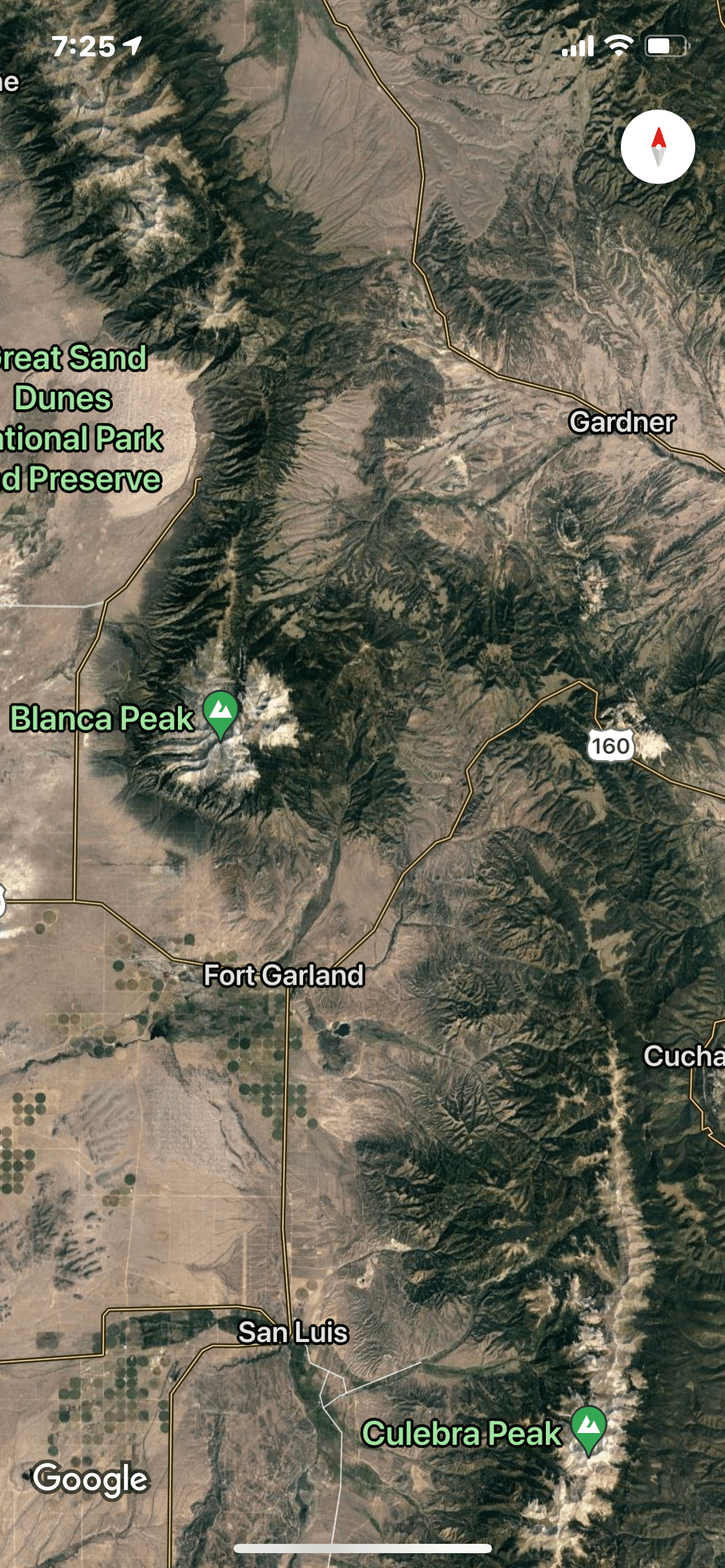
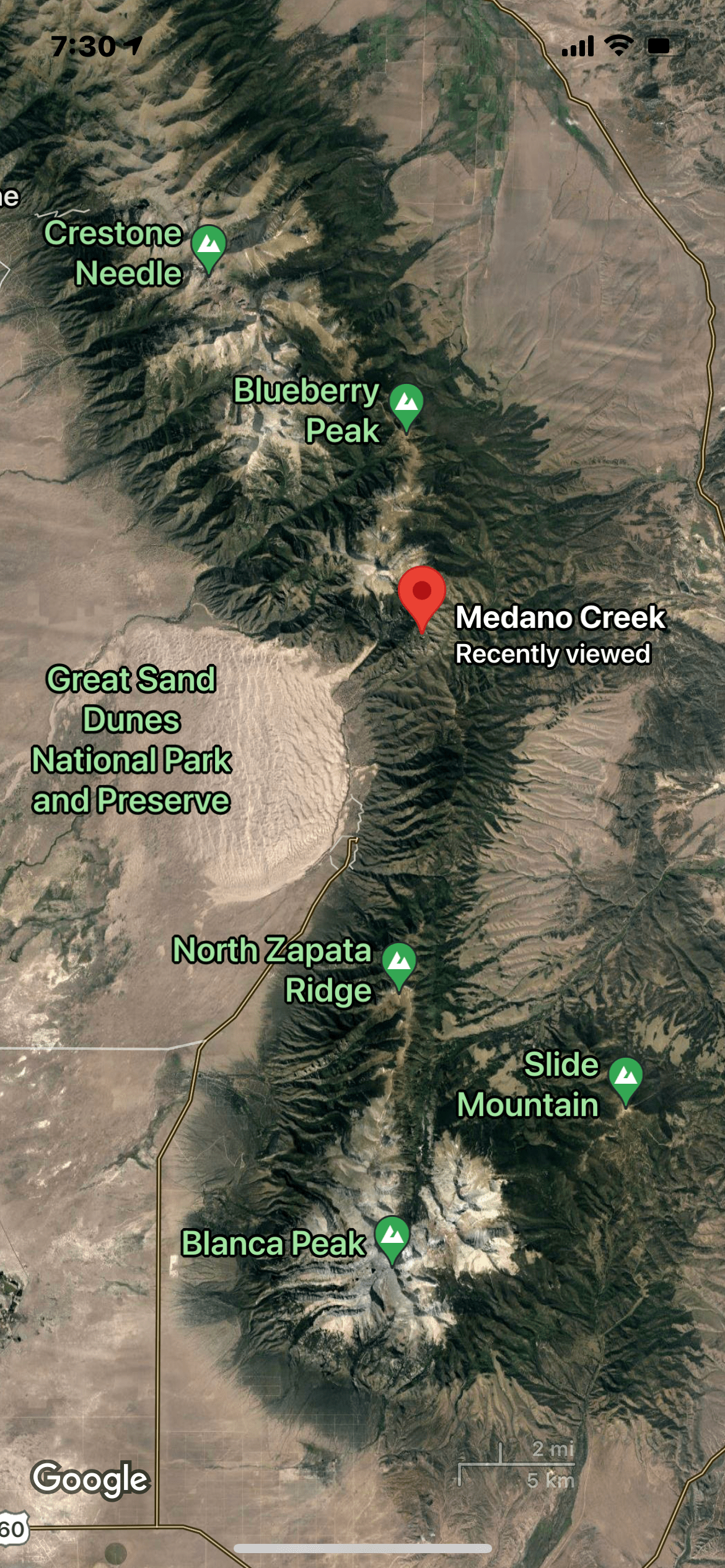
I’m off on my last camping/fishing trip of the year. Snow is already on the jagged peaks of the Sangre de Cristo (Blood of Christ) Mountains in the San Luis Valley, and colder weather will be rolling in next week. I have set up my mobile fish camp in an RV campground just outside of Alamosa, and have my eyes on two waters I haven’t yet explored in the remote high country of this imposing mountain range—the Huerfano (p. WEAR funno) River and Medano (p. MAY dunno) Creek. The Huerfano River lies on the east side of the Sangres where it springs from the flanks of the majestic Blanca Peak, a fourteener and one of the highest summits in the Rocky Mountains. The second, Medano Creek, lies only about 15 miles away as the crow flies to the north on the west side of the Sangres. It is home to the colorful, rare Rio Grande Cutthroats. While close on maps, the two waters actually lie a couple of hours apart by road.

The Sangre de Cristos are one of the most rugged mountain ranges in the United States climbing abruptly over 7,000 feet above the valleys to the east and west, one of the steepest vertical rises of any mountains in North America. Nine of its peaks top 14,000 feet. Unlike the San Juan Mountains on the west side of the San Luis Valley that were created by volcanic activity, the Sangre de Cristo range is the product of tremendous uplift forces which helps to explain their jagged profile. Numerous alpine lakes and streams are hidden away in the deep folds between the soaring peaks. Hiking in this rough high country is not for the faint of heart as I can attest from an outing on Sand Creek lakes several years ago.

Doing my due diligence research prior to this October trip, I found very little mention of either water on-line, except occasional posts by intrepid hikers.  I couldn’t find anyone at my local fly shop who had heard of, let alone fished either.  Apparently neither is on the angling radar screen—my kind of streams!

Day 2:  Medano Creek

After a long day fishing the headwaters of the Huerfano River yesterday, I decide to sleep in a bit and have an extra cup of strong English Breakfast tea before heading out.  Still I’m on the road by 8:30 a.m. for what should be the shorter drive to fish Medano Creek.  Aptly named, meaning sand dunes in Spanish, Medano Creek flows through the Great Sand Dunes National Park and Preserve. The dunes there soar over 300 feet high, the tallest in North America.  They fit in well with the San Luis Valley landscape, the highest true desert in the United States that gets a paltry eight inches of rain a year.  Indeed, while Medano Creek starts out ten miles above the dunes in the Sangre de Cristo Mountains, it eventually disappears in the porous piles of sand.  In the early summer when it still runs through the dunes before vanishing, my little sweetheart granddaughter Aly loves playing in the warm creek waters and digging in the huge natural sandbox. 

Medano Creek Playtime For Aly

Interestingly, biologists tells us that Medano Creek, being completely isolated by the dunes, never held any trout before nonnatives like brown trout were introduced. However, because of the isolation provided by the sand dunes, the creek was a perfect candidate for transplanting Rio Grande Cutthroats, the only native trout in the valley, as part of the recovery program to save that threatened fish. Non-native trout were poisoned out, and the Rio Grande Cutthroats introduced in the 1980s. The program was doing nicely until a huge wildfire burned through the area in 2010. Fortunately, state wildlife aquatic biologists organized to save fish in the lower reaches. The cutts in the creek rebounded nicely and are one of Colorado’s best sustaining population of the Rio Grande Cutts. They are now being used as the stock for restoration efforts such as those in nearby Sand Creek.

My excitement level jumps a notch as I get closer to the imposing sand dunes. This is definitely going to be a completely different day than yesterday. Instead of climbing high into the mountains on a steep rocky road to an alpine water at over 10,000 feet, I’ll be navigating tricky sand pits on the edge of the dunes that can suck even a 4WD drive vehicle to its axles in a flash. My first glimpse of the creek is encouraging, but I start to get a little knot in my stomach when I begin to see the increasingly sober warning signs as I drive further into the dunes.

One warns drivers to lower their tire pressure to 20 psi to make it through.  Fortunately, according to the park ranger at the entry booth, soaking rains last night have firmed up the sand so I don’t need to follow that advisory.  This won’t be so bad, I think.  I’ll take a sandy road over a gnarly rock-infested steep one any day.

Medano Creek Primitive Road Map

But then I come to the big sign that announces “point of no return!”  Yikes, what have I gotten myself into?

YIKES!! INTO THE WILDS!

Soon I run into what will be the first of several wide creek crossings. The water level is low so they are no problem, but could be earlier in the year during runoff.

One Of Several Creek Crossings

I don’t see any fish, and the creek on either side is completely overgrown for several miles.  I start to wonder if this is going to be another frustrating day like yesterday.

Further up another mile or so I run into a hunter near a series of steep cliffs, reputedly mountain sheep territory.

Mountain Sheep Territory

He confirms that is his quarry. The young nimrod says he has been at it for four days and hasn’t seen any. What about fish, I ask? He nods and tells me he’s seen plenty of those. Whew!

As I continue, looking for an opening to investigate the water, the still-sandy road narrows as it weaves its way through the aspen and pines.  I wince as the branches scrape along the side of my SUV and snap at my radio antenna. 

Narrow Road–What’s Around The Bend?

I start to wonder what I’ll do if I meet another vehicle. Then I do. That explains why I’ve been seeing short pull outs scraped into the forest every quarter mile or so. It’s where you back up to when you meet someone. Fortunately the young gents coming down are closer to one so they back up and pull over. I roll my window down to thank them, and ask what things look like above. They mention several more river crossings and then a rocky stretch a few miles up. I ask them if they saw any beaver ponds and they nod, just after the valley widens and the road gets rougher they say.

Their info proves to be correct, and sure enough right after the road begins to climb more sharply and the sand gives way to rocks in the road, the valley widens and I spy a side track that leads to a broad meadow where I can see water.  It’s 10:30 a.m. and has taken me about two hours to drive here from the campground.

I hop out of the SUV and walk cautiously to the creek.  It’s wide and flowing slowly courtesy of a small beaver dam below.  I can see up the steep slope on the other side of the creek evidence of the massive forest fire that swept through here a decade ago. 

Charred pine trunks still stand, but the aspen are coming back, and the vegetation around the pond is thick in places. There are dimples on the water, and as I get closer I can see several foot-long cutthroats swimming nonchalantly as they pick off small midge flies on the surface.  I hustle back to my vehicle and grab the rod that’s rigged with a dry/dropper combo.  The dry is a #18 Royal Coachman Trude and the dropper a creation of my own that I have dubbed Dirk’s Delight.  It’s a #18 beadhead caddis larva that’s been producing all summer on small creeks. 

Dirk’s Delight–CDC Beadhead Caddis Larva

I decide to don my chest waders, anticipating I will be wading beaver ponds today from the looks of things on Google Maps. But it’s nice and sunny—the temperature will reach 75 this afternoon—and the wind is light so I don’t have to slip on a jacket.   

In a flash I’m back on the water, standing back from the shoreline so as not to spook the several cruising cutthroats.  I make a short cast a few feet in front of the biggest, and he jets forward to nail the nymph before it can sink.  BINGO!  Not like the shy brookies yesterday! The handsome cutt poses for a quick photo then slides back into the water. 

Colorful Cutthroat Commences The Fun

I quickly recast, and hook another.  Indeed I get strikes on the next five casts and land a couple more smaller cutts, all but one on the caddis dropper.

When the action slows, I decide to hustle back to my vehicle and get my second rod rigged with two nymphs since the fish appear to prefer something subsurface. That seems to be the ticket, as the action picks up as I work upstream, the fish either being in the deeper trough in the middle of the slow moving channel or up against the opposite shoreline. The fish are definitely not being picky. I catch several that hit the dropper several times after being hooked on the first try but wriggling off.

Around the bend I spy several more cutts cruising along the surface steadily feeding on small tidbits. They aren’t wary and don’t waste any time nailing the caddis or the dry I offer a few yards in front of them. All are healthy and go from 10-12 inches. What fun! At the next bend in a deeper spot under an overhanging bush I’m surprised to get a beauty that pushes 14-inches, and then four more out of the same spot despite all the commotion.

Bend Pool Bonanza

Then it’s on to a big beaver dam and pond I can see upstream. I approach the dam cautiously and cast the flies into the spillway cascade. Immediately something big nails the dry and the battle is on…but short-lived. The cutthroat cartwheels into the air, his sides shining in the sun, and earns his freedom as I magnanimously grant him a long-distance release.

Big Beaver Pond Frolic About To Commence

I move up and carefully scale the big beaver dam.  It doesn’t take long to get back into the groove.  On the first cast parallel to the dam into a pocket under some overhanding trees, a colorful cutthroat inhales the nymph. 

Eager Beaver Pond Trout

Several more come out of that spot. Next I concentrate on a dark, deeper hole in the middle of the pond where a couple of fish are dimpling the surface. It produces several more, but all on the nymph. For the next half hour I work the pond from the shoreline. I get several more cruisers on the dry, one of which I watch incredulously as he hits the dry, then the dropper, then the dry again five times. I actually hook him twice, and he just keeps coming back. Who am I to argue?!? Further on I see a rise in a deep pocket close to the shoreline, and it turns out to be a honey hole. I fool a half dozen more feisty cutts including a long, slim beauty that pushes 14-inches!

By now it’s almost 2 p.m., and my stomach is growling. But just as I’m about to head back to the SUV and lunch, I come upon another beaver dam, this one older and smaller, with a pond that’s partially silted in. I catch several below the dam, then realize I’ll have to navigate around the marshy area it has created to get to the deeper water above. I go back downstream a hundred yards and am just about to take a step into a clear, shallow side channel when I am startled to see a leviathan slowly finning in the narrow confines, picking morsels off the surface. I retreat behind a bush and gently loft a short cast a few feet in front of the big boy. He swims forward slowly and sips in the dry. I set the hook and he thrashes his head back and forth. My heart drops when the fly comes whizzing back towards me. I expect to see the fish zoom off back into the safety of the pond but he resumes his slow amble up the channel. I place the flies above him again, and he jets forward to nail the nymph. I’m so shocked that I momentarily forget to set the hook, but when I do the cutt shows off his muscles. He slashes back and forth in the channel, but luckily doesn’t make a run towards the pond which would have required me to do my famous Usain Bolt imitation running through the marshy muck to keep up with him. Soon he’s easing into my net, a stunning 15-inches. The big fish sports all the striking colors and patterns of a pure Rio Grande Cutt, including the cluster of small spots near the tail, the speckled back, the dark red gill plate, and of course the red slash under his throat.

As I slide the beautiful fish back into the water, I think what a wonderful way to end an extraordinary day! 

But then think am I out of my mind with that one more alluring pool just above and Google Maps showing another whole series of ponds just up the road.  So I negotiate with myself and my stomach.  I’ll fish the pool then call it a day.  The next string of beaver ponds can wait for a return engagement.  The compromise turns out to be a good one.  I catch several more nice fish at the top of the pond in very clear water, then resolutely climb up to the road above, tip my hat to the cutts, and hike a few minutes back to the SUV and lunch while I plot my return next year.   

Last Look And Tip Of The Hat To The Wonderful Cutthroat Of Medano Creek

Note: In my follow up research on access to Medano Creek, I learned an easier route may be from the west side of the Sangres through the Wet Mountain Valley and over Medano Pass. Road 559 appears to be less challenging, gets to the beaver ponds more quickly, and avoids having to navigate the sand. UPDATE: The Medano Pass route is 4wd only, steep, and very rough and rocky in spots. Choose your poison.