Exploring The Hidden Creeks of the Sangre de Cristo Mountains: Day 1 On The Huerfano (Orphan) River

October 2021

For an account of my earlier trip in the Sangre de Cristo mountains where I fished for big cutthroats in an alpine lake see:https://hooknfly.com/2020/07/25/return-to-sand-creek-lakes-revenge-of-the-skunked/

I’m off on my last camping/fishing trip of the year.  Snow is already on the jagged peaks of the Sangre de Cristo (Blood of Christ) Mountains in the San Luis Valley, and colder weather will be rolling in next week. 

Early Fall Calling Card In The Rockies

I have set up my mobile fish camp in an RV campground just outside of Alamosa, and have my eyes on two waters I haven’t yet explored in the remote high country of this imposing mountain range—the Huerfano (p. WEAR funno) River and Medano (p. MAY dunno) Creek.  The Huerfano River lies on the east side of the Sangres in the southern reaches of the Wet Mountain Valley where it springs from the flanks of the majestic Blanca Peak, a fourteener and one of the highest summits in the Rocky Mountains.  The second, Medano Creek, lies only about 15 miles away as the crow flies to the north of the Great Sand Dunes National Park on the west side of the Sangres.  It is home to colorful, rare Rio Grande Cutthroats.  While in close proximity on maps, the two waters actually lie a couple of hours apart by road. 
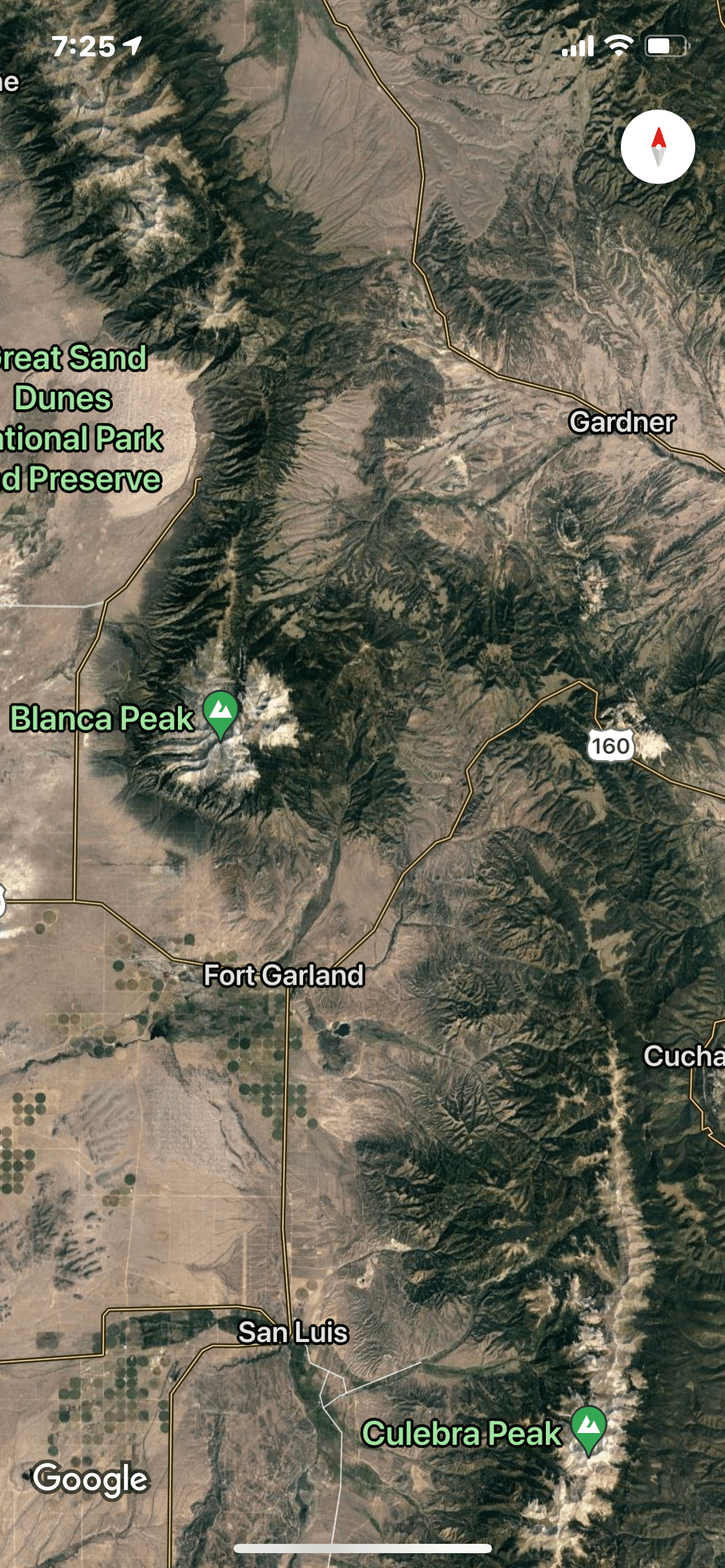
The Sangre de Cristos are one of the most rugged mountain ranges in the United States rising abruptly over 7,000 feet above the valleys to the east and west, one of the steepest vertical rises of any mountains in North America.    Nine of its peaks top 14,000 feet.  Unlike the San Juan Mountains on the west side of the San Luis Valley that were created by volcanic activity, the Sangre de Cristo range is the product of tremendous uplift forces which helps to explain their jagged profile.  Numerous alpine lakes and streams are hidden away in the deep folds between the soaring peaks.  Hiking in this rough high country is not for the faint of heart as I can attest from an outing on Sand Creek lakes several years ago. 

Doing my due diligence research prior to this October trip, I found very little mention of either water on-line, except occasional posts by intrepid hikers.  I couldn’t find anyone at my local fly shop who had heard of, let alone fished either.  Apparently neither is on the angling radar screen—my kind of streams!

Day 1:  The Huerfano River

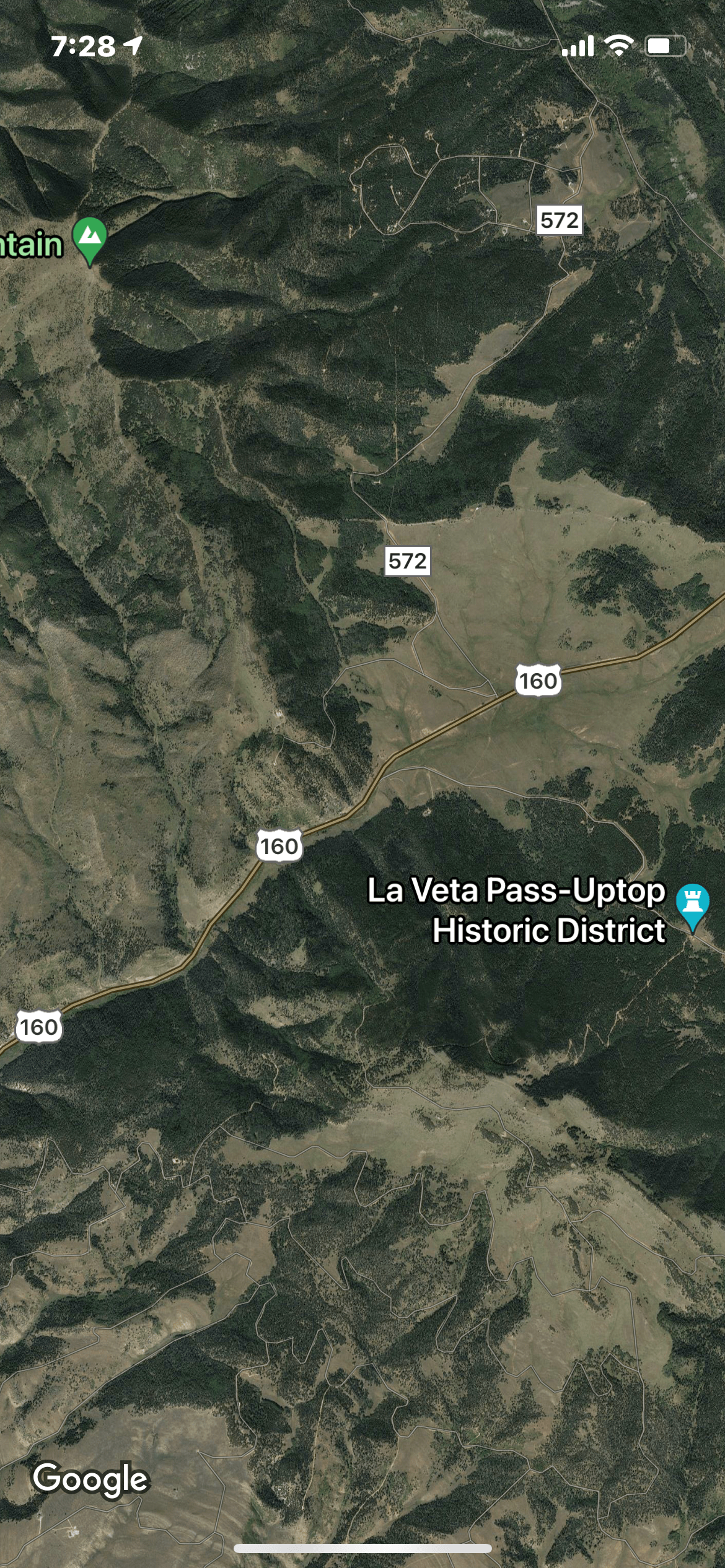
I’m up early the next morning for what will be a two-hour drive east of Alamosa to the headwaters of the Huerfano.  It’s a pleasant scenic route on US 160 through historic Fort Garland to the turn off to the north on Pass Creek Road (Rd572) just before reaching La Veta Pass. 

Blanca Peak And Mt. Lindsey Above Fort Garland
Turn Off On Pass Creek Road (572) Near La Veta Pass

The gravel road starts out fine, the dust settled from a good soaking rain the past few nights.  But then I start to run into stretches where the edges of the road are partially washed out where the rain cascaded through acres of burnt timber and denuded ground from a recent wildfire.  I drive by some heavy equipment trying to repair the damage and am fortunate to squeeze by.  Luckily the road soon improves, and I have to worry about dodging free-ranging cattle and occasional wild turkeys. 

Rd 572 finally turns into Rd 570, and in a few miles when Rd 570 crosses the Huerfano River, I’m not surprised to see it is very low.  This stretch of the river runs through a broad agricultural valley where its waters are diverted for irrigation.  I figure I will find more water higher up.  Rd 570 dead ends into Road 550, a paved highway where I turn left (west) and start up towards the headwaters. 

The Hispanic heritage of the valley and agricultural lands to the east is reflected in the river’s name which means “orphan” in Spanish.  The name comes from an iconic 300-foot high conical butte that stands alone by itself near the river in the prairie eight miles north of Walsenburg.  This massive lone sentinel was an important landmark for early explorers like John Fremont. 

The Orphan Butte

In a few miles Rd 550, a paved highway, transitions into a good gravel road that winds up the valley and then through the narrow confines of the Huerfano State Wildlife Area.  I get my first glimpse of the river and its rushing waters.  It’s heavily overgrown, but has a better flow than down below as I had hoped.

Soon I come to a prominent warning sign notifying me that the next three miles are through private land and that trespassers will be shot and then shot again (or something like that).  Now the road steadily deteriorates with some rocky, bumpy sections.  I shift into 4WD, happy that I have four good AT tires and a high-clearance vehicle.  I pass by a couple of mountain mansions, and then the valley opens up again. It’s hard to keep my eye on the road as the spectacular scene emerges, brilliant golden aspen framing the snow-covered east side of the Sangres. 

But I’m jolted back to reality when I crest a ridge, and the road drops precipitously down the slope. 

Keep An Eye On The Road!!

Road 550 transitions into Upper Huerfano Road 580 that is recommended for 4WD, trails bikes, and ATVs only.  Rd 580 isn’t particularly steep but is pocked with big rocks and an uneven roadbed that require careful navigating.

4-Wheel Drive Vehicle Highly Reommended!

Only in a few places does the road come close to the river, and then it’s mostly overgrown like below.  I decide to keep going to the Lily Lake Trailhead where my map shows the trail intersecting the river in a broad open meadow.  Finally at about 10:45 a.m. I reach the trailhead and am surprised to see four vehicles there, two that are average AWD passenger cars!  I say a quick prayer for the drivers, hoping they have good 6-ply tires.  It’s a long way from any tow truck.

I saunter over to the edge of the parking area, noting the remnants of a SUV running board being used as a fire pit bench. 

Rough Road Casualty

I am greeted by a stupendous view of the river several hundred feet below in a canyon.  The plunge pools look inviting, but only a mountain goat would dare descend from there.  I hatch a plan to walk upstream on the trail then rock hop back down into the canyon.

Mountain Goat Territory

I suit up in my normal high-country fishing uniform—chest waders, Simms Vapor wading/hiking boots, wading staff, and fishing vest loaded to the gills.  I decide to carry only one rod, a lightweight 8.5-foot, four-weight wand rigged with a dry/dropper combo—a #18 Royal Coachman Trude for the surface and a #18 green beadhead caddis larva below. My leader and dropper are 5X.

The trail is in excellent shape thanks to the good work of a corps of volunteers according to a sign I pass.  It ascends gently then descends into the big open valley promised on my map.  The view is spectacular and will distract me for the rest of the afternoon—Blanca Peak and Mt. Lindsey in a magnificent cirque covered with the first snow of the season.  I decide to veer off the trail and follow a game trail that wends through high grass down to the river. 

As I get close to the river, I can see the water is low and crystal clear so I switch into stealth mode.  I creep up to the shoreline, but despite my sneakiness, immediately spook a good-sized brook trout that zooms frantically downstream. 

Ah, the vicissitudes of small stream fishing! My plan is cross the river in a shallow spot that I see 20 yards upstream then hike downstream through the brush on the east side into the canyon where I had spotted those alluring plunge pools–then work my way back up.

My plan works perfectly for about three minutes.  As I wade across in the shallows, I can see a beautiful, deep pool at a bend in the river just above.  Better yet, there is a school of brookies finning in the depths, apparently oblivious to my presence.  I crouch to lower my profile and execute a dainty cast to the head of the pool just below where the current cascades in.  I can see my nymph dropping down to the quarry that awaits.  But the brookies don’t move a centimeter towards either fly.  I try again, with similar results.  Persnickety little devils.  After a half a dozen skillful casts and floats later I stand to get a better look and send the trout into a fleeing vs. feeding frenzy.  Oh well, I rationalize, I will deal with them later when I come back this way.

Then it’s off into the bushes and boulders above the creek to work my way into the canyon.  The game trail I’m following soon runs into a nasty looking loose scree slope forcing me to cross over to the other side. 

Into The Canyon

The streambed rocks are surprisingly slippery, but I execute my best nimble septuagenarian moves to emerge without a dunking.  My sights are set on a tempting pool downstream.  I creep slowly through the brush fishing a couple of little plunge pools on the way, one of which harbors a good-sized brookie who zooms to safety.  When I get to the top of the target pool, I’m disappointed to find it’s very shallow and barren of any fish.  I can see further below where the going gets even rougher, so decide there is plenty of water to work back upstream in the meadow. 

I retrace my steps to below another alluring pool and am immediately captivated by the entrancing view. 

I sit on a warm rock and soak in the grand scene for a few minutes.  This moment is alone worth the trip I think to myself.   The bonus is the four trout I see finning mid-pool in the current, one large one and three smaller.  Then it dawns on me that they are in the pre-spawn amorous courting mode.  I confirm my suspicious by executing several delicate casts which the trout respond to with zero interest.  I decide to switch to a Parachute Adams with a 6X leader and add a #18 Two-Bit Hooker below on a 6X dropper.   Same results.  Clearly amore is trumping appetite. 

Soon I am back to the pool just below where I started in the meadow.  Five brookies are stationed in the depths of the pool.  I kneel craftily and loft a cast above them.  The flies drift perfectly towards the trout, but sadly, like their brethren, they show no interest in my offerings, so I switch flies again.  I add a size #22 black zebra midge to the offerings.  This has no noticeable effect on their obvious case of lockjaw.  If frustration, I stand to size things up, which sends them jetting back and forth upstream and down in the pool in utter terror.

I continue upstream, hoping for better, but the results are the same.  In a half dozen picture-perfect pools, the trout stick their noses up at my offerings while they swim around in romantic bliss.  I take care to stay out of the water when I spot fish over gravel beds just in case some are already spawning.  I spot one beauty that looks to be at least 14-inches, but like females of certain other species she won’t give me the time of day. 

Recalcitrant Brook Trout

Next I try a long perfect looking run along the shoreline upstream that normally would be loaded with fish, but come up empty. 

Toward the top of the meadow, the river splits, and I follow the east fork.  I see a few trout here and there then come to a little beaver pond.  A dozen trout are swimming in the pool created by the spillway, but I get too close, and they go flying downstream by me.  Above the dam the river actually disappears, so I hike back downstream to find the other fork. 

The Orphan Disappears!

It is narrow and winds back west through the meadow and some marshes.  Here and there I spot brookies lying up against the undercut banks, but can’t persuade them to bite. 

It’s about 1:30 p.m. by now and my stomach is growling and patience growing very thin.  I am beginning to resign myself to my first ignominious skunk of the year.  Almost three hours of flailing the water and not a rise or bite let alone a fish.  At least it’s been a scenic ecotour, and I have had the river to myself, nary a boot mark anywhere—just lots of sign of deer and elk!  But wait, what about that good-looking freestone water back down in the state wildlife area I passed through in the morning ?  That could salvage my reputation,

On the short hike back to the trailhead, I begin to plan my redemption.  Without wasting any time shedding my boots and waders, I climb back into the SUV and roll downhill towards the wildlife area, a determined glint in my eyes.  The scenery is again mesmerizing, blazing yellow and orange leaves capturing the afternoon sun, but I keep chugging along. 

More Gorgeous Fall Scenery To Distract From The Angling Task At Hand!!

By 2:30 I’m back at the boundary of the wildlife area and find a nice turnout overlooking the river.  I set up my folding chair and table overlooking a beautiful pool and partake of a hearty lunch and can of RC Cola power drink that helps me regain my mojo. 

Lunch Overlook

Below the turnout, the river bends away from the road and becomes invisible behind the trees and tangle of brush.  I have a hunch that the hidden stretch doesn’t get much pressure, so walk down the road several hundred yards then plunge into the thicket.  I follow a faint path that emerges just below a big boulder where a log has jammed to create a small plunge pool below it. I check the streambed rocks and find them loaded with caddis cases. I also see a few caddis flies flitting about in the air.

I tie back on the Royal Trude and caddis nymph and probe the pool carefully, but the current is much swifter here and not likely to hold a fish.  I navigate around the log and boulder and spy a stretch of water along the opposite bank where the current is slower and the run deeper.  I pop the dry at the top of the run and watch it slide down against the shoreline.  Something flashes at the dry, but misses the fly.  I quickly recast and this time a nice 14-inch brown trout inhales the nymph at the end of the run.  Battle on!  The fish heads for the undercut bank replete with snags, but my rod has enough back bone to turn him.  Soon he’s sliding into my net for a quick photo followed by several deep bows from this appreciative angler and then is released.  The pernicious skunk has been banished!! 

Nice Brownie Banishes Skunk!

I continue working upstream, concentrating on every pocket or run of quieter water where the brownies are hiding out to avoid the strong current.  I manage a half-dozen more before I get to the beautiful pool at the turnout. 

There I fool one more and decide since it’s 4:30 and I have a two-hour drive ahead of me, I’d better hit the road. 

Beautiful Brownie Sporting Fall Colors Caps The Comeback

Good thing I did.  When I get back down to the turnoff for the Pass Creek road (570), a big sign announces the road has been temporarily closed, no doubt because of the washouts.  That means Iwill have the take the long way back around east through the hamlet of Gardner then south on CO 69 with a turn on Rd 520 at Badito, a good gravel road that cuts back west to emerge near La Veta Pass.  Fortunately the route, while a bit longer, is easy driving with more fine scenery.  I make it back to the campground in time for a nice glass of Pinot Grigio, while enjoying the warmth of the setting sun and studying the map for my outing tomorrow on Medano Creek.  Cutthroats beware! And next summer I’ll be back on the Huerfano River giving chase those brookies before they spawn!

Into The Backcountry: Prospecting For Trout On Two New Remote Creeks (near Del Norte, CO)

“I don’t know, I don’t now

I don’t know where I’m gonna go

When the volcano blows.

Jimmy Buffet

June 2021

For two of my adventures chasing the rare Rio Grande Cutthroats on Treasure Creek and the Lake Fork of the Conejos River, see

https://hooknfly.com/2020/01/08/treasure-creek-co-its-a-gem/ and

https://hooknfly.com/2019/09/27/lake-fork-of-the-conejos-river-solitude-in-a-sanctuary-for-rare-rio-grande-cutthroat-trout/

Day One—La Garita Creek

As I bounce down the rough single-track road searching for an open section to fish on La Garita Creek, Jimmy Buffet’s volcano song is running through my head. Just 28 million years ago one of the largest known volcanic eruptions in Earth’s history took place near here, between the towns of La Garita and Creede in southwestern Colorado. It was a supervolcanic event that dwarfed the more recent eruption of Mt. Saint Helens and even the giant volcano that created the massive Yellowstone Caldera. The caldera the La Garita eruption left measures in at about 22 by 47 miles!

This is my first overnight outing in 2021 with my little travel trailer/mobile fish camp.  I have gone a little soft and opted to park it in the relative luxury of the venerable Woods and River RV campground in Del Norte, on the banks of the mighty Rio Grande.  The temperatures are finally rising in the Colorado high country, the runoff is subsiding on a few creeks, and I’m itching to chase some trout on a couple of remote creeks that I recently discovered through some internet sleuthing—La Garita and Carnero on the western edge of the San Luis Valley. 

The Upper Red Point Is Location Of Carnero Creek

Back in May I was searching on-line for some new small waters to explore not too far from my home base in Salida, Colorado, preferably ones that would call home for Rio Grande Cutthroats. Serendipitously, I stumbled on a U.S. Forest Service document that listed creeks in southern Colorado and New Mexico that harbored these beautiful, rare trout.  All of the waters mentioned were small and remote, including two of my favorites—Treasure Creek and the Lake Fork of the Conejos River (See my article and blog about these two gems).  Two I had never heard of—La Garita and Carnero–despite them being only a 90-minute drive from Salida and just over in the next valley from Saguache Creek, which I fish several times each year.  To pique my interest even more, not only are they close to home but there was very little mention anywhere on-line about fishing Carnero Creek and nothing about La Garita.  In fact I had to laugh when the only article that popped up when I search the phrase “fishing La Garita Creek,” were ones I had written awhile back about fishing Cochetopa and Saguache Creeks in the La Garita Wilderness which lies about 70 miles to the northwest as the crow flies.

So on a nice sunny day in late May I decided to do some on-the-ground recon on both creeks since they lie only a few miles apart. I liked what I saw on that day trip.  While La Garita Creek was too high to fish, running at about 50 cfs, the angling prospects there were to my liking.  Ove  five miles of the creek are on public land accessible by a rough 4WD road.  The scenery is spectacular as might be expected of a creek named La Garita, which in Spanish means sentinel or overlook.  Carnero Creek access was more civil on a decent gravel road.  While Carnero was running a bit high and cloudy, there was plenty of water with public access. I actually was able to wet a line on, catching about a dozen or so brown trout on the South Fork. 

I also spotted some promising stretches downstream on the main stem below the confluence of the South, Middle, and North Forks for a future trip.  Unfortunately, I also discovered that the Middle and North Forks that reportedly hold only Rio Grande Cutthroats were too tiny to fly fish except in occasional beaver ponds.  I plotted my return in June when the gauges on the state water level site showed them both falling to a more fishable 15-30 cfs level.  (To find stream water levels in Colorado, Google “Colorado Water Staions” to access the Division of Water Resources gauging stations at https://dwr.state.co.us, then hit search to find the Rio Grande Division, then scroll to find the creeks by name and click on “view”.)

When the day arrived in mid-June with water levels falling rapidly, I hustled to load up my mobile fish camp and made a bee-line to the campground in Del Norte the next morning.  Quickly I set camp up and by early afternoon am heading northeast out of Del Norte on paved CR 112.  Soon I turn north on Highway 33 that turns into a good gravel road.  In seven miles it intersects with E39, a rougher but still passable gravel road that heads directly west paralleling La Garita Creek.  It winds four scenic miles by ranches and second homes till it hits public lands.  That’s when the fun and bumps begin. 

I shift into 4WD and get ready to rock and roll.  The single-track road starts out tamely, but then alternates between fairly smooth dirt sections and rocky, teeth-rattling stretches. 

It should not be attempted except in a high-clearance, 4WD vehicle with AT-rated four-ply tires.  Trust me on this.  Also, I would avoid it after a good rain as it crosses several deep washes.  Aside from that it’s a piece of cake.  My goal is to find a stretch that is not completely overgrown, of which about 80% of the creek is, making fly fishing virtually impossible there.

In a couple of miles I come to a sign announcing I am entering the Little Garita Creek State Land Board property that is open to public use.

I am a little confused at first, but soon figure out the road continues to follow La Garita Creek with its little tributary veering off to the north. 

Several Fishable Stretches On The Creek Can Be Found Upstream of the State Land Board Sign

Finally a ways up the road from the sign I spot a wet meadow dotted with wild iris where I can actually see the creek.  Bingo!  I will find that meadows like this one are a good sign as apparently the streamside brush can’t grow so thick because of all the wet ground the iris love.  I make a mental note of the spot and keep 4-wheeling up the road, which becomes increasingly worse and overgrown.  A couple of time I have to veer off the road that is narrow and hard to navigate because of overhanging tree branches and follow some tracks through adjacent meadows then navigate back on the road. 

Wet Meadows With Wild Iris Often Mean Open Water On The Creek

In a few miles I enter a ponderosa pine forest where the terrain is more open and spot a couple more fishable stretches.  At about 5 miles from the start of the public land, I come to a creek crossing that is too fast and deep to attempt by myself alone in the middle of nowhere.  While lower than in May, La Garita Creek is still running at a healthy 25 cfs.

I retreat a mile or so back downstream to an open stretch and suit up in my chest waders, anxious to get in the cold creek water as the temperature is pushing 90 degrees with very little wind. I’m in the creek by 3 p.m. checking under some stream rocks to see what the trout might be dining on and find them loaded with green cased caddis larvae and dark mayfly nymphs.  There are also some caddis flies flitting about and as a nice flight of mayfly spinners dipping and dancing above the water. On my 8 ½, 4-weight fly wand I tie on a bushy #16 Royal Coachman Trude to imitate the caddis flies as well as the small hoppers in the meadow and a #18 green sparkle beadhead caddis larva about two-feet below it.  The action is fast from the get-go and continues that way for the rest of the afternoon.  I soon conclude they haven’t seen many faux flies lately.  Indeed, I won’t see another vehicle or soul and no boot marks either today or tomorrow when I return. 

In the first promising pool above a beaver pond I quickly net two spunky browns that attack the flies without hesitation, one on the dry and the other on the caddis.

I work upstream a few feet and spy a beautiful pool at a bend in the creek.  Looks like the liar of a big trout….and it is.  I cast up into the riffle above the pool and watch as the Trude bounces down jauntily.  Suddenly a big trout, maybe 15-inches, appears out of nowhere and intercepts the dry, but I yank the away from him before he clamps his jaws shut and miss.  Luckily the fly hook didn’t sting him, so I get a second try.  Again the fly floats down into the bend pool and again the trout rises boldly alongside of it and nonchalantly sucks the Trude in.  Whoosh!  I sweep the rod back and set the hook, immediately and feel his weight, and just as quickly execute my patented long-distance release.  I contemplate committing hari-kari, but decide to try again, beyond all hope.  Alas, although the fly floats over the same spot again, this time the big fellow refuses to make an appearance.  But just a few feet below against the bank, another sizable trout, this one around 14-inches, nails the dropper.  But I miss again and pricked him with the hook so now he’s off his feed as well.  I have to laugh at my ineptitude.  Fortunately my ego is salved on the very next drift through the pool as a nice 12-inchers nails the dry at the tail end of the pool, and in the run just upstream where I catch and release three brownies in quick succession. 

Lair Of The Big Brownies
Third Fish Is the Charm

That will be the pattern for the rest of the afternoon.  In every bend pool or quiet stretch off the main current or behind a boulder, I can count on several strikes and catching at least a couple of fish.  It becomes ridiculously easy, making up for all those times in previous years when the finny buggers have outwitted me.

The fishing really gets interesting when I come to a couple of big beaver ponds.  I work the deep current in the middle of the first and lure a couple of feisty brownies from the depths. 

Out of the corner of my eye I see a good rise just below the next beaver dam.  I sneak up and get into casting position on my knees, then pinpoint my cast between two bushes on either side of the current.  

Another Big Trout Lair

The dry floats about five feet below the bushes and my jaw drops when it is sucked under by a tremendous swirl in the water.  Unfortunately, the fish that made that giant swirl missed the fly!  I try again, and again there is a huge swirl and another refusal.  Clearly the biggest fish of the day has been toying with me.  Then all goes quiet.  I proceed further upstream, doing a high-wire act to mount the big dam and cast into the current flowing down the middle of the pond above.  The dry is abruptly jerked under and when I set the hook my rod bends perilously.  The trout heads towards some shoreline bushes but I manage to turn him away from the snags.  The fight goes on back and forth before the handsome brownie comes to the net.

I continue working upstream to the head of the pond where a small sandbar with brush on it cleaves the stream creating nice flows on either side.  I wade out carefully to probe a fast run between the sandbar and far shoreline, keeping my balance in the soft bottom with my trusty wading staff.  I flip a backhand, side-arm cast upstream, and immediately a mini-geyser erupts around the dry fly.  I am onto another good fish. 

Tricky Stretch Produces

The battler finally comes to the net for a quick photo and release, another 13-inch plus muscular brownie.  Three more fish succumb to siren’s call of my flies in that run, then several more on the other side of the split. 

It’s five o-clock now, and as I size up the next tantalizing pool and beaver pond above, I am thinking of those tasty dishes and Dos Equis amber beer at my favorite restaurant in Del Norte, Los Chavolos.  To fish or not to fish more? The low, rumbling sound of thunder and a few flashes of lighting on a ridge in the distance make the decision for me.  

As I walk up the slope to the road, I start laughing, feeling a bit giddy–and believe me it takes a lot to make a septuagenarian giddy. I have caught and released in the neighborhood of 50 fish in about 2 ½ hours and lost probably that many more.  It’s been one of those flat-out fun days like I used to have in Kansas as a kid, catching countless bluegill in a local farm pond.  Today the trout were where they were supposed to be, usually in numbers, and cooperative in the extreme, a tribute I think to their carefree, unschooled life in La Garita Creek.  Who am I to complain?!?

Day Two On La Garita Creek

After a hearty Mexican dinner at Los Chavolos in Del Norte, I get a good night’s sleep and am back on the road at around 8:30 then trundling up E39 20 minutes later.  Today I vow to slow down and enjoy the scenery and wildflowers on the way to fish the Little La Garita State Land Board stretch several miles below where I chased the trout yesterday.  The bluffs, buttes, and ridges are spectacular under a blue-bird Colorado sky. 

And the landscape is dotted with gorgeous white blooms of the soapweed yucca and the bright orange and red splash of Indian paintbrushes.  It’s cooler today with a little more wind, a refreshing combination. 

A mile or so into the State Land Board wildlife management area, I come to the open stretch I spotted yesterday.  I am using the same outfit and flies—why trifle with success!  I catch a several small brownies in the first two pools then come to a beautiful waterfall flowing cascading from a blown-out beaver pond.  I score a couple at the foot of the waterfall, then move up into the wider flow above.  The action is again crazy good from the get go.  I catch and release five hard-fighting brownies from 11-13 inches. 

The creek above the beaver pond executes a big S-bend, with each curve yielding several  brownies pushing 13-inches.  Above the upper bend a riffle plunges into a fast, deep run, and more willing brownies come to the net.  For the next two hours it’s lights out again, with the trout favoring the caddis larva dropper 2:1 over the dry, although the dry seems to attract more of the bigger fish.  The dry is clearly the best in faster runs where the trout slash out at light speed to nail the fly.  A couple of browns push 14-inches and all are healthy and sleek. 

Around 11 a.m. discover the hackle has been unceremoniously ripped off the Trude by some toothy brownie.  I decide to keep right on fishing without changing flies, and the trout don’t seem to notice any difference. 

No Hackle? No Worries!!

By 12:30 I’m getting hungry, and if on cue the bushes close in, making casting nearly impossible.  Still in that last postage-stamp size pool below the midstream boulder three browns give me a nice bon voyage party. 

After partaking lunch back at the SUV, I drive leisurely back down the road, stopping to snap photos of the wild roses, blooming prickly pear cactus, mountain blue bells, and other wildflowers lining the drive and soak up the spectacular vistas.

It’s been another rare day on La Garita Creek.  All the fish were brown trout—the cutthroats that are supposedly in the creek must be higher up.  No worries!! Miles more water to explore.

When I get back to camp, I immediately contemplate soaking my right elbow in Epsom salts, hoping to ward off a debilitating case of trout elbow that such a prolific piscatorial day can produce.  After all, there are glasses of wine to be hoisted in celebration,  and Carnero Creek awaits tomorrow!

Carnero Creek Beckons